

If you've opened a crypto app in the past year and noticed it skipped the part where you copied a 24-word phrase, you've used a smart wallet. The promise is that crypto can feel like a regular app: log in with a passkey, pay gas in whatever token you already hold, recover your account by texting your sister. The reality is more nuanced. A smart wallet doesn't make the underlying key go away. It moves the recovery and signing logic onto a smart contract, with all the new trade-offs that implies. This piece walks through what a smart wallet is, what it can and can't do, and where hardware wallets fit in once you understand the difference between the two.
What a smart wallet is
A regular crypto account on Ethereum is an Externally Owned Account, or EOA. It's a private key, full stop. Whoever has the key controls the address. A smart wallet is a different kind of account: a smart contract that lives on-chain and behaves like a wallet. The contract holds the funds. Logic inside the contract decides what conditions need to be met before a transaction goes through. The most common standard for this in 2026 is ERC-4337, which Ethereum shipped in 2023 and has since been implemented on most major L2s. Across Ethereum and the L2s, more than 25 million ERC-4337 smart accounts have been deployed and over 130 million UserOperations processed, with Base, Polygon, and Optimism leading the activity. The wallet's contract code can do things a regular EOA has no way to do. Multiple signatures can be required before a transaction goes through. Someone else can pay the gas, rate-limits can kick in on large transfers, or a set of guardian addresses can together restore access after a key loss. The contract defines the rules. The contract still needs something to sign for it. That something is usually a regular key, often held in a passkey on your phone or a session key in a browser. The smart wallet adds a layer of rules around the key, with the key itself still sitting underneath.
What smart wallets let you do
The UX wins matter, especially for new users. Gas sponsorship: A smart wallet can let an app pay gas on the user's behalf. New users don't need to hold ETH before they can transact. This is the feature that makes "sign up with email" wallets feel like normal apps. Pay gas in any token: Through a paymaster contract, the user can pay gas fees in USDC or any other token, and the paymaster swaps it for ETH behind the scenes. The user never sees gas in raw ETH. Social recovery: Lose your phone, lose your key. With a smart wallet, you can pre-designate guardian addresses (friends, family, secondary devices). A threshold of guardians can together approve a new signer for the account, replacing the lost key. Argent and Safe popularized this pattern years ago. Batched transactions: Approve and swap in one click instead of two. Smart wallets group operations into a single user-signed bundle. Spending limits and session keys: A smart wallet can authorize a limited "session key" with restricted permissions: maybe it can sign trades up to 500 USD per day, or only interact with one specific contract. The main key stays cold for everything else. These add up to a UX that looks like a normal app instead of a crypto app, which is the whole appeal.
What smart wallets don't do
A smart wallet repositions the key custody problem rather than removing it. Under every smart wallet is still a signing key, and wherever that key lives is the wallet's true custody surface. If it's a passkey in your phone's secure enclave, the phone becomes the custody point. An MPC service holding the key on your behalf is a custodian by another name, and a browser-resident key hands custody to whatever extension or visited site has access to the browser. The marketing language often skips this layer, but it's there. The smart contract is also an attack surface. Bugs in the contract logic, in the proxy upgrade pattern, or in the social recovery flow have moved meaningful sums in past incidents. The shape of the risk is structural: a regular EOA has no contract code to attack at all, so the only way in is the key itself. A smart wallet sits on top of code that can fail in ways the user can't always see. There's also the question of upgradeability. Most smart wallets are upgradeable proxies, which means the contract logic can change after deployment. That's useful when you need to patch a vulnerability. It's also a trust assumption: whoever controls the upgrade key controls the wallet. The trade-off is structural. You gain flexibility and UX. You give up the simple, hard-to-attack security model of "one key, one signature, one transaction."
Where hardware wallets fit
Hardware wallets and smart wallets get discussed as opposing approaches, though the more interesting setup uses both together. A hardware wallet can be the signing key for a smart wallet account. The smart wallet contract provides the UX layer (gas sponsorship, batching, recovery logic). The hardware wallet provides the custody layer (offline key, on-device signature verification, physical confirmation). You get account abstraction without giving up cold-storage custody for the signing key itself. This is the pattern most institutional users have converged on for smart wallet usage. Safe (formerly Gnosis Safe) accounts secured by hardware wallet signers run a large share of on-chain treasury operations. The hardware wallet protects the signing surface. The smart contract protects the operational surface. For a retail holder, the same principle applies. Your daily-spending smart wallet can be signed by a hardware wallet. Your daily UX is unchanged and your funds aren't sitting in a browser-resident key that a malicious extension can drain.
TapSafe Recovery vs on-chain social recovery
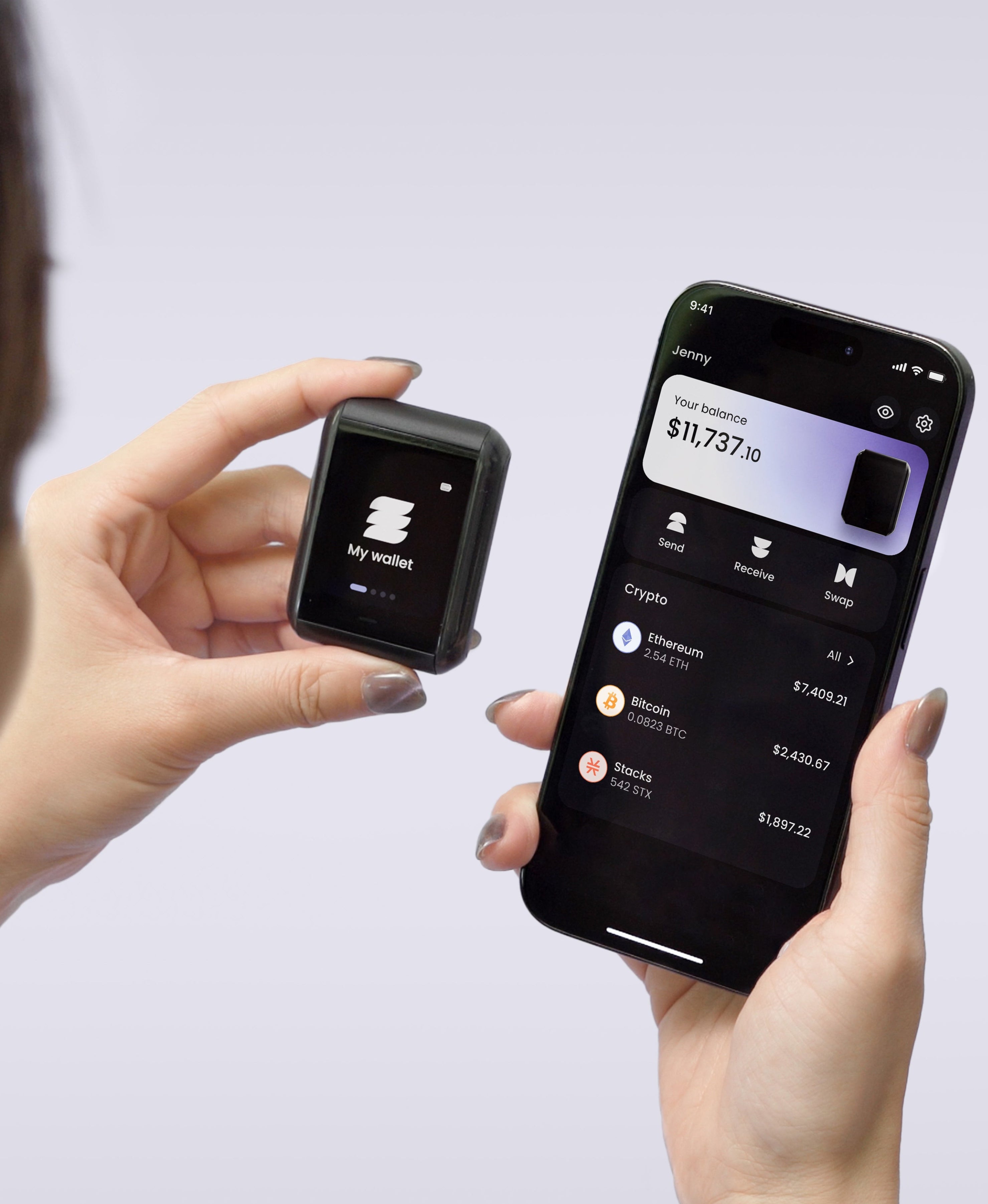
Smart wallets solve one specific problem well: recovery without a seed phrase. The cost is putting your recovery logic on a smart contract that has to be audited, maintained, and possibly upgraded. Ryder One solves the same recovery problem at the fundamental hardware layer. TapSafe Recovery splits your wallet backup across three independent layers: 50% on the Recovery Tag (battery-free, NFC, IP69K rated), 50% encrypted in your phone's iCloud or Google Drive, and an optional 25% per Recovery Contact for the people you designate. No smart contract. No on-chain logic to maintain. And no guardian quorum to coordinate when you've lost your phone in a foreign country. Both approaches answer the same question: "how do I recover access without depending on a single fragile thing?" Smart wallets answer it with on-chain logic, and TapSafe handles the same problem with split-share hardware backup. Neither is wrong. The right answer for any given holder comes down to whether they want their recovery process to run on the blockchain or on tangible hardware.
What to ask before trusting a smart wallet
Three questions. Where does the signing key live? A passkey in a secure enclave is reasonable for small balances. Browser-resident keys are a different story, since any extension that can read the page can read the key, and third-party MPC services move the custody question to a different counterparty. The strongest setup keeps the signing key on a hardware wallet, where it sits offline and signs only with a deliberate button press. Is the contract code audited, and by whom? Multiple audits from credible firms is the baseline. A single audit, or an internal audit, isn't enough for funds you'd be sad to lose. Who controls the upgrade key? An upgradeable proxy works when the upgrade key is timelocked behind a long delay and held by a multisig. The same proxy becomes a problem when a single team member can push a new implementation contract today.
The bottom line
Smart wallets are a UX layer on top of crypto's existing custody model. They let new users skip seed phrases, pay gas in stablecoins, and recover their account through trusted contacts instead of a piece of paper. They don't remove the need for a signing key, and they add a smart contract attack surface that didn't exist before. For the wallets you use for daily activity, a smart wallet with a hardware wallet signer is the strongest combination available in 2026. For the funds you don't touch, the simpler model (like the Ryder One hardware wallet with TapSafe Recovery, no smart contract layer) is the cleaner answer. The point is to understand what each layer is doing under the hood, since both have their place depending on what you're holding.
Pair the UX with the custody. Ryder One can sign for any smart wallet account through its EAL6+ secure element, with TapSafe Recovery as the structural backup that doesn't depend on on-chain logic. See how it works.


Share: