


# Sky Protocol and USDS: What Changed After MakerDAO Rebrand
In August 2024, one of DeFi's founding protocols shed its old name. MakerDAO, live since 2017 and the origin point of DAI, became Sky Protocol and paired the change with a token swap and a wholesale governance reset. The rebrand landed as the final stage of Rune Christensen's Endgame plan, a proposal to break the monolith into modular subDAOs and re-anchor DAI's successor around a wider mix of collateral including tokenized off-chain assets.
Two years on, the reshaped protocol remains one of the three largest stablecoin issuers on Ethereum while carrying a token model, governance layout, and freeze mechanism the original Maker community would not recognize. Legacy DAI and MKR holders still have time to migrate on their own terms, and new USDS holders should know what the token can and cannot do in a self-custody wallet.
In this piece
- What Sky Protocol is
- MKR to SKY and DAI to USDS: how the migration works
- How USDS is backed and how sUSDS pays yield
- The Endgame subDAO structure
- Self-custody read on USDS
- Where Ryder One fits
What Sky Protocol is
Sky Protocol is the rebranded MakerDAO, launched under a new umbrella on 27 August 2024 following a governance vote that approved the Endgame plan's final phase. The protocol still issues an over-collateralized dollar-pegged stablecoin backed by a mix of crypto and tokenized T-bills, still routes governance through a token holder base, and still operates on Ethereum as its base chain. Alongside the new visual identity at sky.money, the rebrand shipped contractual upgrades that migrate the old system's tokens onto new addresses.
Per Christensen's writing, the original MakerDAO structure had become too concentrated in one governance body and too limited in the kinds of collateral it could underwrite at scale. Sky introduces the "Star" concept: independent subDAOs sitting beside the core protocol and running their own products under shared risk parameters. Spark, the lending market spun out in 2023, was the pilot star. Grove followed in 2024 as an institutional treasury venture, and later stars have covered tokenized T-bill exposure and on-chain yield strategies.
MKR to SKY and DAI to USDS: how the migration works
The token swap runs at two fixed ratios. MKR converts to SKY at 24,000-to-1 through the official upgrade contract on Ethereum, so one MKR becomes 24,000 SKY. DAI converts to USDS at 1-to-1, and the swap runs both ways: DAI holders can upgrade to USDS, and USDS holders can downgrade back to DAI. The Sky documentation makes clear that no forced migration is scheduled, so legacy DAI or MKR balances stay live indefinitely.
The economic case for upgrading depends on which token is in the wallet. Converting MKR to SKY unlocks the Sky Token Rewards program, which distributes protocol revenue back to stakers who lock SKY into the governance module. MKR left in place earns nothing new, since rewards flow only through the SKY contract. On the stablecoin side, USDS unlocks the sUSDS savings module and the Sky Savings Rate, while DAI that stays put keeps working but sits outside the new yield venue.
The migration ran during the launch week and has continued at a steady pace ever since. According to DefiLlama supply tracking, USDS climbed past 5 billion inside the first six months and sits near 8 billion by mid-2026, while combined DAI plus USDS float remains close to the pre-rebrand DAI supply of roughly 6 to 8 billion.
How USDS is backed and how sUSDS pays yield
USDS carries forward DAI's over-collateralized design, and the vault mechanics remain the same. Every USDS in circulation is minted against collateral posted to a Sky vault: ETH, wrapped BTC, staked ETH derivatives, and a growing allocation of tokenized off-chain assets sourced through partners like Monetalis, BlockTower, and Superstate. A user posts collateral worth more than the USDS drawn against it, and the vault liquidates if that collateral drops below the maintenance ratio.
The RWA allocation is what distinguishes USDS from a pure crypto-backed dollar. Roughly a third of the reserve stack sits in short-duration US Treasury exposure through tokenized funds, which pushes protocol revenue toward the risk-free rate and lets Sky pay a competitive yield to sUSDS holders without running aggressive DeFi strategies. CoinDesk covered the launch at the rebrand event and flagged the T-bill allocation as one of the main levers behind the improved economics.
sUSDS is the yield-bearing wrapper: users deposit USDS into the Sky Savings Rate contract and receive sUSDS in return, with the redemption rate rising over time. There's no rebase, so the wallet balance stays constant while the claim per share grows. The 90-day trailing yield has clocked in around 5% to 8% APY through 2025 and 2026, tracking the T-bill benchmark plus a spread from the protocol's other revenue lines. For a reader thinking about depeg mechanics on any dollar-pegged token, our piece on the USDC bad weekend is worth revisiting.
The Endgame subDAO structure
The Star model is where the Endgame reorganization gets architecturally interesting. Under the plan, each Star operates as a semi-independent subDAO with its own token, its own governance vote, and its own product focus, all while paying a share of revenue back to the core Sky protocol and drawing risk collateral from the shared pool.
Spark was the first Star to spin up, running a lending market that borrows USDS from Sky at a wholesale rate and lends it into DeFi at retail spreads. Grove, launched in late 2024, focuses on institutional treasury allocations and holds a large slice of the RWA reserve stack. Additional stars have shipped since, each covering a niche the core DAO decided to spin out rather than run in-house. The Sky Ecosystem overview tracks live stars and their token launches.
The upside for a holder is that Sky's exposure to any single product line is buffered by the Star structure: a failed subDAO takes down its own token while the core stablecoin keeps functioning. The downside is that governance becomes a two-layer exercise, and users have to track both Sky and their preferred Stars to stay informed. For holders who never touch governance, that extra layer is mostly invisible.
Self-custody read on USDS
USDS is an ERC-20 token on Ethereum, and by default it behaves like any other ERC-20 in a self-custody wallet. Sending, receiving, and moving between contracts all follow the standard signing flow, and balances survive across any wallet that can hold Ethereum assets. The interesting wrinkle is the freeze function.
DAI, when it launched, had no address-level freeze capability, and that absence was part of its pitch for censorship resistance. Sky governance voted to add a `blacklist` function to USDS shortly after the rebrand, allowing the DAO to block specific addresses from moving USDS balances in response to legal or compliance requirements. The change was contentious in the community, with critics on the Sky governance forum arguing it undermined the neutrality that had defined DAI for years. Proponents argued the function was a prerequisite for the growing regulated-partner list and for holding tokenized T-bill exposure at scale.
The regulatory backdrop shapes the trade-off. Our breakdown of the GENIUS Act explains why fully-reserved payment stablecoins now face bank-style rules in the United States. USDS sits outside that regime because it's over-collateralized rather than 1-to-1 fiat backed, and the freeze capability lets Sky respond to court orders and sanctions notices without moving under the payment-stablecoin framework. Sky's contracts are also upgradeable through the DAO, so the on-chain rules governing USDS can change through governance votes at any time. That's a different risk shape from immutable-contract tokens, and it matters if the position sits above pocket change. Readers weighing options across issuers might read our take on USDC vs USDT for the fiat-backed side of the comparison.
Where Ryder One fits
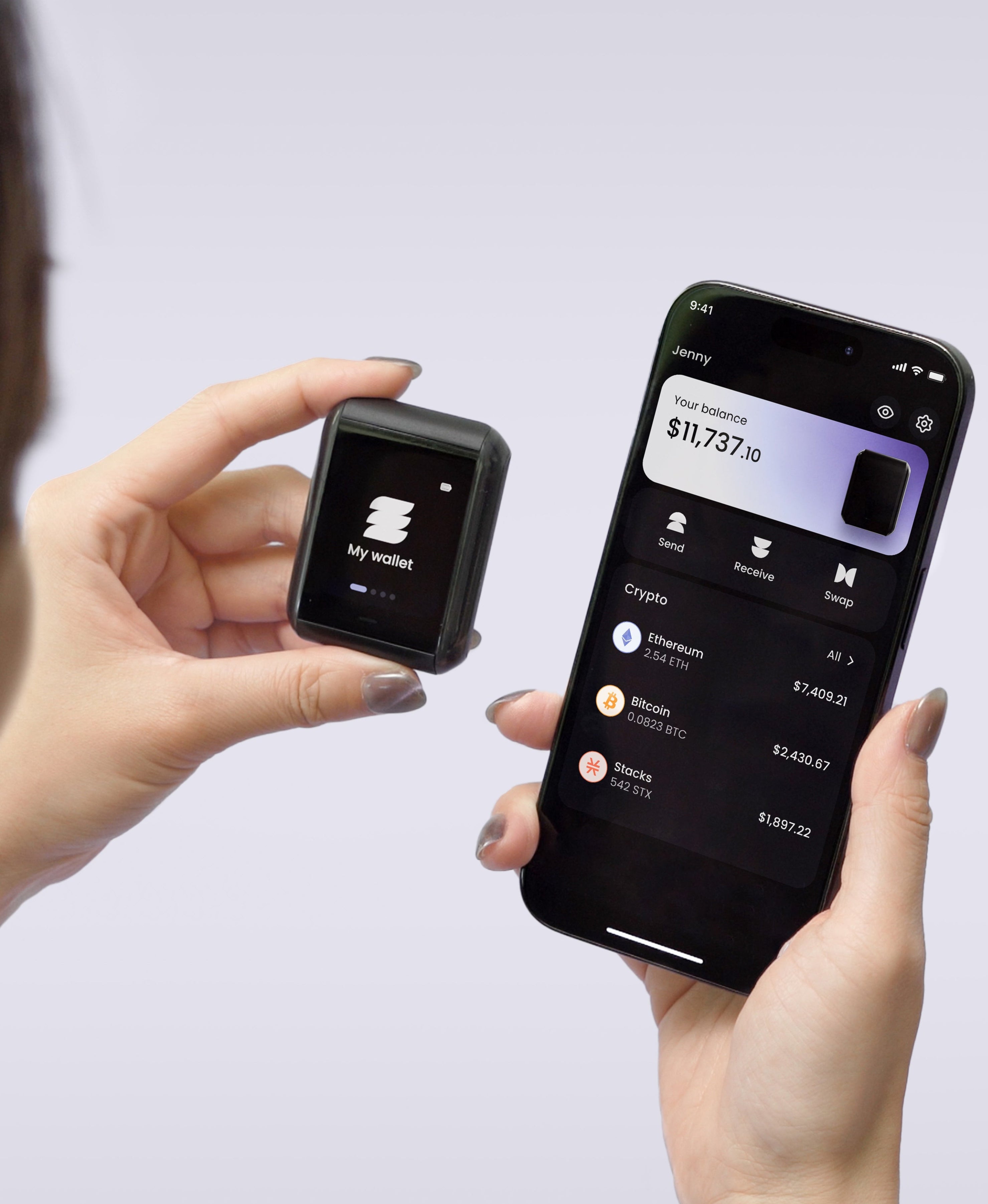
USDS is a first-class ERC-20 on Ethereum, so it works on Ryder One alongside DAI, USDC, USDT, and the other stablecoins the device supports. Sending USDS, upgrading DAI to USDS, and depositing into sUSDS all run through standard Ethereum transactions signed on the 1.6-inch AMOLED touchscreen, with full transaction detail on display before the button confirms.
The self-custody read for USDS follows the same pattern as any other stablecoin: the private key controls transfers, and the issuer controls the token contract. Sky governance can pause, freeze, or upgrade USDS, so the wallet doesn't insulate a holder from protocol-level actions. What it does insulate against is the everyday layer of key theft, phishing, and clipboard hijack that removes far more crypto than governance disputes ever will. Our writeup on self-custody covers the underlying model.
Backup follows Ryder One's TapSafe Recovery design, which splits the wallet across a Recovery Tag (50%) and an encrypted phone backup (50%), with optional Recovery Contacts adding a distributed layer. The Recovery Tag carries an IP69K rating, and the device itself carries IP67. Losing any single component doesn't lock the holder out, and the seed phrase remains accessible on-device under the BIP-39 standard, so a Ryder One holder is never locked to Ryder hardware.
The bottom line
Sky Protocol is what happens when a foundational DeFi project decides it needs a new operating model to scale into the RWA era. The rebrand carried more than a logo swap: it rewrote the token schedule, split the DAO into subDAO Stars, added a freeze mechanism to the stablecoin, and re-oriented reserves toward tokenized Treasuries. For holders of legacy DAI or MKR, migration is optional but the incentives lean toward upgrading, and new holders picking USDS off an exchange should note that governance-driven contract changes now sit on top of the usual reserve questions.
USDS looks like a stablecoin on the wallet balance screen and behaves like one for everyday transfers, so a holder's key hygiene is where security work happens. Keep the private key on hardware that verifies every transfer on-screen, and the protocol's redesign becomes background noise instead of an attack surface.
Take the next step
Whichever stablecoin sits in the wallet, the layer a holder controls with certainty is the key that signs the transfer. Ryder One keeps that key offline in an EAL6+ Infineon SLC38 secure element, verifies every transaction on a 1.6-inch AMOLED touchscreen, and replaces the paper seed-phrase habit with TapSafe Recovery. $229, and 60 seconds to set up.
SEO
- Target keyword: sky protocol / usds stablecoin
- SEO title: Sky Protocol and USDS: What Changed After MakerDAO Rebrand (57 chars)
- Meta description: Sky Protocol rebranded MakerDAO in August 2024, swapping DAI to USDS and MKR to SKY. Here's how the mechanics work and the self-custody read. (141 chars)
- Hero alt text: Sky Protocol USDS MakerDAO rebrand — Ryder self-custody hardware wallet


Share: