

Most crypto holders treat seed phrase storage like an afterthought. The wallet hands you 12 or 24 words on day one, you scribble them on the card, you put the card in a drawer, and you move on. Six months later, half of holders can't remember which drawer. A year in, a meaningful number can't remember if they ever wrote them down at all. Seed phrase storage is the single biggest survivability question in self-custody. The crypto math is bulletproof. The 12-word recovery phrase you stuffed in a sock drawer is not. Here's where holders are keeping their phrases in 2026, ranked by how likely each option is to fail when you need it most.
Paper in a drawer
The default setup. Pen, ink, paper, drawer. It works on day one. It survives most things for a few months. It does not survive house fires, basement floods, moves where boxes get mixed up, divorces, cleaning sprees, kids, pets, ink fading on cheap thermal paper, or roommates with curious hands. The Ledger 2020 customer database leak (and the 2026 follow-up) showed that paper backups have a meta problem too: the people who know you own crypto are the same people who know to look in your drawers. If you've got a small balance and you check on it monthly, paper is fine for a while. If you've got anything you don't want to lose, paper is borrowed time.
Stamped metal plates
The standard upgrade. Stainless steel, titanium, sometimes brass. You stamp the words letter by letter into a slab and stick it somewhere paper can't survive. Metal solves the failure modes that kill paper: fire, water, ink fade, fragility. Most holders who level up from paper end up here, and most self-custody guides recommend it as the answer. Metal plates do survive worse conditions than paper. But the upgrade stops short of what most people think it does. A metal plate is still one object. It's still in one location. The 2026 threat model isn't whether your paper survives a fire. It's whether the one object holding your keys survives everything from house fires to break-ins to relationships changing to you forgetting where you put it three moves ago. Metal solves the durability question. It doesn't solve the single-point-of-failure question. If the plate burns, gets stolen, or quietly disappears in a move, the funds protected by it are gone. The honest framing: paper is fragile, metal is durable but still a single point of failure, and the holder who only goes as far as metal hasn't fixed the deeper problem.
Bank safe deposit box
Popular for high-balance holders. Move the metal plate (or paper, in some cases) into a safe deposit box at a bank. The good: physical security is much better. The bank's vault is harder to break into than your house. Fire and flood resistance is high. The bad: access friction. Banks have business hours. Some require you to be present in person to access your contents, which is a problem if you're travelling or if the country you're in goes through political instability. There's also the legal question: contents of a safe deposit box can be frozen by law enforcement or seized in certain estate scenarios. Storing crypto recovery materials in a regulated financial institution introduces the exact custodial risk people use crypto to avoid.
Split storage across multiple locations
The usually-recommended advanced setup. You write the phrase across two or three pieces, store each in a different location, and rely on the redundancy. The intuition is right. The execution usually isn't. Splitting a 24-word phrase into two halves and storing each separately is not Shamir Secret Sharing. Each half still leaks information about the whole. An attacker who finds half the words has cut the effort to find the rest by orders of magnitude. True multi-share storage uses SLIP-39 (Shamir-based, supported by Trezor and Keystone), where each share alone reveals nothing about the master seed and a threshold of shares is required to reconstruct. That works mathematically. It also requires you to track multiple shares across multiple locations indefinitely, through every life event you can't predict. The complexity that protects you is the same complexity that loses your shares over a five-year horizon.
Memorisation
A small but real subset of holders try to memorise the phrase and rely on no physical backup. 24 random words is hard for most brains to retain reliably across years, especially when you don't recite them often. The cases where memorisation fails are the cases where it matters most: hospitalisation, severe stress, cognitive decline, or just enough time passing that you can't remember word seven. There's also no recovery path for your family if you can't tell them what you didn't write down. Memorisation as a sole strategy is high risk. Memorisation as a supplement to a written backup is fine.
Cloud, photo, or password manager
This one shows up more than anyone wants to admit. People photograph the recovery card. People paste the phrase into a notes app. People store it in 1Password. Don't do this. Cloud-stored seed phrases are the leading vector for "my hardware wallet was secure but my phrase got drained anyway" stories. iCloud and Google Drive have been compromised. Password managers have been breached (LastPass 2022 exposed encrypted vaults to attackers who were still chipping away at them years later). Photos sync to cloud by default on most phones. The hardware wallet's whole purpose is keeping the phrase off the internet. Putting it back on the internet defeats the architecture.
How Ryder thinks about this
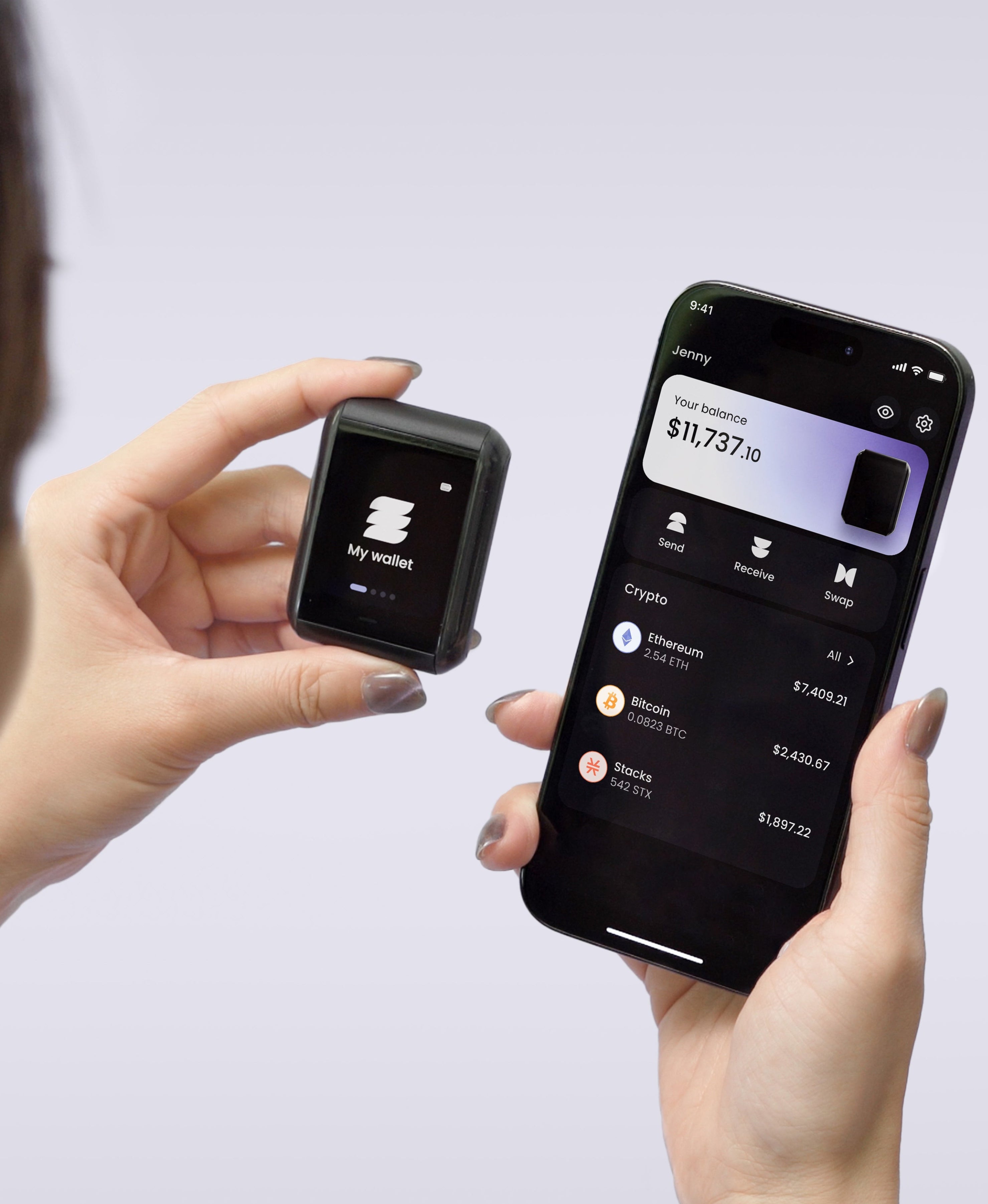
The whole "where do I store my seed phrase" question comes from one assumption: that there has to be a single piece of paper, metal, or memory that holds everything. We thought that was the wrong assumption. Ryder One uses TapSafe Recovery, which spreads recovery across three layers: a Recovery Tag you keep with you, a phone backup, and optional Recovery Contacts who can help you recover if the other two are gone. No single layer alone gives access to your funds. The seed phrase remains accessible on-device as a last resort, which means you meet the BIP-39 standard and you're never locked into Ryder hardware. If you want to leave for any other hardware wallet, you can. The result: you don't have to design and maintain a multi-location storage system across a 30-year horizon. The wallet handles it. You can still write the seed phrase down if you want. It's there, on-device, anytime. You're not depending on that single artifact surviving everything.
The takeaway
Paper is borrowed time, metal is durable but still one object, bank deposit boxes add custodial friction and DIY split-storage usually leaks information unless it's true Shamir. And of course, memorisation alone has a high probability of failing you, particularly under stress. If you want the structural answer (no single point of failure) without designing your own multi-location filing system, Ryder One is built around that exact problem.


Share: