


RWA tokenization moved from a slide-deck talking point to a live market during the last twenty-four months. By mid-2026, more than 36 billion USD of tokenized assets sit on public blockchains, tokenized US Treasury products alone are estimated at roughly 11 billion USD, and BlackRock's BUIDL fund holds around 2.85 billion USD in AUM after crossing 1 billion in early 2025. Larry Fink has kept calling tokenization the next generation for markets in earnings calls since 2023, and Franklin Templeton, Ondo, and Superstate have shipped products that make his framing look less like a talking point than a road map. If you hold crypto in self-custody, this shift changes what your hardware wallet can hold, and it comes with strings attached that don't get discussed enough.
In this piece, we walk through what RWA tokenization means in 2026, where the money has gone, how the custody model behind tokenized Treasuries works, what a self-custody holder gains and gives up, and where Ryder One fits.
What RWA tokenization is
RWA tokenization is the process of issuing a blockchain token that represents a legal claim on an off-chain asset. That off-chain asset can be a Treasury bill, a share in a money market fund, a private credit loan, a slice of a commercial building, or a bar of gold in a vault. On-chain, the token lives on Ethereum, Solana, Avalanche, or a similar public chain. The claim itself lives in a paper contract governed by securities law in the issuer's home jurisdiction.
The token behaves like an ERC-20 in most ways: it can sit in your wallet, appear in your portfolio tracker, and be sent to another address. The difference sits in the smart contract itself. Most tokenized securities use a permissioned ERC-20 variant or the ERC-1400 security token standard, which adds transfer-restriction hooks so the contract can check whether a receiving wallet has passed KYC before it accepts the incoming balance. Sending BUIDL to a wallet that hasn't cleared Securitize's identity checks doesn't fail because of gas or user error; the contract itself rejects the transfer.
That single design choice separates tokenized Treasuries from Bitcoin, ETH, and most stablecoins. Your ownership is recorded on a public chain, so you can verify it against block explorers and audit tools. Your ability to move that ownership is gated by an off-chain compliance layer. Both facts are true at the same time, and the reader has to hold both in mind when thinking about what self-custody means for these assets.
Where the money is going in 2026
The biggest tokenized asset category by far is short-duration US Treasury exposure. BlackRock's BUIDL, tokenized by Securitize on Ethereum with deployments on Arbitrum, Avalanche, and Polygon, sits near 2.85 billion USD in AUM and commands roughly 40% of the tokenized Treasury market. Franklin Templeton's BENJI, one of the earliest products in the category, remains among the top five by size. Ondo Finance's USDY, structured as a yield-bearing token whose price appreciates daily rather than rebasing to one dollar, has crossed 3.7 billion USD in TVL across its product suite. Superstate's USTB and a handful of newer entrants fill in the rest of the top tier.
Private credit is the second cluster. Maple Finance and Centrifuge have both crossed into material institutional volume, with tokenized loan pools funding trade finance, receivables, and short-dated corporate debt. Commodities remain smaller in dollar terms but growing: tokenized gold products from Paxos and others sit in the low billions combined.
The forecasts vary wildly. McKinsey's base case sees the tokenized asset market reaching roughly 2 trillion USD by 2030, with an optimistic scenario near 4 trillion. Boston Consulting Group has published a higher-end estimate of 16 trillion. The gap between the two forecasts is a good stand-in for how much disagreement remains about how quickly regulated capital and public-chain infrastructure will meet in the middle.
The custody model behind tokenized Treasuries
Here is where the interesting trade-off lives. When you buy BUIDL, you don't hold a bearer instrument. You hold an ERC-20 balance in a wallet that Securitize has whitelisted after running KYC, AML, and qualified-purchaser attestations against your identity. The smart contract for BUIDL maintains that whitelist onchain and automatically rejects any transfer to a wallet that isn't on it. Ondo's USDY uses a similar whitelist. Franklin's BENJI runs on a comparable permissioned model.
What that means in practice: your private keys sit in your hardware wallet, and the token balance is yours to hold indefinitely. Nobody at BlackRock or Securitize can touch a wallet they haven't been onboarded to. But if you want to send that BUIDL to your co-founder, your spouse, or a DeFi protocol, the receiving address has to be whitelisted too. If it isn't, the transaction reverts.
Issuers also retain administrative powers written into the contracts. Depending on the fund's terms, the transfer agent may pause transfers during market stress, freeze specific addresses in response to a court order or sanctions action, or force-redeem tokens back to fiat under defined circumstances. These powers exist because the underlying asset is a regulated security, and the token inherits that regulation. They aren't hidden; they sit in the offering documents Securitize publishes, and any prospective holder should read them the way they'd read a mutual fund prospectus.
The upshot is a middle-ground custody model. Your keys decide whether the position moves at all, the whitelist decides where it can go, and the issuer decides what happens under exceptional conditions. That is a different arrangement from holding Bitcoin, where nothing outside your seed phrase has authority, and it also differs from holding a Treasury ETF share at a broker, where the broker holds the position on your behalf and the token doesn't exist in your name.
What self-custody holders get and don't get
For a self-custody holder, tokenized Treasuries change three things.
The first is programmability. A whitelisted address can move BUIDL into DeFi collateral pools that accept it, use it as margin on approved venues, or redeem it directly onchain for USDC through Securitize's redemption flow. None of that is possible with a brokerage Treasury position, which sits in a segregated account and requires the broker to move it. If you already run onchain workflows and want short-duration yield without holding stablecoins, tokenized Treasuries are the first product category that fits.
The second is settlement. Onchain redemption windows for BUIDL and USDY typically settle same-day or next-day, compared to T+1 or T+2 for equivalent brokerage transactions. Yield accrues continuously and can be swept or reinvested through smart contracts you control. That matters more for treasuries at operating companies than for retail holders, but it's a measurable improvement over the settlement rhythm of the legacy plumbing.
The third is the trade-off already covered: your position lives inside a permissioned wrapper. That wrapper adds compliance value from the issuer's perspective and removes some of the properties that make Bitcoin and ETH useful in a self-custody frame. Handing BUIDL to a hardware wallet that hasn't cleared KYC won't work. Assuming the position is immune to administrative action would be a mistake. And treating it as a bearer asset misreads what the underlying instrument is.
None of this is a reason to avoid tokenized Treasuries; it's a reason to be clear on what you're holding. A tokenized Treasury is a regulated security represented onchain, while a Bitcoin balance is a bearer asset with no issuer sitting behind it. Both categories belong on a hardware wallet, and they answer separate questions about who has final authority over the position.
Where Ryder One fits
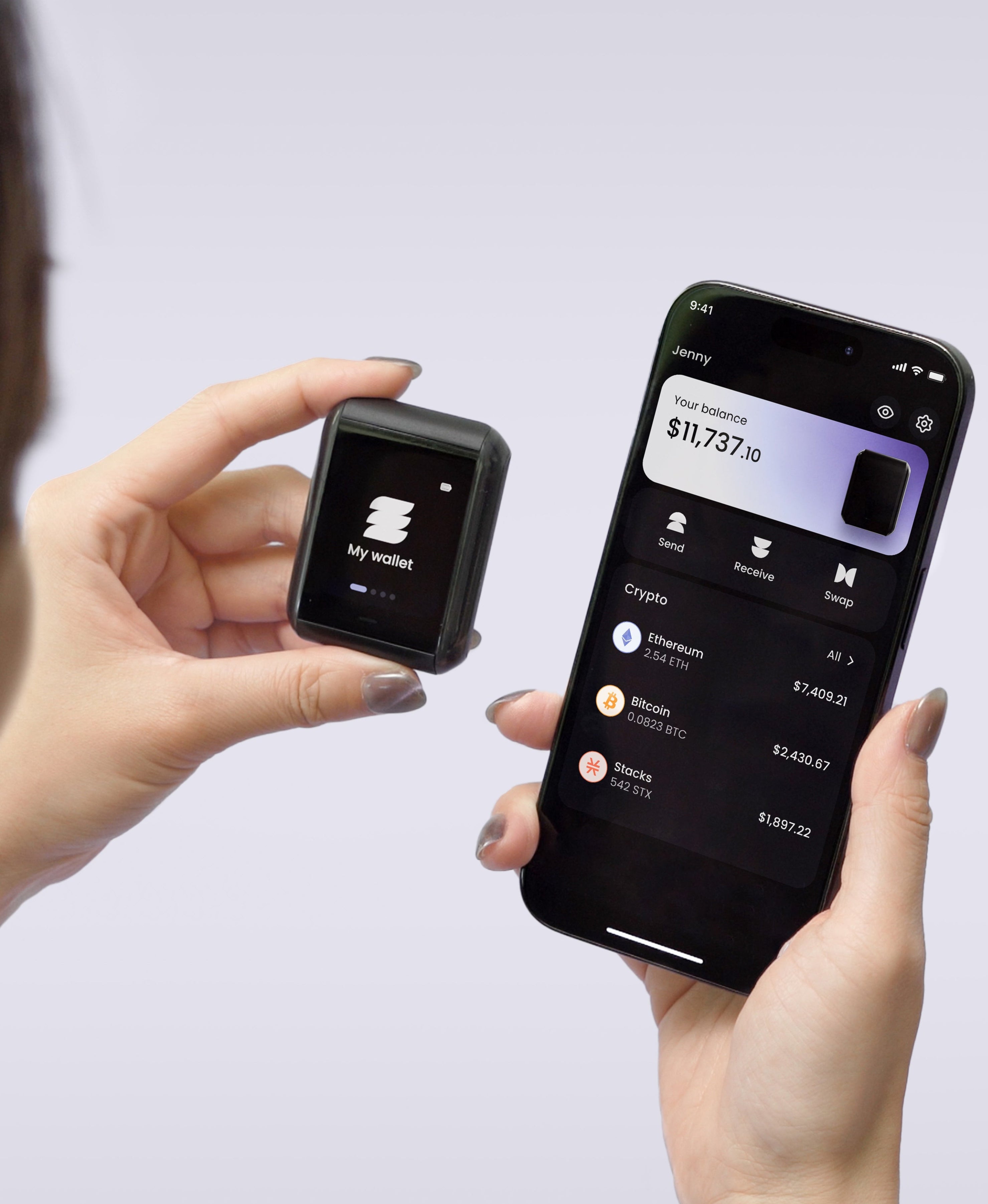
Ryder One is built for holders who want to keep private keys offline across every asset type they hold, from bearer crypto to tokenized securities. We designed the device around an EAL6+ Infineon SLC38 secure element, and every transaction is verified on the 1.6-inch AMOLED touchscreen with a button press wired directly to the secure element. NFC-only communication keeps radio and wired data paths out of the signing flow, and Qi wireless charging handles power without exposing a data port.
For a tokenized Treasury position, the signing question matters. When you approve a BUIDL transfer, you're signing a permissioned ERC-20 call whose success depends on the recipient being whitelisted. The details of that call have to be readable before you press the button, because the destination address and the amount are the parts that get audited by the contract. Anti-blind-signing on Ryder One means the transaction details render on the device screen in full detail, so you can confirm both before signing.
TapSafe Recovery is the backup layer we built to remove the seed phrase as a single point of failure. The Recovery Tag holds 50% of the recovery share, your paired phone holds the other 50% encrypted in iCloud (iOS) or Google Drive (Android) rather than on the phone itself, and up to four optional Recovery Contacts can each hold a 25% share. Your BIP-39 seed phrase stays accessible on-device as a last resort, so the wallet never ties you to Ryder hardware. Ryder One ships at $229 with a Recovery Tag, Qi wireless charger, and travel pouch.
For self-custody holders adding tokenized Treasury exposure alongside Bitcoin and ETH, self-custody on Ryder One keeps the keys under your control across both categories. The permissioned features of the underlying token don't change with the wallet; the signing hygiene and backup posture do.
Bottom line
RWA tokenization has become a working market in 2026, with tokenized Treasuries leading the way and 36 billion USD of assets already onchain. For a self-custody holder, the category adds a useful yield-bearing option that can sit on the same hardware as your bearer crypto. The catch is that tokenized Treasuries are permissioned instruments. The whitelist gates transfers, the issuer retains administrative powers, and the token inherits the regulation of the underlying security. Understanding those constraints is part of the decision, and the way to hold the position responsibly is with keys you control and a signing flow you can read on-device before you approve anything.
Hold your keys, across every asset class. Ryder One keeps Bitcoin, ETH, and tokenized securities on an EAL6+ secure element, with TapSafe Recovery as your backup.
SEO
- Target keyword: rwa tokenization
- SEO title: RWA Tokenization in 2026: What It Means For Self-Custody (55 chars)
- Meta description: Tokenized Treasuries crossed $36B on-chain in 2026. Here is what RWA tokenization means for self-custody holders, and what strings come attached. (146 chars)


Share: