


# Robinhood Tokenized Stocks: The On-Chain Custody Catch
At the "To Catch a Token" event in Cannes on June 30, 2025, Robinhood switched on over 200 tokenized US stocks and ETFs for users across the EU and EEA, initially on Arbitrum and later on its own Layer 2 called Robinhood Chain, which went live in July 2026. The pitch was 24/7 exposure to Apple, Nvidia, Tesla, SPY, and QQQ from the same app EU customers already used for crypto. The catch sits underneath the wrapper: what a holder owns on chain is a debt token issued by a Robinhood Jersey entity, and the underlying share sits with a US broker-dealer inside a custody chain that a private key on your device cannot touch.
In this piece, we walk through what the tokens are, how the custody stack works, the OpenAI and SpaceX private-equity controversy that followed a week after launch, how EU and US regulators have responded, and where a hardware wallet like Ryder One fits when the on-chain object is a claim wrapper rather than the equity itself.
What Robinhood tokenized stocks are
A Robinhood stock token is an on-chain token that tracks the price of a US-listed equity or ETF. When Apple trades on Nasdaq, the token labelled AAPLx (or its ETF equivalent) tracks that quote via a price oracle inside the Robinhood app and on Robinhood Chain. Dividends flow through to token holders, the tokens can be moved to a self-custody wallet, and inside the Robinhood ecosystem they can trade around the clock rather than only during US market hours.
Under the hood, the tokens are issued as tokenized debt securities by Robinhood Assets (Jersey) Limited, a Robinhood entity outside the US, and passported into the EU under MiFID II via a Lithuanian licence. Each token in circulation is nominally backed 1:1 by the underlying share, which is held by a US broker-dealer that Robinhood contracts with for custody of the equities. The classification matters: the token gives economic exposure to price and dividend flows, and it does not confer voting rights, shareholder rights, or a direct legal claim on the share itself.
How the custody stack works
The custody path is worth walking end to end, because it's what makes the on-chain-wallet piece a partial answer.
At the bottom of the stack sits the actual equity, an ordinary US share registered at DTC and held by the US broker-dealer Robinhood uses as its custody partner. That broker-dealer holds the share on behalf of Robinhood Assets (Jersey) Limited, the Jersey issuer that mints the token. The token itself is an ERC-20 style claim against that Jersey issuer, saying "the holder is owed the economic performance of one Apple share." On Robinhood Chain the token can move peer-to-peer, sit inside a DEX like Uniswap's day-one deployment, or be pulled into self-custody the same way any ERC-20 can. What a holder of the token has is a wallet-signable claim on a Jersey debt security, which is itself a claim on a share held by a broker-dealer. Three layers deep before the equity is reached.
From a signing-hygiene standpoint, the layer that a hardware wallet secures is the topmost one. Whoever holds the private key controls the movement of the token, can redeem it back to Robinhood, or can trade it on a Robinhood Chain DEX. That's a property claim worth defending with a signing device. The layers below (the Jersey issuer's solvency, the broker-dealer's custody discipline, the enforceability of the claim under Jersey and EU law) sit outside what any wallet can influence.
The OpenAI and SpaceX controversy
A week after the Cannes launch, Robinhood ran a promotion offering EU users a small parcel of tokenized OpenAI and SpaceX exposure. Those two aren't listed stocks, so the wrapper looked different: the tokens tracked private-company equity held inside special-purpose vehicles, not exchange-traded shares.
OpenAI disowned the offering on X within a day, writing "we did not partner with Robinhood, were not involved in this, and do not endorse it" and warning that "any transfer of OpenAI equity requires our approval; we did not approve any transfer." The company urged users to approach the product with caution. Robinhood CEO Vlad Tenev defended the structure publicly, arguing that while these weren't listed shares, the tokens were designed to give retail exposure to private-company value that had historically been reserved for large investors. What the episode surfaced was the ambiguity that sits inside any "tokenized stock" label: some tokens track a share Robinhood custodies through a broker-dealer, some track SPV positions, and the on-chain UI doesn't always draw a bright line between the two.
EU and US regulatory posture
The Bank of Lithuania, which is Robinhood's lead supervisor in the EU under the MiFID passport, asked the brokerage to clarify the structure of the OpenAI and SpaceX tokens so it could assess whether the disclosure and classification lined up with EU rules. Robinhood engaged with regulators across the bloc and stated publicly that the offering complied with MiFID II. BaFin in Germany has previously flagged tokenized stock wrappers that resemble derivatives without the corresponding disclosure regime, though the current Robinhood offering is passported into Germany under Lithuania's licence rather than authorised by BaFin directly.
The US side has been quieter, and by design. Robinhood filed a 42-page proposal with the SEC's Crypto Task Force in April 2025 asking for a unified federal framework for tokenized real-world assets, and the response has been consultative rather than a green light. Through the first half of 2026, no tokenized-stock product from Robinhood has been rolled out to US retail. The stock tokens are gated to non-US users, and marketing inside the US treads carefully around that geofence. Tenev has signalled that a US retail rollout is the ambition once the federal framework arrives.
Where Ryder One fits
If you're an EU holder who moves a Robinhood stock token off the Robinhood app into a self-custody wallet, you've absorbed the same custody question every tokenized asset raises. The private key controls the token. That token is a claim on a Jersey debt security, and the Jersey issuer holds the underlying share via a US broker-dealer. Losing the key ends the ability to move the token; losing the position in the underlying equity is a separate operation that runs through the issuer's compliance and redemption process rather than through the chain.
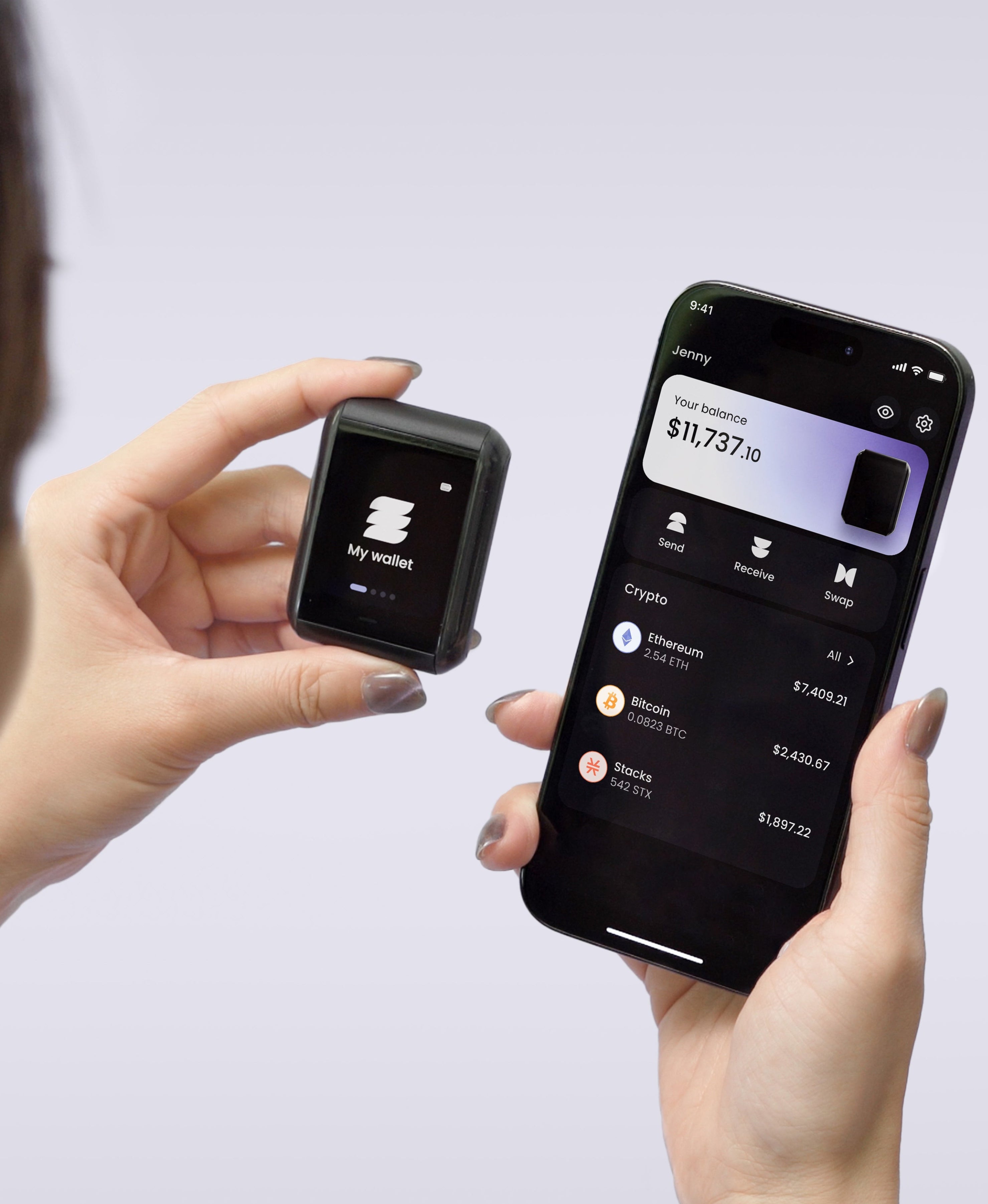
That means a hardware wallet does two jobs on a Robinhood stock token that it does not do on the equity itself. It defends the signing surface (a compromised hot wallet key drains the token the same way it drains any ERC-20), and it makes the readable receipt visible before a transfer confirms. Ryder One generates and stores keys inside an EAL6+ Infineon SLC38 secure element that Halborn audited, and every transfer renders on a 1.6-inch AMOLED touchscreen with the destination, the amount, and the contract in readable form before the physical button becomes active. Communication is NFC-only, so no USB port or Bluetooth radio gives a remote attacker a lane to pivot through.
Backup is where the standard playbook breaks. Paper seed phrases fail to fire, water, or misplacement, and metal seed plates upgrade the durability of the medium while still leaving the security posture resting on one object surviving everything. TapSafe Recovery breaks that single point of failure across three surfaces: a Recovery Tag (IP69K, 50% share), a paired phone (backed up encrypted into iCloud or Google Drive so losing the handset doesn't lose the share, 50% share), and up to two optional Recovery Contacts who each hold 25% and see nothing about the wallet contents. The BIP-39 seed phrase stays available on-device as a last resort, so no holder is locked into Ryder hardware. Ryder One ships at $229 with the Recovery Tag, a Qi wireless charging pad, and a travel pouch, weighs 38 grams at 41 x 55 x 14.5 mm, and carries an IP67 rating. Practicing self-custody on a tokenized stock means both the signing hygiene and the backup posture have to hold.
Bottom line
Robinhood's tokenized stocks are a working product for EU retail, and the growth arc from a Cannes launch to a dedicated Layer 2 in a little over a year shows that demand for 24/7 US equity exposure was there. What holders should keep in mind is the shape of the claim. Each token is a Jersey-issued debt security whose economics track a US share, whose backing sits with a US broker-dealer, and whose transferability on chain is governed by EU securities law rather than by the DTC ledger.
A hardware wallet doesn't change any of that. It defends the piece of the stack that a signing device can defend: the token, the transfer, the signature. The equity behind the token stays inside a custody chain the chain doesn't see. Understanding which layer the wallet protects is the point of walking through the stack before routing size through it.
Whatever tokenized stock wrapper you hold, the layer you own is defined by the key. Ryder One keeps that key inside an EAL6+ secure element, renders every transfer on a readable screen, and backs it up with TapSafe so no single object holds your position hostage.
SEO
- Target keyword: robinhood tokenized stocks
- SEO title: Robinhood Tokenized Stocks: The On-Chain Custody Catch (54 chars)
- Meta description: Robinhood tokenized US stocks launched for EU users in June 2025 on Arbitrum. Here's the custody stack, the OpenAI controversy, and the self-custody read. (155 chars)


Share: