


# Ripple RLUSD Stablecoin: Why XRPL Rails Change the Read
Ripple's ripple rlusd stablecoin sits in a strange spot in the market. Compared with USDT's roughly $190 billion and USDC's roughly $77 billion (both figures as of April 2026, per industry tracking data), a $1.6 billion token is still a rounding error. What makes RLUSD interesting isn't scale. It's the plumbing: a regulated dollar issued directly on the XRP Ledger, which settles in three to five seconds and doesn't need a gas token in the wallet you're paying from.
That combination changes what a stablecoin can be used for, and it changes what a self-custody holder should think about before pulling one into their own wallet.
Table of contents
- What RLUSD is
- The growth to $1.6 billion, and where the supply lives
- The XRP Ledger leg vs. the Ethereum leg
- How it compares to USDC, USDT, and PYUSD
- Where Ryder One fits
- The bottom line
What RLUSD is
RLUSD is a US-dollar-pegged stablecoin issued by Standard Custody & Trust Company, a Ripple subsidiary that holds a limited-purpose trust charter from the New York Department of Financial Services. Reserves are US dollar deposits, short-term US Treasury bills, and cash equivalents, held in segregated accounts at BNY, which took on the custody role in 2025. Deloitte publishes attestations on the reserves each month.
That regulatory shape puts RLUSD closer to USDC than to USDT. There's a named US regulator, a named custodian, a named auditor, and monthly proof-of-reserve reporting the public can read. The token launched on December 17, 2024 after Ripple secured NYDFS approval earlier that month, with initial exchange partners including Uphold, Bitstamp, MoonPay and Independent Reserve. Kraken listed it a few months later, and by 2026 it had spread across most of the venues an institutional buyer would use.
The regulatory shape also means the issuer can freeze specific addresses on either chain, and can claw back tokens under law-enforcement orders. Ripple's own developer documentation confirms this: the XRP Ledger deployment uses Individual Freeze, Deep Freeze, and Clawback settings that let the issuer disable a counterparty's ability to send or receive the token. Standard practice for a regulated stablecoin, and something worth knowing before you route funds through one.
The growth to $1.6 billion, and where the supply lives
RLUSD went from launch to roughly $132 million in circulation over its first year. Then the curve steepened. By late June 2026 the token was at $1.59 billion in market capitalization, with roughly $370 million of new supply minted in April alone. That put RLUSD around the ninth-largest stablecoin globally.
Transfer volume tells a related story. Token Terminal recorded $18.4 billion of RLUSD transfers in Q1 2026, the highest quarter on record, with more than half of that activity landing in March. The token is being moved, and the flows are big enough that treasury desks and payment processors are paying attention.
Where the supply lives matters. About 82 percent of RLUSD sits on Ethereum, where the stablecoin infrastructure (DEX pools, lending markets, bridges) is more mature. The remaining 18 percent lives on the XRP Ledger, where RLUSD now holds roughly 88 percent of all stablecoin liquidity on that chain. So on Ethereum, RLUSD is a small newcomer in a crowded market. On XRPL, it's the dominant dollar.
The XRP Ledger leg vs. the Ethereum leg
This is where RLUSD becomes something other than another USDC clone. The XRP Ledger was designed for payments in a way Ethereum wasn't, and RLUSD gets to use that design directly.
On XRPL, a payment settles in three to five seconds with a fee measured in fractions of a cent. There's no gas token to buy first in the sense a new user needs to worry about: XRPL fees are paid in drops of XRP, but the amounts are so small that a fraction of a single XRP funds thousands of transactions. When Chainlink integrated RLUSD price feeds into both networks, XRPL-native DeFi projects suddenly had a regulated dollar with reliable pricing to build against.
On the Ethereum leg, RLUSD behaves like any other ERC-20. It sits in DEX pools, it plugs into lending markets, it bridges to L2s. Nothing about that is unusual. What's unusual is having the same token live on a payments-first chain like XRPL, so a business can hold RLUSD on Ethereum for DeFi yield and move it to XRPL for a cross-border settlement in the same day.
Ripple has been pushing the payments angle hard. RLUSD is now integrated into Ripple Payments (the corporate-cross-border product) as a settlement asset, replacing XRP-as-bridge-currency for use cases where a stable-value leg is what the counterparty wants. XRP still pays the transaction fee. RLUSD carries the value.
How it compares to USDC, USDT, and PYUSD
Four regulated (or semi-regulated) dollars, four different shapes.
USDT is the incumbent at roughly $190 billion. It's the deepest liquidity in crypto, and it's issued from offshore under a Hong Kong-based structure. Reserve reporting has improved since the 2021 CFTC settlement, but the reserve mix and the audit cadence still lag USDC's disclosures. If you're trading on any centralized venue globally, USDT is what most pairs quote against.
USDC at about $77 billion is the regulated benchmark. Circle went public on the NYSE in June 2025, quarterly SEC disclosure is now mandatory, and the GENIUS Act put a federal framework around dollar stablecoin issuance. USDC is the token most US-facing institutions choose when they want a dollar that maps to traditional-finance oversight.
PYUSD from PayPal is around $3.4 billion. Its edge is distribution: it plugs into PayPal and Venmo, moving into consumer payments in ways a crypto-native stablecoin cannot.
RLUSD at $1.6 billion is the newest of the four. It has NYDFS supervision, monthly Deloitte attestations, and reserve custody at BNY. What it adds over USDC is the second chain and the payment-rail integration.
The layer that stays the same across all four: whichever wrapper you hold, the issuer sits on top of the ledger, and the token in your wallet is a claim against a company. What you control with certainty is the private key that signs the transfer. That's not a feature of RLUSD or USDC or USDT specifically. It's a feature of self-custody.
Where Ryder One fits
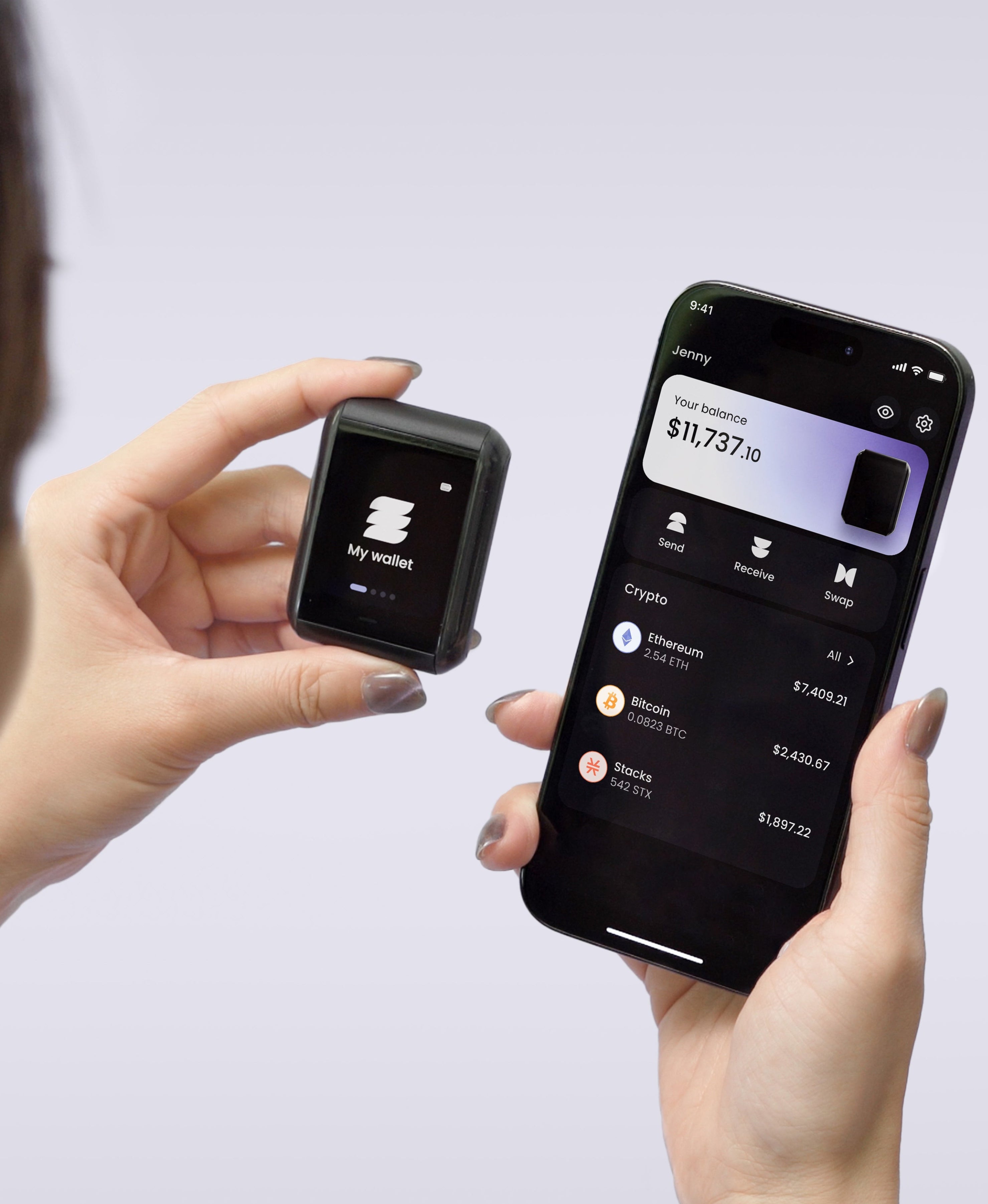
Ryder One supports Bitcoin, Ethereum, Solana, and a growing list of ERC-20 and SPL tokens. That means RLUSD's Ethereum leg is a first-class asset on the device today, and the settings on-screen for sending or receiving RLUSD look identical to how you'd handle USDC or USDT. Users who want to hold the XRPL-native version of RLUSD should check the current supported chains on the Ryder One product page before routing funds there.
For the Ethereum version, the setup is what you'd expect from a hardware wallet: private keys generated inside the EAL6+ secure element on the device, every RLUSD transaction verified on the 1.6-inch AMOLED screen before you sign, and the address book letting you check a recipient wallet against a known reference. Because RLUSD's issuer can freeze specific addresses, address hygiene matters more than it does for a pure crypto asset. Receiving from a sanctioned counterparty is the kind of thing that gets a downstream address flagged, and on-device address verification is the layer that catches clipboard hijacks before they turn into that problem.
For backup, the seed phrase is always accessible on-device as a last resort, and it meets the BIP-39 standard so you're never locked to Ryder hardware. TapSafe Recovery splits the wallet across a Recovery Tag and an encrypted phone backup, with each layer holding 50 percent of the recovery data. Tag plus phone equals full recovery, no single object equals full access. That model matters for a stablecoin position the same way it matters for BTC or ETH: the token is only as safe as the key, and the key is only as safe as the backup that reconstructs it if the device is lost.
The bottom line
Ripple's RLUSD is a competent regulated dollar with one differentiator that matters: it lives natively on the XRP Ledger, which was built for payment settlement in ways Ethereum wasn't. If your use case is holding a stable dollar for on-chain trading, USDC and USDT are deeper. If your use case is cross-border settlement or you're working inside an XRPL-based application, RLUSD is the token that fits the rails.
None of that changes the self-custody read. Every regulated dollar stablecoin, RLUSD included, is a claim on an issuer, and the issuer can freeze the balance if compelled by law enforcement. The layer you own with certainty is the private key. Keep it in a hardware wallet that verifies every transaction on-device, and back up the recovery in a way that survives losing any single object. That's the frame RLUSD fits into, alongside every other dollar wrapper on the market.
Take the next step
If you're holding any regulated stablecoin (RLUSD, USDC, USDT, or PYUSD) and it's sitting on an exchange or a hot wallet, the risk isn't the peg. It's the key. Ryder One keeps your private key offline in an EAL6+ secure element, verifies every transaction on a 1.6-inch AMOLED screen, and replaces the fragile seed-phrase-on-paper problem with TapSafe Recovery. $229, and 60 seconds to set up.
SEO
- Target keyword: ripple rlusd stablecoin
- SEO title: Ripple RLUSD Stablecoin: Why XRPL Rails Change the Read (58 chars)
- Meta description: Ripple's RLUSD hit $1.6B by mid-2026 under NYDFS oversight. Here's what its XRP Ledger rails add, and the self-custody read for holders. (152 chars)


Share: