


# Pump.fun Just Crossed $1B in Fees. What's Left in 2026.
Pump.fun didn't invent memecoin gambling on Solana. It industrialized it. The site lets anyone spin up a token in under a minute with a pre-baked bonding curve, no liquidity providers, no listing fee, and instant tradability. That model has now pulled in over $1 billion in cumulative revenue, making it the first Solana app ever to cross ten figures. In Q1 2026 alone, the platform booked $124.7M in fees, roughly 30% of Solana's total app revenue for the quarter. Those are casino numbers, and the house is winning.
In this piece, we walk through how the machine works, who's taking home money, what the PUMP token launch changed, why sniper bots have hollowed out retail returns, and what a self-custody read looks like when the odds are this stacked.
The machine: bonding curves, graduation, and 2 SOL
Anyone can mint a token on Pump.fun in the time it takes to name a pet. You pick a ticker, upload an image, and the protocol locks 80% of a fixed one-billion supply into an on-chain bonding curve while sending 20% to your wallet. Price climbs along a preset curve as buyers pile in; sells push it back down. When a coin's market cap crosses roughly $69,000 to $90,000, it "graduates" to a Raydium liquidity pool, and Pump.fun takes about 1.5 SOL plus a 1% swap fee on every trade along the way, per the site's own fee docs.
The pitch, when Alon Cohen and co-founders Dylan Kerler and Noah Tweedale launched in January 2024, was that automated curves prevent classic rug pulls. Liquidity is locked to the contract until graduation, so a creator can't drain the pool the way early Uniswap scams did. That framing is technically correct and practically misleading. The rug moved. Instead of a dev pulling liquidity, the dominant scam shifted to coordinated pump-and-dumps: creator wallets front-loaded via bots, a burst of social hype, then a single-block dump the moment retail piles in.
The PUMP airdrop: $600M in twelve minutes
On July 12, 2025, Pump.fun ran its long-teased token sale. The public leg offered 150 billion PUMP (15% of supply) at $0.004 apiece and, per multiple accounts, sold out in twelve minutes for $600M. A concurrent private sale added another $700M, bringing the raise to $1.3B on a $4B fully diluted valuation. Since then the team has been aggressive about signaling value flow to token holders: in late 2025 the project announced a buyback-and-burn program committing 50% of future revenue and a $370M PUMP burn to prop up the token price.
Token holders get exposure to protocol fees and light governance over parameters like the graduation threshold. What they don't get is any claim on the underlying gambling activity's outcome. The house-edge argument is the whole thesis: if launches keep happening at 20,000+ per day, PUMP holders clip a share of fees regardless of who wins on the tokens themselves. That's a fine model for the equity, and a brutal read for the users generating those fees.
Sniper bots have already eaten the trade
Here's the part almost every "how to trade Pump.fun" guide skips. By the time you see a coin trending in a Telegram channel, bots have been buying it for milliseconds. They watch mempool transactions, detect new token creation events, and slot buy orders into the same block the mint lands in. Multiple bots often hold sizable positions at the very bottom of the curve before a human ever loads the page.
The consequences are quantified and grim. Research on Pump.fun and related Solana launchpads found that about 98% of tokens on the platform show signs of manipulation, with roughly 97% of tokens failing to graduate or holding zero value within days. Bot operators aren't hiding: there are subscription products like PumpFun Sniper openly selling millisecond-latency execution to whoever pays. For an average trader, this means the "fair launch" branding hides a two-tier market where the fast tier is closed to you and the slow tier is where the fast tier exits its position.
Bonk.fun, cross-chain expansion, and the launchpad war
The competitive picture has been wild. Through mid-2025 and into 2026, LetsBONK (bonk.fun) briefly took over 80% of Solana launchpad market share before Pump.fun clawed it back. The Block reported that Pump swung from as low as 5% share back to 90% inside two weeks late last year, and PUMP surged on the flip. As of mid-2026, Pump.fun still commands roughly 60% of the Solana launchpad category, with Moonshot, Believe, and DAOS.fun rounding out the rest.
The team has also been positioning for cross-chain expansion. Subdomain registrations for `ethereum.pump.fun`, `base.pump.fun`, and `monad.pump.fun` have appeared on-chain, hinting that the memecoin factory model is coming to other networks whether or not those chains asked for it. Ethereum brings deeper liquidity and a wider retail audience; it also brings gas costs that could reshape which strategies still work at 2 SOL per launch equivalent.
Regulators are circling, but not landing yet
The 2026 US regulatory picture is more active than the 2023-2024 baseline. In March 2026 the DOJ charged ten people over an international crypto market-manipulation ring that included coordinated pump-and-dumps of low-cap tokens, with the FBI having created undercover token projects to lure operators into the open. The DOJ's own priorities memo names rug pulls and digital-asset investment scams as top-of-list targets.
Pump.fun the entity has not been charged as of this writing. Individual operators using the platform have been, and the pattern is going the same way past exit-scam waves went: enforcement follows scale. The higher the fees the platform prints, the sharper the incentive to test whether facilitating unregistered securities offerings at industrial scale is a criminal problem for the operators or a private problem for the users. Either way, the exposure your wallet carries doesn't wait for a subpoena.
Where Ryder One fits
If you trade on Pump.fun, or on any of the dozen platforms trying to be it, the base problem is the same. You're moving fast, holding volatile bags, and interacting with contracts you didn't audit and probably can't. Losing a coin to a coordinated dump is bad. Losing your entire wallet on top of that because your keys were sitting in a hot wallet is worse.
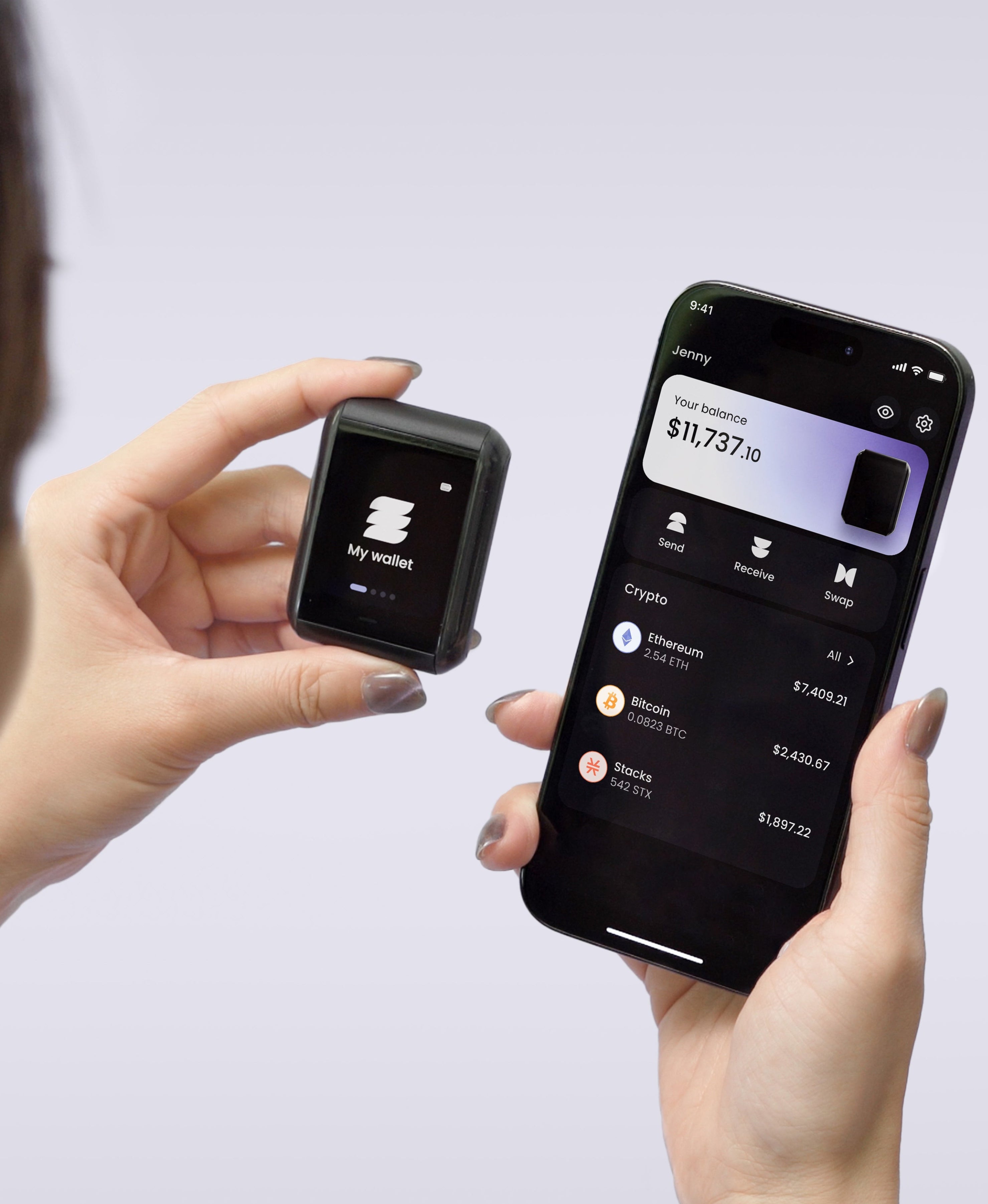
Ryder One is $229 and keeps your private keys inside an EAL6+ certified Infineon SLC38 secure element. Communication is NFC-only, so there's no USB, no Bluetooth, no WiFi surface for an attacker to reach across. The 1.6-inch AMOLED touchscreen shows the full transaction details before you approve, so you see the destination address and the amount on the device itself rather than on a phone that might be compromised. When you're signing a Raydium swap or a Pump.fun trade, what appears on the Ryder One screen is what gets signed.
Backup is handled by TapSafe Recovery, our custom Shamir-based system that splits wallet recovery across three layers so no single object holds full access. The Recovery Tag holds 50%. A paired phone holds the other 50%, stored encrypted in your iCloud or Google Drive rather than on the device itself, so a lost phone doesn't lose the backup. Optional Recovery Contacts each hold 25%, up to four contacts, none of whom see any wallet data. And the BIP-39 seed is always accessible on-device as a last resort, so you're never locked to Ryder hardware. If you'd rather understand what is self-custody before buying anything, start there.
Bottom line
Pump.fun is what happens when a bonding curve, a fast blockchain, and a global retail audience meet. It's an efficient revenue machine, a bruising market for anyone showing up second, and the clearest example this cycle of why "on-chain" and "safe" are unrelated properties. The platform did over a billion dollars in fees. Most of the people who paid those fees are not up on the trade.
If Pump.fun is part of your rotation in 2026, the sensible move is to protect the layer you control. Trade with a size you can lose without pain. Move any position you want to hold off the trading wallet. And keep your long-term crypto behind a hardware wallet where signing requires a physical button press verified by a chip designed to keep secrets, not a browser extension that trusts whatever popped up last.
Pump.fun will keep printing tokens. Your job is to make sure your coins aren't printed alongside them.
Get Ryder One for $229 and put your keys behind hardware built to survive the memecoin era.
--- SEO
- Target keyword: pump.fun news
- SEO title: Pump.fun Just Crossed $1B in Fees. What's Left in 2026. (55 chars)
- Meta description: Pump.fun hit $1B in cumulative fees, $600M PUMP airdrop, 98% manipulated tokens. What the 2026 memecoin factory means for self-custody. (135 chars)


Share: