


# Polymarket vs. Kalshi: Which One Holds Your Money
Prediction markets went from a niche corner of the internet to a headline category in November 2024, when Polymarket's presidential contract carried roughly $3.3 billion in trading volume around the Trump vs. Harris race, part of over $9B in total election-related activity. By April 2026, combined monthly volume across Polymarket and Kalshi hit about $24 billion, up from under $5B the previous September. Two platforms drive most of it, and they take opposite paths to arrive at similar products.
In this piece we walk through what each platform is, how each one is regulated, where the deposits sit while you're trading, how fees and liquidity compare, and where a hardware wallet fits into the picture.
What each platform is
Polymarket is a crypto-native prediction market that lets users bet on outcomes by trading yes/no share contracts. Founded in 2020 by Shayne Coplan, the platform runs on Polygon and settles every trade in USDC. Positions live in your own on-chain wallet, or in a proxy wallet Polymarket creates for email-only signups. UMA's Optimistic Oracle resolves disputed outcomes. The company reached a $1B valuation in June 2026 after a $200M raise.
Kalshi is the CFTC-licensed sibling. Founded by Tarek Mansour and Luana Lopes Lara out of Y Combinator, the platform received its designated contract market approval from the CFTC in November 2020 and opened to US retail in 2021. Kalshi lists event contracts on elections, sports, economic releases, weather, and pop culture, with payouts denominated in US dollars from customer accounts at qualified banks.
The end product feels alike. The plumbing under the hood diverges in ways that matter for how you hold money you haven't bet yet.
Regulatory posture
Kalshi has taken the paperwork-first path. As a Designated Contract Market, it sits inside the rule book that governs CME's futures exchanges, subject to the 23 Core Principles under the Commodity Exchange Act. Contracts clear in-house, funds sit in segregated accounts at US banks, and the exchange cannot pledge or rehypothecate trader balances for company operations. Kalshi won a federal court ruling in October 2024 that allowed it to list political contracts, ending a multi-year fight with the CFTC.
Polymarket took the opposite path. The platform launched globally, settled with the CFTC in January 2022 for $1.4 million, and blocked US IPs while operating everywhere else. That geo-block lasted until the CFTC issued a no-action letter in September 2025 covering QCX, a licensed DCM Polymarket acquired for around $112 million. That opened the door for a US relaunch in 2026 under CFTC oversight rather than around it.
Where the two land looks alike on paper. Both are supervised by the CFTC, and both list contracts that resolve to cash. The difference is which balance sheet holds the money you have on deposit while a contract is open.
Where the money sits
This is the part that matters if you care about custody. On Kalshi, when you deposit dollars, that balance lands in a customer omnibus account at a US bank. Kalshi sees your name against a ledger row. Your funds are held apart from the company's operating capital, so a Kalshi bankruptcy doesn't sweep your account into creditor claims. Kalshi puts it in writing: customer funds live in segregated accounts at qualified US banks, and Kalshi cannot rehypothecate them. That's the shape of custody a US brokerage offers.
On Polymarket, when you deposit, you're sending USDC to a smart contract on Polygon that maps to your wallet address. The company does not run a corporate bank account holding user balances. As Trust Wallet's explainer puts it, Polymarket is non-custodial: your USDC lives in your wallet, and only the collateral you post to open a position is locked in escrow until the market resolves. Between trades, the balance you see on the site is USDC in the wallet you control, that you can withdraw to any other Polygon address at any time.
Both models solve real problems. Kalshi answers the "am I trading on a legal US exchange" question. Polymarket answers the "can anyone freeze this balance while I'm away from a keyboard" question. Which one you care about depends on what you're worried about.
The follow-on question is what happens if either company fails. A CFTC-registered DCM has a bankruptcy runway shaped by Part 190 of the Commodity Exchange Act; customer positions get transferred where possible, and customer funds sit behind a legal firewall. A non-custodial protocol has smart contracts that hold escrowed positions until oracle resolution, with no company able to freeze anything, and the code-is-law caveats every DeFi platform carries. Different risks, both bounded, neither eliminated. If you want to understand the underlying idea behind holding the keys yourself, our glossary post on what is self-custody walks through the tradeoffs.
Fees and liquidity
Fees look close on paper and separate in practice. Polymarket runs a maker-taker model with 0% fees for makers who post limit orders, and takers paying between 0.75% on sports contracts and 1.80% on crypto markets after a March 2026 pricing update. Makers also collect USDC rebates from the taker fee pool. For traders who use limit orders, effective costs can round to zero.
Kalshi charges on every trade, taker or maker, with fees priced from a probability formula that peaks around 1.75 cents per contract at a 50/50 line and tapers as prices move toward the extremes. A trader running frequent contracts pays measurably more on Kalshi than on Polymarket per dollar of notional volume.
Liquidity depends on the market. Polymarket carries deeper books on major political and macro contracts thanks to global participation and heavier crypto-native flow. Kalshi has tighter pricing across a wider set of US sports contracts, since sports drives the platform's daily volume in 2026 and the exchange lists match-level markets for the NFL, NBA, and MLB.
Where Ryder One fits
Whichever platform you pick, the balance you aren't betting is the balance most at risk. On Kalshi the risk shape mirrors any brokerage: hacked account, phished login, incorrect settlement dispute, or a slow support queue during a crisis. On Polymarket the risk shape is a hot wallet holding USDC that touches DeFi contracts every time you place an order.
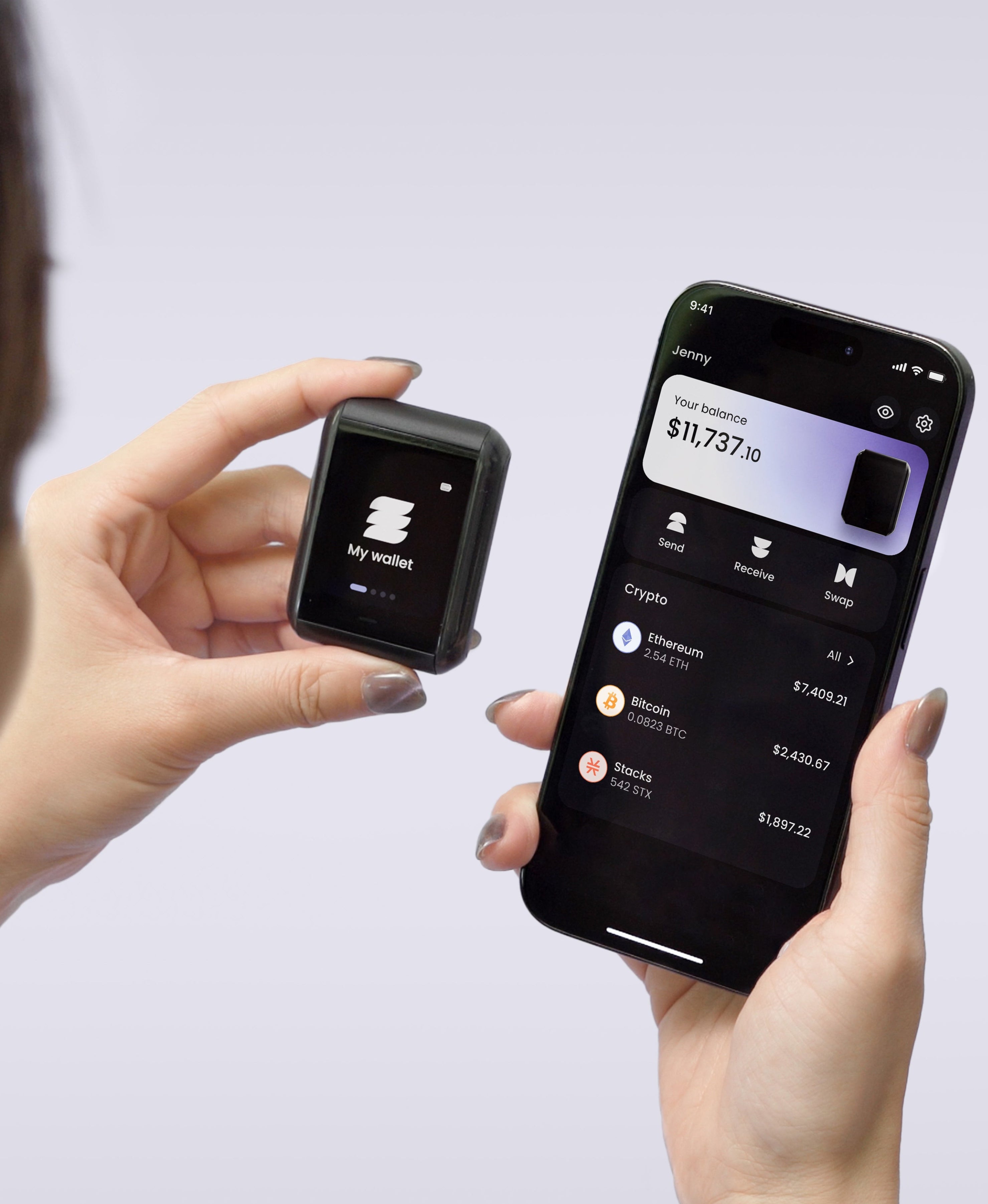
Ryder One is $229 and keeps your keys inside an Infineon SLC38 secure element with EAL6+ certification. Communication is NFC-only, so there is no USB, Bluetooth, or WiFi surface for a remote attacker to reach. The 1.6-inch AMOLED touchscreen shows the full transaction details before you approve; the address, the amount, and the contract you're signing all appear on-device. Recovery runs on TapSafe, our Shamir-based system that spreads wallet backup across a Recovery Tag, an encrypted iCloud or Google Drive blob paired to your phone, and optional Recovery Contacts. No single object holds full access by itself.
The workflow this enables is boring in a good way. Keep a hot wallet with what you plan to trade this month. Move the rest of your holdings onto a Ryder-secured address between sessions. If Kalshi is your platform, keep the dollars you plan to deploy in the exchange balance and pull profits to a bank account tied to a secured setup at home. The hardware wallet doesn't remove exchange risk. It removes the tail where you lose everything because a browser extension approved a signature on your behalf while you were doing something else.
Bottom line
Polymarket and Kalshi answer overlapping questions with a similar product. Polymarket answers "can I trade an outcome without asking permission from a US exchange," and does so with on-chain USDC that lives in your wallet. Kalshi answers "can I trade the same outcomes under CFTC-supervised customer-fund segregation," and does so with a brokerage-style account balance behind qualified US banks. Fees favor Polymarket for high-frequency traders. Regulatory clarity favors Kalshi for anyone who wants the CFTC as a backstop. Liquidity depends on which contract you care about.
Choosing between them is a taste question about which kind of trust you're comfortable with. What isn't a taste question is what happens to the money you're holding but haven't yet traded. That balance sits somewhere. Making sure the somewhere is a wallet you control, backed by a chip designed to keep secrets, is the part of the setup you can decide once and stop worrying about.
Get Ryder One for $229 and keep the crypto behind your prediction-market bets under keys only you can sign with.
--- SEO
- Target keyword: polymarket vs kalshi
- SEO title: Polymarket vs. Kalshi: Which One Holds Your Money (49 chars)
- Meta description: Polymarket runs on-chain USDC in your wallet. Kalshi holds customer funds at CFTC-registered US banks. The custody read on both, plus where hardware fits. (156 chars)


Share: