


# Polymarket Review 2026: How the On-Chain Prediction Market Works
If you've been watching prediction markets blow up this year, Polymarket sits at the center of that conversation. The platform crossed $10 billion in monthly trading volume for the first time in March 2026, and Intercontinental Exchange valued it at $9 billion when it invested in October 2025. Whether you're looking to trade or just want to understand what the platform does, this review covers how Polymarket works, what its track record looks like, where the actual risks sit, and how to keep your USDC collateral protected when you use it.
How Polymarket Works
Polymarket is an on-chain prediction exchange where every market is a yes/no question tied to an actual event. Will the Federal Reserve cut rates before September? Will a particular team win the championship? Will a specific trade deal get signed? Each question runs as a binary market on the Polygon blockchain, with positions priced in USDC between $0.00 and $1.00. If you hold the winning side when the market resolves, each share pays out at $1.00 USDC.
Polymarket doesn't set prices. Traders buy and sell shares continuously, and the market price reflects the probability that participants assign to each outcome. A contract trading at $0.72 means the crowd currently prices that outcome at 72%, though prices shift with every new trade as fresh information enters the market.
Your funds sit in a smart contract on Polygon that only your wallet can authorize. Polymarket holds no private keys on your behalf, so a platform outage or even a company bankruptcy can't freeze your positions unless the smart contracts themselves are compromised. That separation between the platform and your funds is a core part of what makes the design interesting.
USDC on Polygon is how all deposits and withdrawals flow. You can fund your account by transferring USDC from an external wallet or buying it directly through MoonPay with a Visa, Mastercard, or bank card. As of 2026, Polymarket charges taker fees tiered by category: 1.8% on crypto markets, 1.5% on economics, 1.0% on politics, and 0.75% on sports. Gas costs for withdrawals are covered by the platform, so exits carry no on-chain fees.
Polymarket's Track Record
The clearest test of prediction market value came during the 2024 US presidential election. While national polls placed Donald Trump and Kamala Harris in a near statistical tie through October, Polymarket had Trump's contract trading above $0.60 by late in the month. Trump won. Research published in 2025 found that Polymarket resolves in line with its implied probabilities more than 94% of the time, a full month before outcomes become certain, a record that outpaces traditional polls in head-to-head comparisons across political and economic events.
The platform's growth followed that accuracy. Trading volume expanded from $73 million in 2023 to approximately $9 billion across 2024, then hit $10.57 billion in March 2026 alone, its highest single month on record. In early 2026, Dow Jones signed an exclusive partnership to incorporate Polymarket's live probability data into publications including The Wall Street Journal, giving the platform an audience well beyond crypto-native circles.
Fundraising tracked the growth. Reports from March 2026 indicated Polymarket was exploring a round at a $20 billion valuation, though the round that closed in that period came in at a $15 billion valuation with $600 million raised, followed by an additional $400 million raise in April.
The Risks of Using Polymarket
A persistent concern in Polymarket's history is whale concentration. During the 2024 election cycle, one French trader operating eleven linked wallets reportedly accumulated around $85 million in profit through directional bets, pushing Polymarket's Trump probability ten to fifteen percentage points above rival platforms at certain points. Polymarket published Market Integrity Rules in March 2026 banning insider trading, spoofing, and wash trading, though enforcement on a decentralized protocol remains an open question.
The platform's legal standing has grown more complicated since its US relaunch. Polymarket returned to American users in late 2025 after acquiring a CFTC-licensed derivatives exchange and receiving an amended designation order. State-level resistance arrived quickly: Tennessee issued cease-and-desist orders in January 2026, a Nevada judge issued a temporary restraining order blocking access for state residents, and Minnesota passed legislation in May 2026 that classifies operating an unauthorized prediction market as a felony, effective August 1. More than twenty jurisdictions internationally restrict or block the platform entirely.
If you're in an affected US state or international jurisdiction, check your local laws before depositing, since the regulatory landscape has shifted significantly since the platform's US relaunch and continues to evolve at the state level.
Why Self-Custody Matters When You Use Polymarket
Here's the part that most Polymarket reviews skip past. At the protocol level, the platform is non-custodial: your USDC sits in smart contracts that require your wallet's signature to move, and the platform can't access those funds even if its servers go offline. That's a notable design advantage over centralized betting platforms, where a company failure can freeze your account balance overnight.
The key vulnerability isn't the protocol. It comes from how you connect: many users access Polymarket through browser-based or mobile wallets where the private key lives on an internet-connected device, and if that device is compromised, your USDC collateral can be drained before you have time to react. If you lose access to your wallet without properly stored recovery information, your funds are gone regardless of what the smart contracts say about ownership.
Self-custody with a hardware wallet closes that gap. When you connect Polymarket through a hardware wallet paired with MetaMask or Rabby, every transaction requires on-device confirmation before it goes through. Your keys never touch the internet. A phishing attack or malicious browser extension can't sign a withdrawal without that confirmation step, which means your USDC stays protected even if other parts of your browser environment are compromised.
Ledger and Trezor both work with Polymarket via MetaMask. The pairing takes about fifteen minutes to configure, and once set up it covers every interaction: deposits, position entries, and withdrawals, all signed on the device.
Getting Started with Polymarket
Getting onto Polymarket involves four steps, and each one gives you a decision about how much protection to build in from the start.
Step 1: Set up a wallet. MetaMask and Rabby both work well. If you're planning to hold substantial USDC collateral, pair either with a hardware wallet before you deposit anything.
Step 2: Fund with USDC on Polygon. Transfer from an exchange or buy through MoonPay on the platform using a card.
Step 3: Connect your wallet at polymarket.com. Click "Connect Wallet," select your provider, and approve the connection. Polymarket creates a proxy smart contract linked to your wallet address; you control it, Polymarket doesn't.
Step 4: Browse markets and trade. Find a question where you have a view, buy shares in the direction you expect, and hold through resolution. Prediction markets reward an information edge; trading without one is closer to speculation than investing.
Keep position sizes proportional to your confidence in the specific outcome, and remember that taker fees apply on entry, so short-duration trades on thin margins often don't pencil out.
Protect Your USDC With a Ryder One
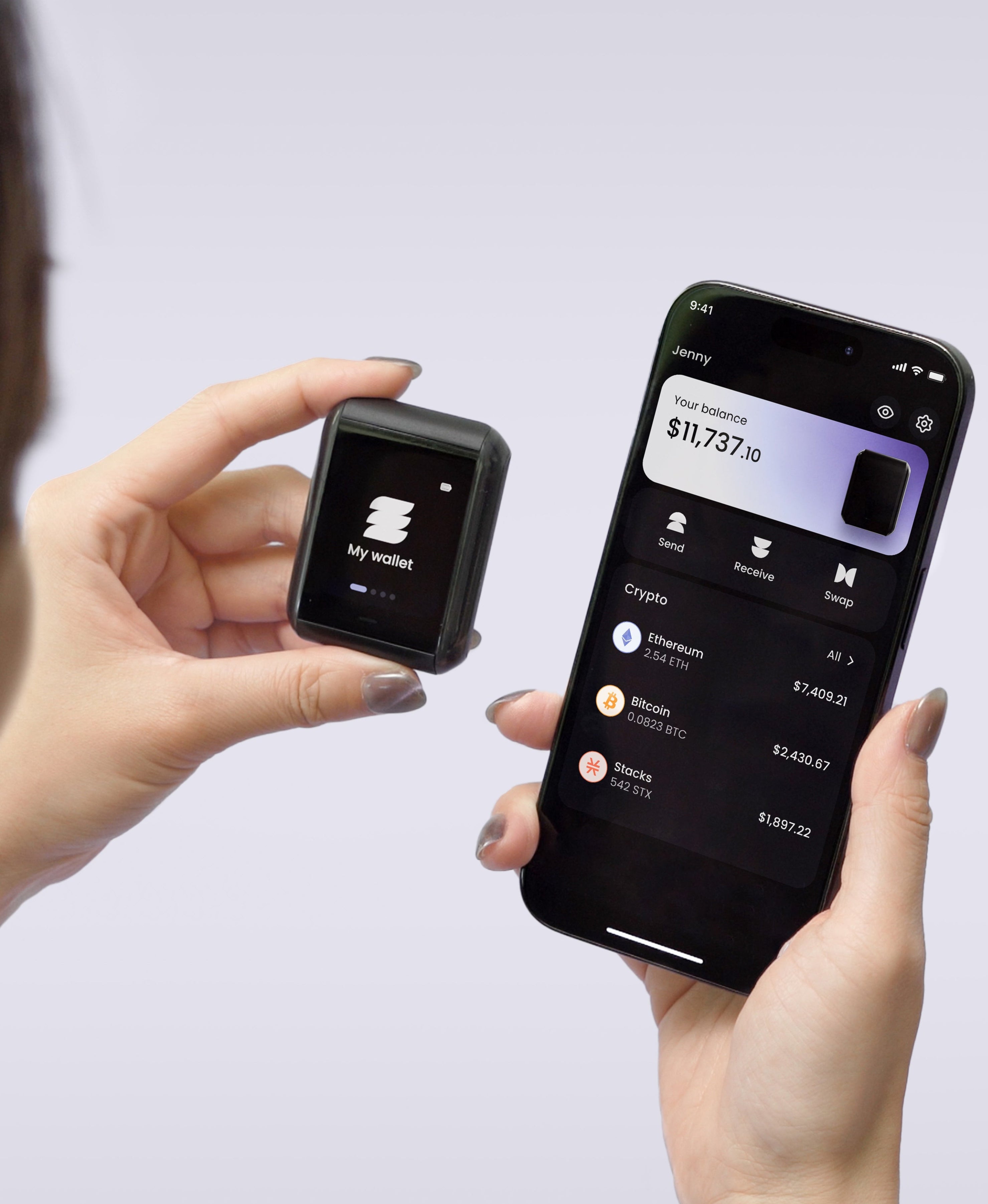
If you're using Polymarket with any amount of USDC worth protecting, a hardware wallet is one of the more practical steps you can take. The Ryder One ($229) is built on an EAL6+ Infineon SLC38 secure element, the same chip class used in current-generation passports, with a 1.6-inch AMOLED touchscreen and a physical button wired directly to the secure element for transaction confirmation. It connects via NFC only, with no USB, Bluetooth, or Wi-Fi, which removes the attack surface that comes with permanently connected protocols.
Recovery works through TapSafe, a 2-of-2 Shamir's Secret Sharing setup that splits your seed phrase between a Recovery Tag and a phone backup, so neither piece alone can restore the wallet without the other. There is no single point of failure in the recovery chain. The firmware has been audited by Halborn; the full audit report is public.
Polymarket's on-chain architecture means your USDC is already protected at the protocol level. A hardware wallet handles the last remaining exposure: the private key that authorizes every transaction.
Get the Ryder One at ryder.id/products/ryder-one.
SEO
- Target keyword: polymarket review
- SEO title: Polymarket Review 2026: How the On-Chain Prediction Market Works
- Meta description: Polymarket review 2026: how the on-chain prediction market works, its track record, key risks, and why a hardware wallet protects your USDC.
- Hero alt text: Ryder One hardware wallet held near a phone displaying the Polymarket prediction market interface with open USDC positions


Share: