

For most of the last decade, "hardware wallet" meant a small device with a USB cable and a couple of buttons. The default connectivity was wired. The default form factor was something you plug in. That's changing. NFC crypto wallets (devices that talk to your phone through a short-range radio tap rather than a cable) have moved from niche to mainstream over the last 18 months. This piece explains how they work, what they get right, what they trade off, and who they fit best.
What an NFC crypto wallet is
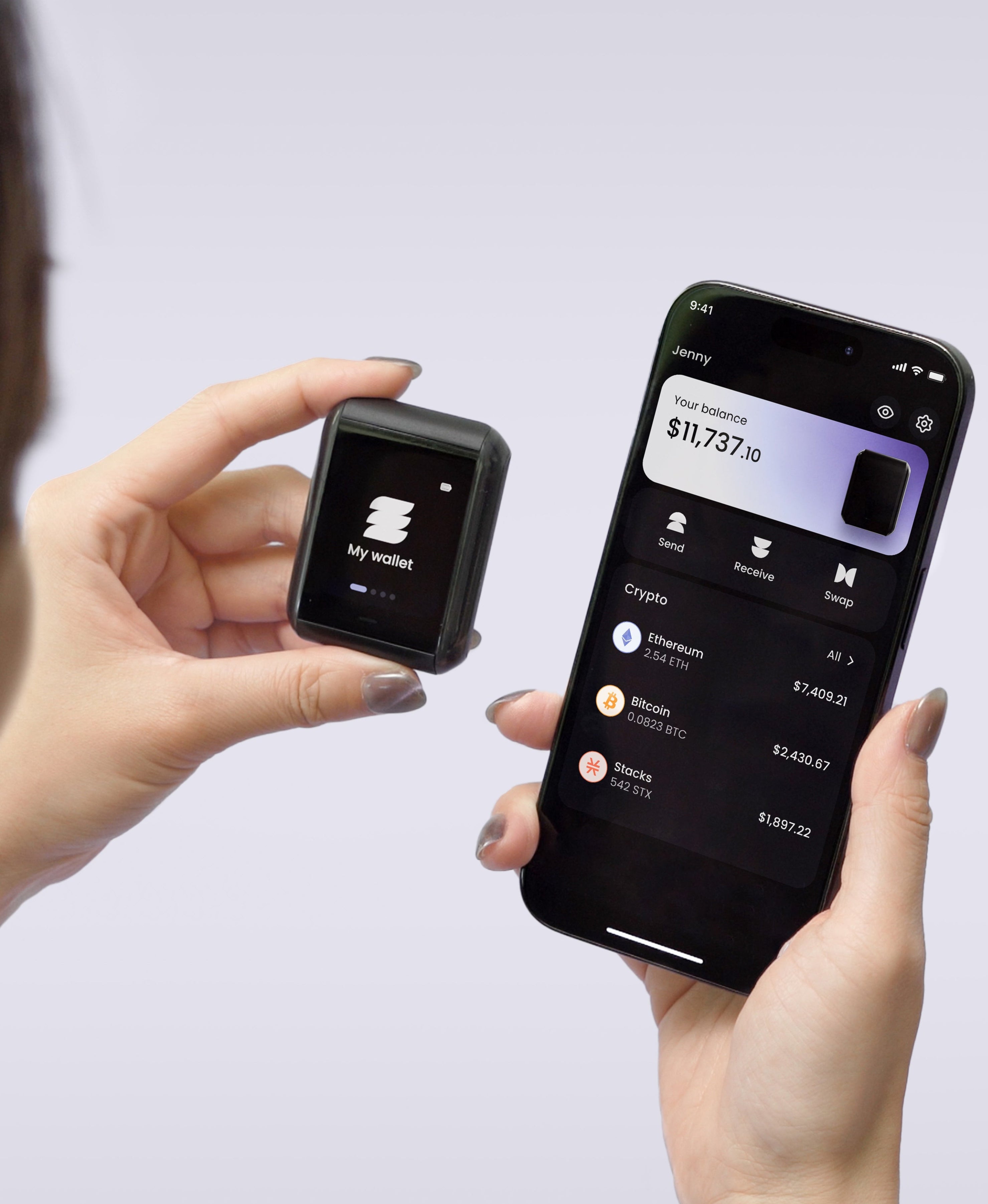
An NFC crypto wallet is a hardware wallet that communicates with your phone or laptop through near-field communication, the same short-range radio standard used in tap-to-pay cards and access badges. When you initiate a transaction in your wallet app, the app builds the unsigned transaction and waits. You hold the NFC wallet up to your phone. The two devices communicate over a few centimeters of distance. The hardware wallet displays the transaction details on its own screen, you confirm, and the signed bytes pass back to the app for broadcast. There's no USB cable. There's no Bluetooth pairing dialog. There's no battery in the wallet for many designs. The wallet draws power from the NFC field generated by the phone for the duration of the operation.
Why NFC works for crypto
Crypto signing has a specific shape that fits NFC well. - Most signing operations are short. You don't need a persistent connection between the wallet and the phone, you need a brief, secure conversation that delivers an unsigned transaction one way and a signed transaction the other way. A few milliseconds is plenty. - The communication range is small by design. NFC operates within about four centimeters. An attacker can't sniff the conversation from across the room, and the wallet doesn't keep an open communication link sitting in the background ready to be exploited. - There's no pairing phase. Bluetooth requires a discovery and pairing flow that has historically been a source of vulnerabilities. BLE pairing exploits have hit major wallets in the past, so NFC tap-to-sign sidesteps the entire category. - The form factor can shrink dramatically. Without a USB port, without a battery, the device can be card-sized or smaller. That changes how people carry and use it.
Where NFC wallets sit against the alternatives
Versus USB wallets. USB wallets are reliable but require a cable, a free port, and a host computer in close proximity. They wear out (USB ports corrode and unseat over years of use). The trade-off is that USB wallets can be powered by the host for longer operations. Versus Bluetooth wallets. Bluetooth wallets give you wireless freedom over a longer range. The cost is an always-on radio surface and a pairing flow that's been exploited in production. The seed itself is still safe (it's in the secure element), but transaction tampering attacks become a real concern. Versus QR-based wallets. QR wallets transmit the unsigned transaction visually. They're elegant from a security standpoint (no radio at all) but slow and finicky for daily use, especially when the screen on either side is small or not there at all. NFC wallets sit in a middle ground. Better security model than Bluetooth, smaller form factor than USB, more reliable than QR.
What NFC wallets give up
Two things, mainly. Long operations are painful. You need to hold the device against the phone for the duration of any sign. For a single transaction, that's a couple of seconds. For some advanced multi-signature or batch operations, it can be longer than feels comfortable. Most NFC wallets handle this by keeping the operation short. Power-hungry features are off the table. A battery-free NFC wallet can do everything that fits in a few hundred milliseconds of NFC field power, which covers signing, address display, and confirmation flows. It can't run a continuous Bluetooth connection or maintain a long-lived state. For the typical self-custody flow (a handful of transactions per week, plus occasional check-ins), neither trade-off is a real cost.
Who NFC wallets fit
Phone-first users. If your primary interface to crypto is a mobile app, an NFC wallet is the closest fit to how you work. No adapter, no cable, no second device. Travel-heavy users. A card-sized NFC wallet is far easier to keep on you (or stash in a hotel safe) than a USB device with a cable. People who want fewer points of failure. No port to wear out. No battery to die. No firmware that has to support an always-on Bluetooth stack. Fewer moving parts. Long-term holders. If you're checking and signing once or twice a month, the brief NFC dance is a feature, not a bug. The friction reminds you to look at what you're signing.
Who they don't fit
Active DeFi users signing dozens of transactions per session. Holding the wallet against the phone for every sign gets old fast. A USB or Bluetooth wallet is faster for high-frequency signing. Workflows that need long-lived connections. If your tooling expects a persistent USB or Bluetooth link (some institutional setups, some hardware wallet management tools), NFC isn't the fit.
What to look for in an NFC wallet
A few specifics worth checking before buying. The chip. The wallet should use a certified secure element (EAL5+ at minimum, EAL6+ is the current top tier). Without this, the device is relying on software to do work the chip should be doing in silicon. The screen. NFC wallets are often card-sized, but the screen still needs to be readable. If you can't comfortably read the destination address, you'll skip the check, and skipping the check is how money gets stolen. The backup. NFC means no battery in many designs, which means the device itself is a one-shot for storing the seed. Your backup story (the seed phrase, plus whatever recovery layer the manufacturer offers) is what stands between you and a permanent loss. The supply chain. Buy direct from the manufacturer. NFC wallets are small and easy to tamper with mid-shipping if a third-party reseller decides to reset and re-package one.
How Ryder One does it
Ryder One is built around NFC because the security model fits long-term self-custody through increased ease-of-use and a short communication range. This hardware wallet has an EAL6+ Infineon secure element with a 1.6-inch AMOLED screen for transaction confirmation. A standard wallet's backup hinges on a single piece of paper or metal surviving every fire, flood, and house move that happens between today and the day you need it. TapSafe Recovery splits the backup across your wallet, battery-free Recovery Tags, your phone, and/or an optional circle of Recovery Contacts. No single component on its own gives anyone access. The seed phrase is on-device as a last resort, so you're never locked into our hardware.
The short version
NFC crypto wallets fit phone-first holders who want fewer moving parts, no cable, and a security model that doesn't include an always-on Bluetooth surface. They give up some speed for high-frequency signing in exchange for a smaller, more durable form factor. If you're checking and signing a few times a week, the device that lives in your wallet is more useful than the one that needs a USB-C cable. See how Ryder One works.


Share: