

You hold Bitcoin in your hardware wallet. You want to swap some of it for ETH. The standard playbook for getting that done has three steps, all of them painful for a self-custody holder. Step one, send Bitcoin from your hardware wallet to an exchange like Coinbase or Kraken. Step two, sell the Bitcoin for USDT and buy Ethereum. Step three, send the Ethereum back to your wallet. Three transactions, two trips through a CEX's custody, network fees on each leg. And during the time the funds are on the exchange, you've broken self-custody for whatever it's worth to you. Cross-chain swaps from cold storage are the answer to that workflow. You initiate the swap from inside your wallet app. The funds never leave your custody for longer than the swap takes to clear on-chain. There's no CEX in the middle. There's no withdrawal address you have to type into a form. This piece walks through how cross-chain swaps from cold storage work, where Ryder Swap fits in, and when this is the right tool versus when an exchange still wins.
Why the traditional flow is friction-heavy
The exchange-detour playbook has costs that add up quickly. Network fees: Each transaction on the way to and from the exchange costs gas. On Ethereum during a busy week, that gas alone can hit double digits, so it’s worth checking the live fee market on a tracker like Etherscan Gas before you swap. Time: Each on-chain transfer takes confirmations. A round trip can be 30+ minutes on a busy day, especially if the network is busy! The price you saw when you started isn't the price you'll get when you finish. Counterparty exposure: Funds sitting on the exchange, even briefly, are at the exchange's mercy. Pause withdrawals, lose a hot wallet to an exploit, declare bankruptcy: the playbook has been run before. KYC friction: If you haven't used the exchange in a while, you may need to re-verify identity. Some exchanges have changed their KYC tier requirements year over year. Re-verification is not always quick. The traditional flow makes sense if you don't already have the alternative. The alternative is now built into most major hardware wallets.
How a cross-chain swap moves value
A cross-chain swap moves value from one blockchain to another without the user manually shuffling through an exchange. There are several mechanisms underneath, and which one a particular swap uses depends on the chains involved. The most common pattern in 2026 is a DEX aggregator that combines liquidity from many decentralized exchanges and bridges, then routes the user's swap through whichever combination of paths gives the best output amount. The user sees one transaction. The system handles the rest. For same-chain swaps (ETH to USDC on Ethereum, say), this is conceptually simple: the aggregator finds the best decentralized exchange for that pair and routes the order there. For cross-chain swaps (Bitcoin to USDC on Solana), the path involves a bridge or a wrapped-asset protocol. The aggregator picks the route. Funds move. What the user does is sign one or two transactions on their hardware wallet. The wallet shows the destination, amount, and destination chain on its screen. The user confirms. The swap happens.
How Ryder Swap works
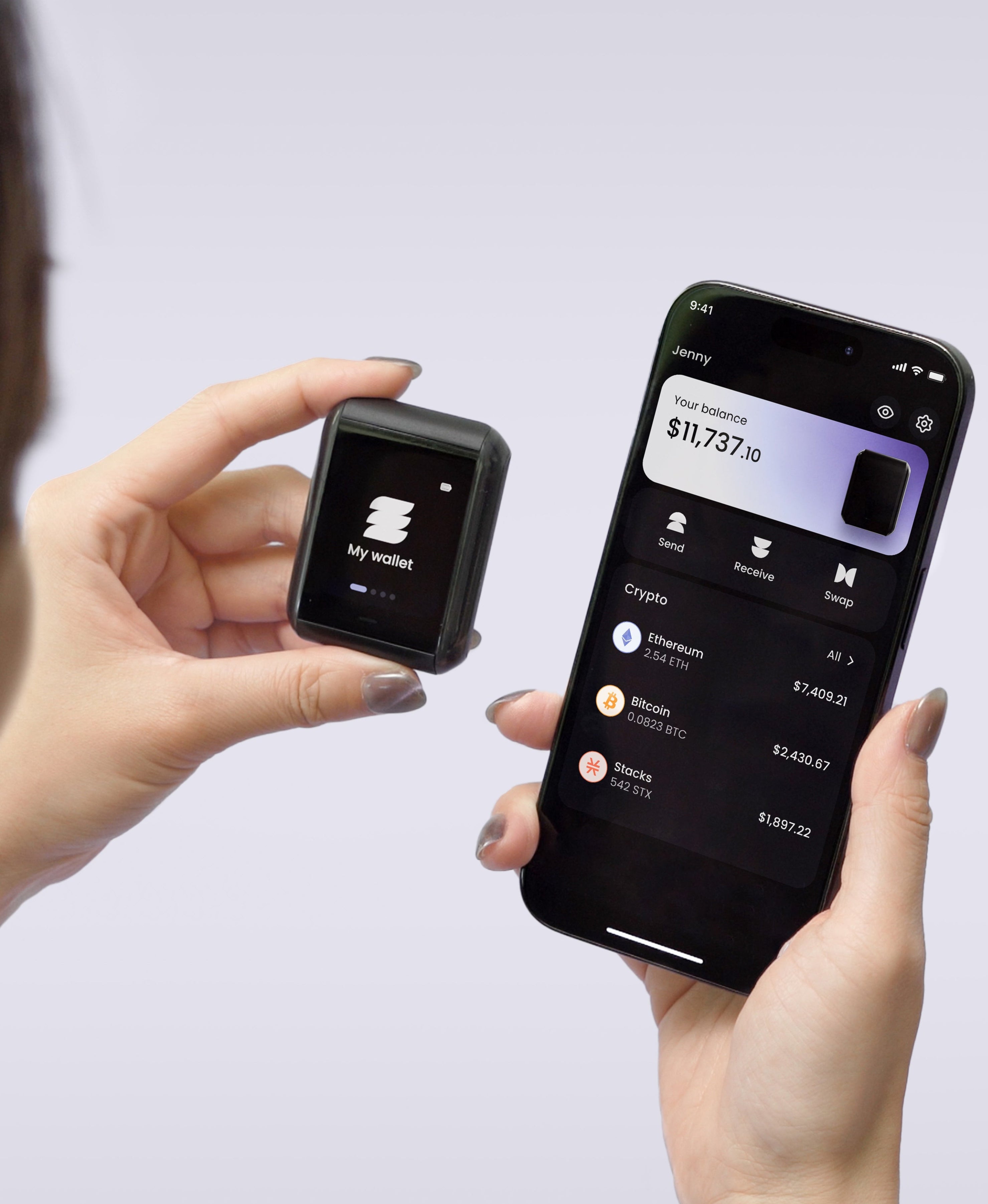
Ryder One ships with Ryder Swap integrated into the companion app, powered by Swaps.xyz. The flow looks like this. You open the Ryder app. You tap Swap, and then pick the asset you're swapping from and the asset you want to swap into. Once you enter the amount, the app queries Swaps.xyz for the best available route across supported networks and shows you the output you'll receive, the route the swap will take, and the fees involved. Once you tap to proceed, the app prepares the transaction. Your hardware wallet shows each transaction on the device's screen so you can verify all the details on the device. Once you finally confirm the details, the swap executes. The funds move from your wallet to the swap protocol, then to your wallet's address on the destination chain. At no point does the swap require you to send funds to a third-party custody account. At no point do you go through KYC. The whole flow runs on smart contracts and your signatures. Coverage for swaps via Ryder Swap includes Bitcoin, Ethereum, Solana, and a growing list of top ERC-20 and SPL tokens.
Trade-offs to know
DEX-style swaps aren't free, and they aren't always the cheapest path. Three things to keep in mind. Slippage: A cross-chain swap pulls liquidity from on-chain pools. On a quiet market with deep pools, slippage is small. On a volatile day or for a less-liquid token, slippage can eat several percent of the swap value. Best-route algorithms minimize this. They don't eliminate it. Bridge risks: Cross-chain swaps that cross between non-EVM and EVM chains often go through a bridge protocol, and that layer has a long history of catastrophic failures — Chainlink notes that cross-chain bridges have been hacked for more than \$2.8B in total (nearly 40% of all Web3 value stolen). Aggregators try to route around bridges with bad track records, but the risk is part of the model. Slow path on edge cases: Some cross-chain pairs (for example, native Bitcoin to native Solana) involve more steps under the hood than the user sees, and the worst case can take longer than a centralized-exchange route. For time-sensitive trades, an exchange might be faster. For most swaps under five figures and outside extreme volatility, the cross-chain route is competitive on cost and clearly better on custody. For very large trades during fast markets, an exchange may still win on execution.
Security at the swap moment
The security advantage of swapping from cold storage isn't only about custody. It's about what's verifiable. When you sign a swap transaction on your Ryder One, the device's 1.6-inch AMOLED touchscreen shows you all the transaction details so you can see exactly what you're signing. If something on your phone or laptop has tried to swap the route or the destination, the device will show the modified version, and you'll catch it before pressing the button. The touch button is wired directly to the secure element. No software path can sign without it. This is the same defense that protects you against address-substitution attacks on regular sends. The wallet signs nothing without you confirming on the device. Swaps don't change that. The firmware that runs the secure element is independently audited by Halborn, so the verifiability claim isn't just a marketing line. The audit report is public.
When to use it, when not to
Use a cross-chain swap from your hardware wallet for any swap where you'd otherwise be tempted to do an exchange round trip and where the swap size is reasonable. The convenience of staying in self-custody usually outweighs the small premium on routing fees. Use a centralized exchange for very large trades, time-critical execution, or trades into pairs that don't have big on-chain liquidity pools.
The bottom line
Cross-chain swaps from cold storage close the last big gap in self-custody. For years, the workflow penalty for keeping crypto in your own wallet was that any time you wanted to change what you were holding, you broke custody to do it. That penalty is gone. The swap happens in your wallet, signed on your hardware, with funds you control the whole time. For anyone holding crypto for the long term who occasionally wants to move between assets, this is the path that no longer requires giving up the thing self-custody was supposed to give you in the first place.
Swap without leaving cold storage. Ryder One lets you swap across chains directly from the wallet app, with every transaction verified on the device's screen and TapSafe Recovery protecting the backup. See how it works.


Share: