


# Mt. Gox Repayments in 2026: Where the 140,000 BTC Distribution Stands
When Mt. Gox imploded in February 2014, the exchange disclosed that roughly 850,000 BTC belonging to customers had vanished from its wallets. About 200,000 BTC was later recovered from an old cold-storage address, leaving the bankruptcy estate with around 140,000 BTC to distribute. Twelve years and one extended deadline after another, that distribution is still grinding through. The Tokyo District Court approved another payout extension this year, pushing the repayment window deeper into 2026.
For creditors who filed claims a decade ago, the wait has been its own kind of education. For everyone else watching from the sidelines, Mt. Gox is the longest-running case study in what happens when you let someone else hold your keys.
What the trustee has paid out so far
The Rehabilitation Trustee, Tokyo lawyer Nobuaki Kobayashi, began moving coins to creditors in July 2024 after years of legal preparation, starting with the cohort that opted for the "early lump-sum" payment plan. By the end of 2024, roughly half of the 140,000 BTC pool had been transferred to designated exchanges (Kraken, Bitstamp, BitGo, SBI VC Trade, Bitbank) for distribution to creditors who had completed their KYC and account-linking steps.
The remaining balance sat in trustee-controlled wallets through most of 2025. Then in late October 2025, the trustee filed for another extension of the repayment deadline, citing creditors who had not finished verification and edge cases involving deceased claimants and inheritance paperwork. The new outside date is October 31, 2026. Coins that have not been distributed by then revert to a holding pattern while the court resolves the remaining claims.
If you're keeping score: of the 140,000 BTC the estate set aside, around 70,000 had moved by mid-2026, with the rest queued behind verification and legal cleanup. That balance is one of the largest single piles of Bitcoin held outside an active exchange, and its slow trickle has been a recurring talking point for market analysts every time a tranche moves.
What the original creditors will receive
Here is the part that still catches new readers off guard. Mt. Gox creditors aren't being made whole in dollar terms. They're being repaid a pro-rata share of the recovered Bitcoin, calculated against a claim that was denominated in 2014 BTC quantities. If you had 100 BTC on the exchange in 2014, you don't get 100 BTC back. You get roughly 14% of that amount in actual coins, because the estate only recovered about 14% of what was lost.
The cash value at today's prices is, of course, a different story. Bitcoin traded around $600 when Mt. Gox failed. The same coin is worth dramatically more now, which means the 14% repayment in BTC terms still translates into a windfall in fiat for many claimants. Bloomberg reported in 2024 that several large claimants and the claims-fund secondary buyers who acquired creditor positions for pennies on the dollar were the biggest winners.
Long-term holders who never sold their position have spent the decade watching Bitcoin appreciate while their share of the estate sat in legal limbo. The creditors who sold their claims to recovery funds in 2014 and 2015 got out at distressed prices and missed the upside entirely. Both outcomes are products of the same underlying fact: somebody else was holding the keys.
The structural lesson nobody likes to repeat
Mt. Gox is often described as a story about poor security at one exchange, and it was that. The Trustee's own filings and subsequent Chainalysis tracing work showed that coins were being siphoned out as early as 2011, three years before the public collapse. Internal controls were thin, hot wallet management was sloppy, and the platform's leadership did not detect the bleed until it was far too late.
But framing Mt. Gox as a one-off ignores what's repeated since. Cryptopia (2019), Bitfinex (2016), FTX (2022), and Binance's 4.3 billion USD DOJ settlement in 2023 all rhymed in some way. When an exchange holds your private keys, your claim on your coins is a contractual one against an intermediary. That contract can be diluted by a hack, a bankruptcy, a regulator, or a slow-moving trustee twelve years into a court case.
A hardware wallet flips that arrangement. The keys are generated on a chip you hold, the signatures happen inside that chip, and an exchange's solvency stops being a load-bearing assumption about whether your money is still there.
How TapSafe Recovery handles the part that scares people
The standard objection to self-custody is the seed phrase. Twelve to twenty-four words on a piece of paper that, if lost, takes your wallet with it, and if found by the wrong person, gives them everything. We hear that concern often, and it's a fair one. A seed phrase on its own is a brittle artifact.
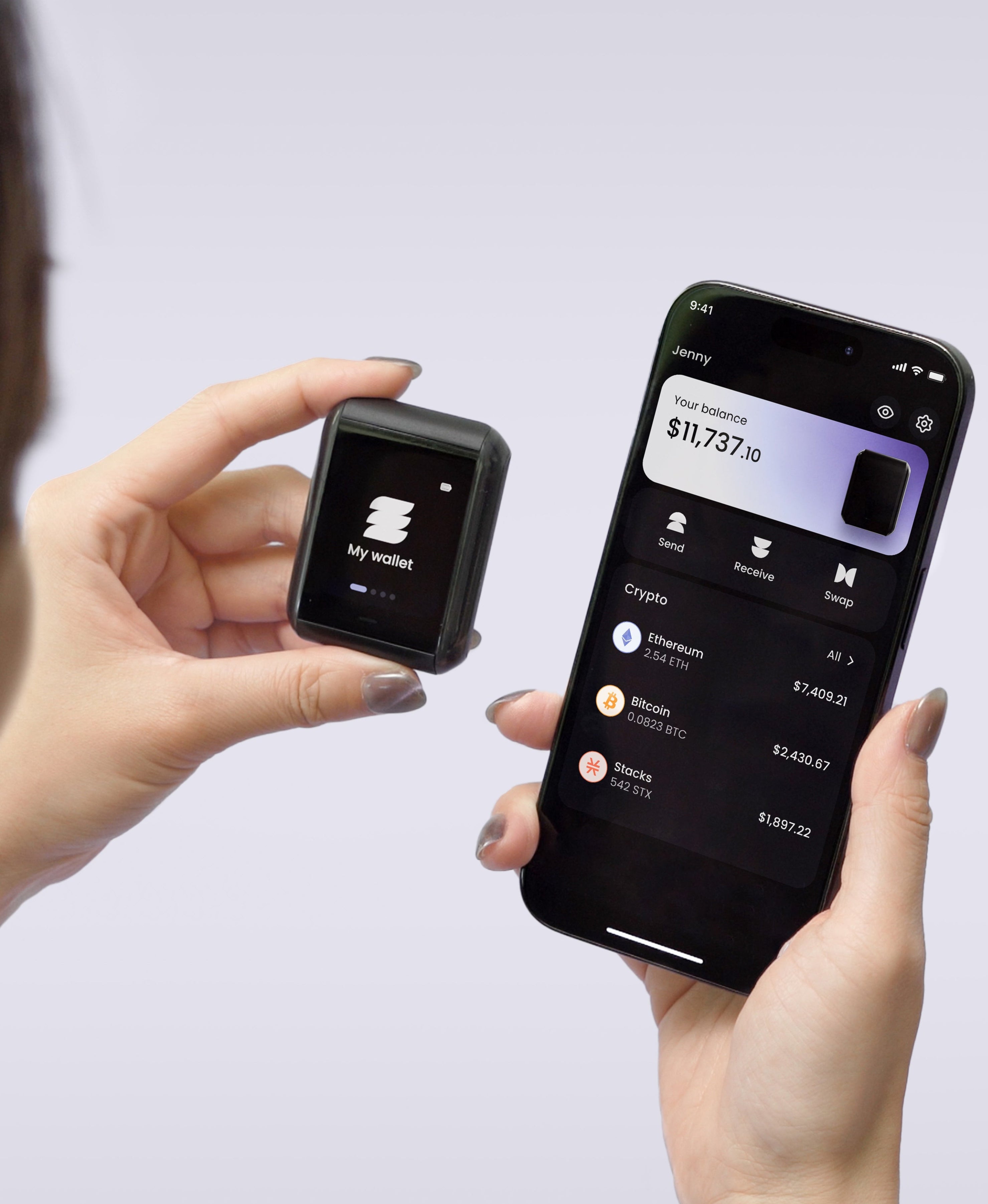
So we built Ryder One around a different recovery model called TapSafe. The setup spreads your wallet across components instead of pinning it to one piece of paper. Your Recovery Tag holds 50% of the recovery information, an NFC card that's IP69K rated and lives wherever you keep important documents. The other 50% is a phone backup stored encrypted in your iCloud (iOS) or Google Drive (Android), not on the phone itself, so a lost or stolen handset doesn't lose the backup. Together, the tag and the phone backup are a 2-of-2: either piece alone is useless to an attacker, and either piece alone is useless to you, which is the point.
If you want a third layer, you can add Recovery Contacts. Each contact holds a 25% share, paired in person over NFC and synced to their own cloud. The contacts can never see your wallet balance or signing keys. They only carry a fragment of the recovery, so two of them together can help you rebuild if you ever lose both your tag and your phone backup at once.
The seed phrase still exists, by the way. It lives on the device as a last-resort backup and follows the BIP-39 standard, so you are never locked to our hardware. If you ever want to walk away with your keys, you can. We just don't think you should have to depend on that piece of paper as your only line of defense.
Where the Ryder One fits
The Ryder One is a compact hardware wallet with a 1.6-inch AMOLED touchscreen, an EAL6+ Infineon SLC38 secure element, and NFC-only communication. There's no USB, no Bluetooth, no Wi-Fi. Every transaction shows up on the device's screen with full readable detail before you confirm with the physical button, and that button is wired directly to the secure element, so no software path can sign without your tap.
It charges over Qi wireless and ships at $229 with a Recovery Tag, the Qi charger, and a travel pouch in the box. Setup takes under sixty seconds: tap the phone, tap the tag, tap the phone again. After that, the keys live offline, the backups live in the places you control, and an exchange's solvency stops being part of your security story.
The Mt. Gox creditors who are receiving coins this year had to wait twelve years for someone else's legal process to give back what was theirs to begin with. Whatever they choose to do with those coins next, the lesson is paid in full.
The bottom line
Mt. Gox is the slowest unwinding in crypto history, and it's still not over. Roughly half of the recovered 140,000 BTC has reached creditors as of mid-2026, with the rest waiting on KYC, inheritance claims, and a new October 2026 deadline. The lucky claimants will pocket more dollars than they ever expected. The unlucky ones sold their claims a decade ago. Both outcomes traced back to the same flaw: a third party was holding the keys.
If you'd rather not learn that lesson the way Mt. Gox creditors did, move your long-term holdings into self-custody on a hardware wallet. The Ryder One ships with TapSafe Recovery built in, so the trade-off between security and accessibility stops being a binary choice.
SEO
Target keyword: mt gox repayment
Meta description: Mt. Gox's 140,000 BTC distribution is still grinding through court. Here's where the 2026 repayments stand, what creditors receive, and the custody lesson.


Share: