


Strategy (formerly MicroStrategy) holds roughly 847,000 Bitcoin as of June 2026, after adding 1,800 BTC in early June at an average price near $63,500. At current Bitcoin prices, the stack is worth about $53 billion, which keeps Strategy at the top of the global corporate Bitcoin treasury ranking by a wide margin.
In this piece, we walk through where Strategy's microstrategy bitcoin holdings 2026 picture stands mid-year, what's shifted since the prior 845K BTC update, what the recent buying cadence signals, and what retail self-custody holders should take from the company's continued accumulation.
The current numbers
As of mid-June 2026, the breakdown looks like this:
- Total BTC held: ~847,000
- Average acquisition price: ~$69,200 per BTC
- Total cost basis: ~$58.6 billion
- Current market value: ~$53.4 billion (at $63K BTC)
- Mark-to-market position: roughly 9% underwater
Strategy's 2026 purchases have come in smaller and more frequent batches than the large debt-financed buys of 2024 and 2025. Where prior quarters often pushed 30,000+ BTC in a single window, the current pace is closer to 5,000 to 10,000 BTC per quarter. The shift reflects two pressures at once: Bitcoin's drawdown has compressed Strategy's debt capacity, and management has shown a more measured posture this year. Saylor's commentary on recent calls leans on the same line he's used since 2020, which is that the company plans to hold through cycles and add when conditions allow.
What's changed since the prior 845K BTC report
A handful of updates are worth flagging.
The first is continued accumulation through the drawdown. As Bitcoin slid from $71K to $59K in early June, Strategy still picked up BTC in three small tranches ($101M, $30M, and $25M according to its 8-K filings). The buys were modest, yet the message was consistent: every drawdown is treated as an accumulation window, and the company isn't waiting for confirmation that the bottom is in.
Second, the quarter saw no new convertible debt. Past cycles leaned heavily on convertible notes to fund BTC purchases, while this quarter's accumulation came from operating cash flow and incremental equity issuance. That reduces the debt load embedded in the position and improves the resilience of the balance sheet, which is a quieter shift than a billion-dollar buy but matters more for risk.
Third, the tax overhang has cleared. The IRS's 2024 guidance on Section 174 treatment of corporate digital-asset holdings settled how mark-to-market unrealized gains flow through book income without creating immediate tax liabilities. That uncertainty had hung over Strategy's reporting since CAMT (corporate alternative minimum tax) discussions in 2023, and removing it lets the team focus on accumulation rather than tax structuring.
What the continued accumulation signals
A few deeper reads come out of the buying pattern.
Conviction at the top hasn't moved. Strategy has never sold a single Bitcoin since first buying in August 2020, and the 2026 buys through a 17% drawdown reinforce the same playbook: accumulate regardless of cycle position, hold through volatility, and avoid the timing question entirely.
The corporate template is being copied, slowly. Marathon Digital, MetaPlanet, Twenty One Capital, and a growing list of public companies now hold sizeable Bitcoin treasuries. By mid-2026, corporate Bitcoin holdings outside Strategy reached about 150,000 BTC, up from roughly 80,000 BTC at the start of 2024. The trend doesn't make Strategy unique anymore, but it does validate the original thesis.
The dilution math is becoming the harder constraint. Strategy's market cap trades at a premium over the value of its BTC stack (investors pay more than $1 per dollar of held Bitcoin because of operating gearing and listed-equity access), and that premium has compressed from peaks above 2x to around 1.3x today. Every additional equity issuance to fund buys dilutes existing shareholders, so accumulation isn't free even when the BTC purchase price is attractive.
What retail holders should take from this
A few takeaways, none of which require action.
Concentration is climbing. Strategy alone holds roughly 5.2% of all Bitcoin ever mined, and once you add other corporate treasuries (1%), spot ETFs (5%), and known exchange holdings (8%), close to 19% of Bitcoin sits inside institutional or corporate wrappers. The retail share has been shrinking on the same trend.
A liquidity floor has formed. When Strategy and similar treasury companies step in on every meaningful drawdown, they create a continuous bid under Bitcoin's price that didn't exist in earlier cycles. That doesn't prevent volatility, yet it changes the floor dynamics.
Self-custody stays the position that doesn't depend on corporate behavior. A Bitcoin holding on a hardware wallet is unaffected by Strategy's debt load, MetaPlanet's quarterly results, or any other company's balance-sheet decisions. The position is yours, off any third party's books, and visible only to you.
How the math compares to retail
A retail holder with 1 BTC and a hardware wallet has the same per-coin Bitcoin exposure as a corporate treasury. The differences sit on the operational side.
On tax treatment, Strategy gets institutional accounting (mark-to-market under updated GAAP guidance), while a retail holder generally faces capital gains treatment when they sell. If both hold indefinitely, the practical outcomes converge. On borrowing, Strategy uses corporate balance-sheet capacity to amplify exposure, while a retail holder typically doesn't and probably shouldn't.
Liquidity differs too. Strategy can move large blocks through OTC desks; a retail holder might face slippage on $100K+ market sales, although this rarely matters at typical sizes. On counterparty risk, Strategy stores BTC with institutional custodians like Fidelity Digital Assets and Coinbase Custody, while a retail holder with a hardware wallet has no custodian at all. The retail position ends up with the cleanest custody profile in the table; Strategy's holding is institutional but counterparty-dependent.
Where Ryder One fits
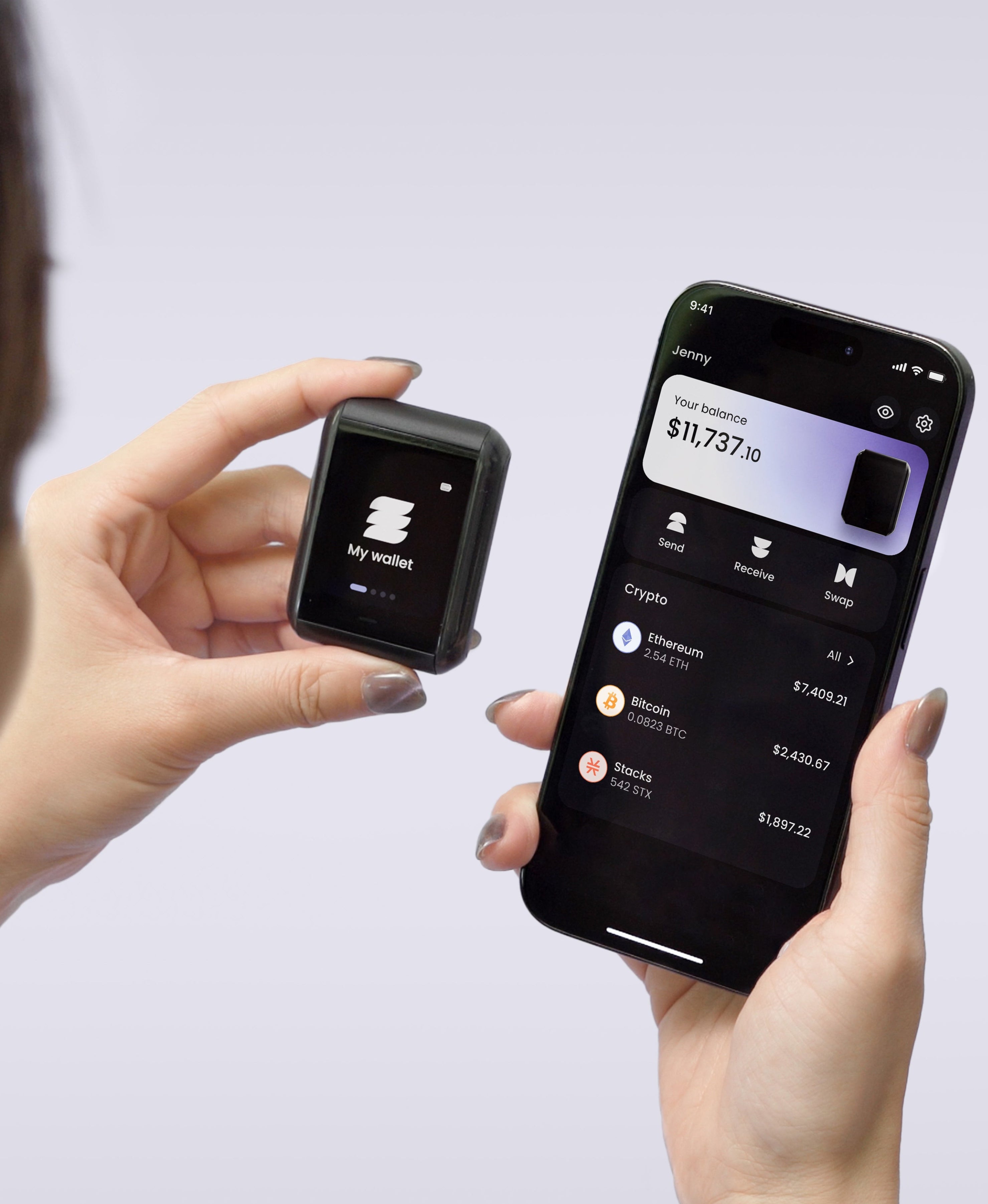
Ryder One is the direct-custody answer for retail holders building a long-term Bitcoin position. We designed the EAL6+ Infineon SLC38 secure element to keep your private key offline, and every transaction is verified on the 1.6-inch AMOLED touchscreen with a button press wired straight into the secure element. NFC-only communication keeps wireless data paths out of the picture entirely.
We built TapSafe Recovery so the backup isn't its own single point of failure. The Recovery Tag holds 50% of the recovery share, your paired phone holds the other 50% encrypted in iCloud or Google Drive (not on the phone itself), and you can optionally add up to four Recovery Contacts who each hold 25%. Your BIP-39 seed phrase stays accessible on-device as a last resort, so the wallet never locks you to our hardware. Ryder One ships at $229 with a Recovery Tag, Qi wireless charger, and travel pouch in the box.
For holders watching Strategy keep accumulating through the drawdown, Ryder One handles the one decision still inside retail control: where you hold what you have. Corporate buying creates the price floor; the wallet decides who keeps the position.
The bottom line
Strategy holds about 847,000 Bitcoin as of mid-June 2026, after adding 1,800 BTC through the recent drawdown. The company continues to accumulate despite a 9% mark-to-market underwater position, and corporate Bitcoin treasury concentration keeps climbing across the rest of the public-company landscape. For retail self-custody holders, Strategy's behavior is useful background (it normalizes institutional ownership and supports a price floor), but it doesn't change the direct-custody case. The position you hold on your own hardware is unaffected by what's on anyone else's balance sheet.
Hold your share, off any balance sheet. Ryder One holds your Bitcoin offline on an EAL6+ secure element, with TapSafe Recovery as the backup.
SEO
- Target keyword: microstrategy bitcoin holdings 2026
- SEO title: MicroStrategy Bitcoin Holdings June 2026: 847K BTC Updated (60 chars)
- Meta description: Strategy holds ~847,000 BTC as of June 2026 after adding 1,800 through the drawdown. Current position, recent buys, and what it means for retail. (148 chars)



Share: