


The EU's Markets in Crypto-Assets Regulation (MiCA) entered into force on 29 June 2023, with stablecoin rules applying from 30 June 2024 and the full crypto-asset service provider regime applying from 30 December 2024. Within months of the CASP phase kicking in, Coinbase's European arm delisted USDT and other non-authorized stablecoins for EEA users, and Kaiko reported USDT trading volumes on EU venues fell more than 70% between Q4 2024 and Q2 2025. On paper, MiCA is the most sweeping crypto rulebook in any major economy. In practice, it drew the perimeter around exchanges, custodians, and stablecoin issuers, and it left self-custody outside that perimeter on purpose.
If you're an EU holder trying to work out what "mica crypto regulation" changes for you specifically, this piece walks through what MiCA is, when each phase kicks in, what it did to exchanges, what it explicitly doesn't touch, and where a hardware wallet like Ryder One sits under the new rules.
What MiCA is
MiCA is EU Regulation 2023/1114, the first cross-border legal framework for crypto-assets in any major economy. It replaces the patchwork of national rules that used to govern EU exchanges and stablecoin issuers, and it applies the same requirements across all 27 member states. The scope is defined narrowly: MiCA covers crypto-asset service providers (CASPs) and the issuers of two token categories, asset-referenced tokens (ARTs) and e-money tokens (EMTs). Everything from centralized exchanges and brokers to custodial wallet providers falls inside the CASP definition.
The categories matter because MiCA treats them differently. An ART is a token backed by a basket of assets. An EMT is a token pegged to a single official currency, which is where fiat-backed stablecoins like USDC, USDT, and EURC sit. Issuers of EMTs face bank-like capital rules, reserve-composition requirements, and monthly disclosure obligations. CASPs face licensing, capital, and conduct requirements, plus the extended FATF travel rule with no de minimis threshold on transfers.
Timeline of enforcement
MiCA came into force on 29 June 2023, but the substantive provisions phased in over 18 months so that market participants had time to adapt.
- 30 June 2024: Titles III and IV applied, covering ART and EMT issuance. Stablecoin issuers wanting to serve EU customers had to be authorized as either a credit institution or an e-money institution, hold 1:1 reserves, and meet ongoing disclosure rules.
- 30 December 2024: Title V applied, covering the full CASP regime. Exchanges, custodians, brokers, and other intermediaries need a MiCA authorization from a national regulator, with an EU-wide passport following on from that.
- 1 July 2026: The transitional window closes. Firms that were operating under prior national licenses lose the grandfather period and must hold a MiCA CASP authorization to keep serving EU clients.
The European Securities and Markets Authority (ESMA) coordinates the technical standards, and national competent authorities (BaFin in Germany, AMF in France, CNMV in Spain, Central Bank of Ireland) issue individual CASP licenses.
What changed for EU exchanges and stablecoins
The most visible effect of MiCA was on the stablecoin market. Once Title III applied in mid-2024, exchanges serving EU customers had to check whether the stablecoins they listed came from an authorized EMT issuer. Circle got USDC and EURC authorized under an Electronic Money Institution license from a French regulator. Tether didn't apply for authorization. Its CEO Paolo Ardoino argued publicly that MiCA's reserve rules, which require EMT issuers to hold 30% to 60% of reserves in EU bank deposits, would expose the company to bank-failure risk of the kind that briefly depegged USDC when Silicon Valley Bank collapsed in March 2023.
Faced with the December 2024 deadline, EU-facing venues cleared their listings. Coinbase Europe pulled USDT, PYUSD, DAI, and several other tokens for EEA users in late 2024 and early 2025. Crypto.com followed with its own delisting round in January 2025. Binance restricted EU USDT trading pairs shortly after. USDC volumes on the same venues nearly doubled through the transition, as EU liquidity migrated toward authorized stablecoins.
On the CASP side, exchanges had to get a MiCA license from one national regulator and then passport that authorization across the bloc. The travel rule, imposed through the parallel Transfer of Funds Regulation, now requires any regulated CASP to share originator and beneficiary information for every crypto transfer with no minimum threshold, dropping the FATF's usual EUR 1,000 floor for the EU.
None of that is small. A regulated EU exchange in 2026 operates under stricter reserve, custody, disclosure, and information-sharing rules than a US exchange does. The direction of travel is clearly toward regulated intermediaries looking more like traditional financial institutions than they did four years ago.
What MiCA explicitly doesn't touch: non-custodial wallets
Here's the part most European headlines skipped. MiCA's scope is intermediaries and issuers, which means the regulation stops at the point where a licensed CASP is in the transaction. It doesn't reach the user who holds their own keys and interacts with the chain directly from a self-hosted wallet.
Recital 22 of the regulation states that crypto-asset services provided "in a fully decentralised manner without any intermediary" should not fall within scope. Article 2(2)(c) carves out services where "the crypto-asset service is provided in a fully decentralised manner without any intermediary." And when the European Commission's Q&A on custody clarified what counts as a custody service under MiCA, it drew the line at whether the provider controls the keys: if only the client holds the keys, the provider is outside the definition of a custodian and therefore outside the CASP regime.
For self-custody users, that means the practical rules haven't changed. Holding USDT in your own wallet remains legal across the EU. Sending USDT peer-to-peer from a self-custodied wallet to another self-custodied wallet remains legal. Interacting with a fully decentralized protocol from your own address is outside the CASP perimeter by design. What MiCA Title V prohibits is regulated EU service providers offering non-authorized stablecoins to public customers, which is a different thing from banning the tokens themselves.
This distinction shows up in ESMA's guidance too. The regulator has been careful to note that peer-to-peer transfers between self-hosted wallets aren't subject to the travel rule when no CASP is involved on either side. A hardware wallet is a self-hosted wallet by definition; there's no intermediary sitting between you and the chain when you sign a transaction on the device.
Where things get more nuanced is around hybrid services. A "decentralized" exchange with a front-end operated by an identifiable company, a governance token controlled by a small set of holders, and a treasury run by a legal entity is unlikely to qualify for the Recital 22 exemption. ESMA has signalled that if there's an identifiable intermediary extracting fees or holding upgrade keys, the protocol probably needs a CASP license. Pure self-custody, by contrast, has no intermediary to license.
Where Ryder One fits
The MiCA transition is a good reason to look hard at where you're holding assets. If you've been keeping USDC, EURC, or bitcoin on an EU exchange, the exchange is now operating under strict conduct and disclosure rules, which is broadly good for consumer protection. It also means the venue can freeze balances under court order, pause withdrawals during a compliance review, or delist a token overnight the way Coinbase Europe did with USDT. Any asset you hold on a licensed CASP sits inside that regulatory perimeter.
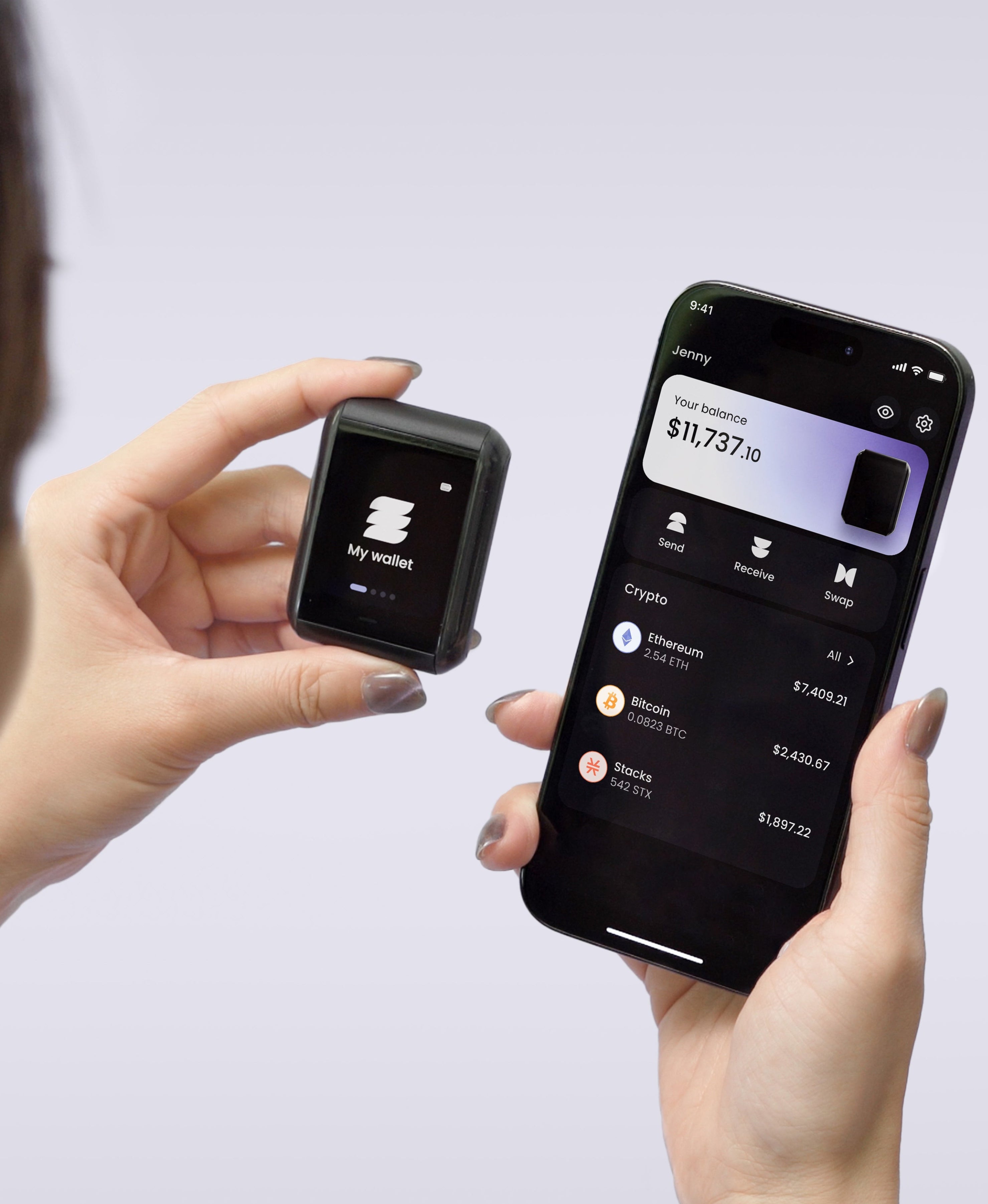
Moving assets to a hardware wallet takes them outside that perimeter. Ryder One holds your private keys on an EAL6+ Infineon SLC38 secure element that never exposes them to a connected device. Every transaction is verified on the 1.6-inch AMOLED touchscreen, with a physical button wired directly into the secure element, so what you see on the display is what you sign. NFC-only communication means no USB port, no Bluetooth radio, no wireless data path for a remote attacker to work through while you're moving funds off an exchange before a delisting takes effect.
We built TapSafe Recovery because a wallet outside the exchange system needs a backup story that doesn't turn into its own weak link. The Recovery Tag holds 50% of the recovery secret and is IP69K rated for water and dust. Your paired phone holds the other 50%, encrypted into iCloud or Google Drive rather than on the device itself, so losing the phone doesn't lose the backup. Recovery Contacts can optionally hold 25% each, without any visibility into your wallet contents. The BIP-39 seed phrase stays accessible on-device as a last resort, so you're never locked to our hardware. Ryder One ships at $229 with the Recovery Tag, Qi wireless charging pad, and travel pouch in the box.
For EU users specifically, the regulatory upside is clear. A hardware wallet is a self-hosted wallet under MiCA, which means the rules around CASP licensing, travel-rule reporting, and stablecoin authorizations don't apply to what sits inside it. Your relationship with the chain is direct.
The bottom line
MiCA rewrote the rules for EU exchanges, brokers, and stablecoin issuers. It set reserve requirements for EMTs, licensing requirements for CASPs, and a travel-rule regime that goes further than the FATF baseline. USDT effectively exited the EU's regulated venues because Tether declined to seek authorization, and the market rebalanced toward MiCA-authorized issuers like Circle. Any European crypto user who transacts through licensed venues will feel the difference through KYC intensity, transfer information-sharing, and the shrinking menu of stablecoins on offer.
What the regulation deliberately left alone is your right to hold assets in a wallet you control. Recital 22 and Article 2 keep non-custodial wallets and decentralized services outside the CASP regime, and ESMA has been consistent on that point through its Q&A guidance. If you already believed self-custody was the safer default, MiCA is a reason to move faster rather than a reason to reconsider. The regulated rails are getting more regulated. The unregulated path, the one where you hold your own keys, still starts with a hardware wallet.
Keep your keys outside the regulatory perimeter. Ryder One holds your crypto offline on an EAL6+ secure element, with TapSafe Recovery as the backup and no exchange sitting between you and the chain.
SEO
- Target keyword: mica crypto regulation
- SEO title: MiCA Crypto Regulation: What Europe's Rules Mean for Self-Custody (64 chars)
- Meta description: MiCA reshaped EU exchanges and stablecoins in 2024 and 2025, but left non-custodial wallets alone. Here's what the regulation changes for self-custody. (152 chars)


Share: