

# MetaMask in 2026: What the Biggest Hot Wallet Gets Right (and Wrong)
If you've ever opened Uniswap, minted an NFT, or bridged to a Layer 2, there's a good chance you did it through MetaMask. The extension has been the on-ramp to Ethereum for the better part of a decade, and it earned credit for onboarding an entire generation of DeFi users. That same reach turned it into the biggest attack surface in crypto, and understanding why matters as your balance grows.
Below we cover what MetaMask is, how it stores keys, the newer surface area from Snaps, Card, and Portfolio, where it falls short, and how pairing it with a hardware wallet fixes the parts that keep costing people money.
What MetaMask is and where it fits
MetaMask is a self-custodial hot wallet built by ConsenSys, the Ethereum-focused company Joseph Lubin founded in 2014. The wallet shipped in 2016 as a browser extension for Chrome and Firefox, added a mobile app in 2020, and since 2023 has held non-EVM assets like Bitcoin and Solana through the Snaps sandbox alongside standard ETH, ERC-20, and NFT support.
The core job of MetaMask is to hold your keys on your machine, sign transactions, and bridge a decentralized application in your browser to the underlying chain. Connecting to a dApp injects a JavaScript provider into the page so the site can request signatures and read your address. Approving a transaction produces a signed payload from a private key encrypted on your disk, which the extension relays to a node (Infura by default, or one you specify) for broadcast to the network.
Reach is the story. ConsenSys has cited more than 30 million monthly active users since 2022, and the Chrome extension alone reports over 100 million lifetime downloads. That footprint made MetaMask the default self-custody experience for Ethereum.
How MetaMask stores keys (the local keystore and browser memory issue)
Under the hood, MetaMask is a JavaScript wallet running inside your browser process. During onboarding, the extension generates a 12-word BIP-39 seed phrase, derives your private keys from it, and stores those keys inside an encrypted keystore file on your local disk, protected by the password you set. The full mechanism is documented in the MetaMask developer docs.
The trade-off shows up at signing time. To sign a transaction, MetaMask has to decrypt the private key into browser memory, use it to produce a signature, and then discard it. That decryption window is brief, but it lives inside a process that also runs whatever untrusted JavaScript is loaded from every tab and extension you've installed. A browser exploit, a malicious add-on, or a compromised dependency in a page you visit can, in principle, read that memory before the key clears. Halborn walked through several browser-wallet key extraction paths in a 2023 write-up.
The takeaway isn't that MetaMask is careless with keys; the engineering team has patched dozens of these issues and runs one of the higher bug bounties in the industry. Software living inside a browser inherits the browser's threat model.
MetaMask Snaps, Card, and Portfolio in 2026
MetaMask in 2026 is more than a browser extension. Three products have grown up around it, and each expands what the wallet does without changing where keys live.
Snaps are third-party extensions that plug into MetaMask through a permissioned sandbox. Since general availability in September 2023, Snaps have added Bitcoin, Solana, Cosmos, Starknet, and Aptos support, plus transaction-insight modules that flag phishing signatures before you sign. The official Snaps directory lists over a hundred approved integrations as of mid-2026, which is how MetaMask stops being ETH-only without ConsenSys writing every chain integration.
MetaMask Card rolled out globally with Mastercard through 2025 and 2026. The card links to a MetaMask smart account and pulls funds from your on-chain USDC to settle at any Mastercard merchant, and CoinDesk covered the wider EU and UK expansion in early 2025. It runs against a delegated smart account, so it does not touch your primary seed phrase.
Portfolio and the Delegation Toolkit round out the stack. Portfolio ties balances, staking, bridging, and swaps into one dashboard, and MetaMask Bridges routes swaps across EVM networks and (via Snaps) into Bitcoin and Solana. The Delegation Toolkit shipped in 2025 so developers can build session keys, spending limits, and social recovery on top of standard accounts.
Where MetaMask falls short
The parts of MetaMask that make it convenient are what make it the highest-value target in wallet phishing. Four attack surfaces sit around the extension.
The browser process. Everything MetaMask does happens inside the same environment that runs every tab, ad, third-party script, and other extension you've installed. Malicious Chrome extensions have drained wallets before, and Google's extension review has repeatedly missed clipboard hijackers and fake wallet copies posted to the Web Store. Even a clean MetaMask install shares memory with whatever else is loaded at that moment.
Signature phishing and dApp spoofing. Wallet drainers like Inferno, Angel, and Pink target MetaMask because that is where the users are. A phishing site can call `eth_signTypedData_v4` and ask for a Permit signature that reads like an approval but transfers your entire USDC balance to an attacker. We wrote about this pattern in our piece on wallet drainers, and the numbers are grim: Scam Sniffer counted $494 million stolen through drainer sites in 2024.
Blind signing. For years, MetaMask's signature popup showed a hash or a description like "signTypedData_v4" without decoding what the underlying call would do on chain. Clear signing has improved through 2024 and 2025 with data decoders and simulation previews, and the MetaMask security docs now recommend expanding every signature. Even so, the extension cannot guarantee that what it renders matches what the chain will execute if the browser itself has been compromised.
SIM-swap risk on mobile. The mobile app stores its keystore on the phone. If an attacker takes over your number, resets your iCloud or Google account, and reaches a backup that includes MetaMask, they can reinstall the app on their device and try to unlock it. Kevin Rose lost roughly $2 million in NFTs in early 2023, and the industry has seen many similar losses since.
How to pair MetaMask with a hardware wallet
The cleanest way to use MetaMask above trivial balances is to stop letting MetaMask hold your keys. The extension has supported hardware-wallet accounts since 2018, and Ledger, Trezor, Keystone, and (through WalletConnect) a growing list of NFC devices including Ryder One can be paired so the extension becomes the interface while the hardware wallet holds and signs with the keys.
When you connect a hardware account, MetaMask shows balances and lets you build transactions, but every signature request routes to the device and the key never enters browser memory. That combination gives you dApp coverage from MetaMask alongside the isolation of a device the browser cannot reach, and it is the setup we recommend to anyone running DeFi positions above a few thousand dollars. For where the hot and cold lines sit, see our piece on hot vs cold wallet.
Where Ryder One fits
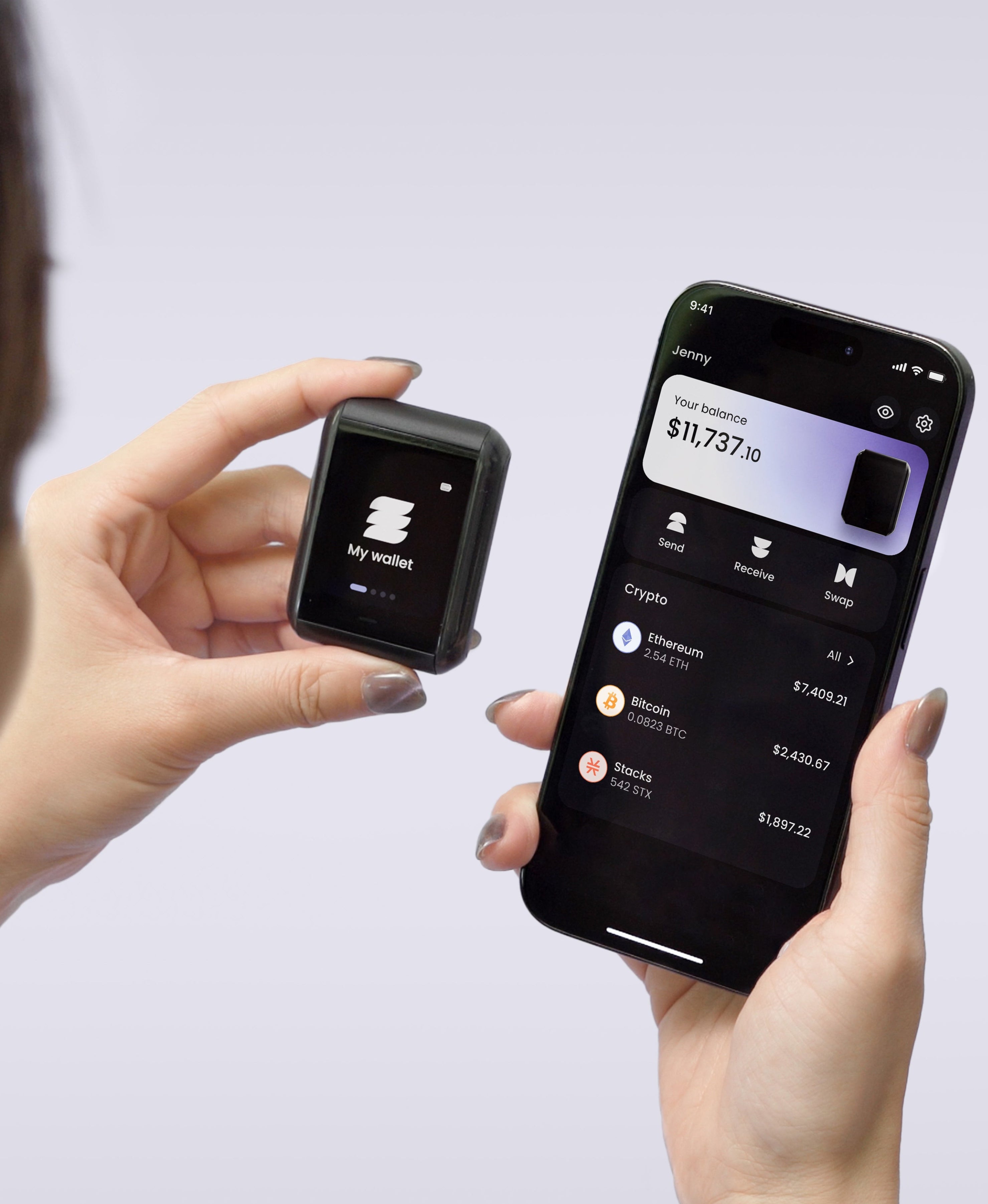
Ryder One is our hardware wallet, and it plugs into MetaMask through WalletConnect so the extension keeps the dApp interface while the device holds the keys and produces every signature. Every Uniswap swap, mint, or bridge transaction gets built in MetaMask, then travels to Ryder One over NFC for review on the 1.6-inch AMOLED touchscreen before you sign. What you see on-screen is what gets broadcast.
Anti-blind-signing is the design principle at the core: every transaction is decoded on-device with the function name, token, spender, and amount. The button wires directly to the EAL6+ Infineon SLC38 secure element, so no signature leaves the chip without a press the hardware can verify came from a human. If a phishing site plants a malicious Permit call inside a plausible-looking approval, the screen shows the attacker's spender address before you ever sign.
Backup uses TapSafe Recovery, our alternative to the 12-word seed phrase model MetaMask, Ledger, and Trezor all inherit. The Recovery Tag holds 50% of your wallet and is IP69K-rated for high-pressure water, dust, and extreme temperatures; your paired phone holds the other 50%, encrypted inside your own iCloud or Google Drive rather than on the phone. Neither piece grants access alone. The BIP-39 seed phrase is available on-device as a last resort, so you are never locked to Ryder hardware. Paper seed phrases are brittle, metal seed plates upgrade the medium but still leave a single object as the point of failure, and TapSafe removes that single point of failure entirely.
Ryder One costs $229 and ships with the Recovery Tag, a Qi wireless charger, and a travel pouch. Firmware and secure-element design have been audited by Halborn.
Bottom line
MetaMask did the work of onboarding a generation of Ethereum users, and any honest picture of self-custody has to credit it for that. What the extension cannot escape is that a wallet inside a browser inherits the browser's attack surface, and above a certain balance that surface matters more than convenience does. The upgrade path is plugging a hardware wallet into MetaMask so the keys stop sitting inside a browser tab.
If you hold enough crypto in MetaMask that a bad signature would ruin your week, move the keys onto a device the browser cannot touch. Ryder One is built for that.
SEO
- Target keyword: metamask
- SEO title: MetaMask in 2026: What the Biggest Hot Wallet Gets Right (and Wrong) (66 chars)
- Meta description: MetaMask has 30M+ users and the biggest attack surface in crypto. Here's what it gets right, where it falls short, and how to pair with hardware. (147 chars)
- Hero alt text: MetaMask hot wallet 2026 — Ryder self-custody hardware wallet


Share: