


# Kraken IPO 2026: What an Exchange Going Public Means for Your Coins
In November 2025, Kraken's parent company Payward confidentially filed a draft S-1 with the SEC after an $800 million funding round put its valuation at roughly $20 billion. Five months later, at the Semafor World Economy Summit on April 14, 2026, co-CEO Arjun Sethi confirmed the filing publicly while acknowledging that a weak crypto market had pushed the listing back. By mid-2026, Bloomberg reported the debut could slip into 2027, and CoinDesk noted the pre-IPO valuation had settled closer to $13 billion.
In this piece we'll walk through what the Kraken IPO is, why exchanges go public, what a public listing does and doesn't change about the risks of leaving your coins on the platform, and where the "not your keys, not your coins" line still holds five years after Coinbase became a public company.
What the Kraken IPO is
Kraken is one of the older U.S. crypto exchanges, founded in 2011 by Jesse Powell and now run by co-CEOs Arjun Sethi and David Ripley. Payward, the parent entity, has been signalling a public listing since 2021 and stopped over the SEC's earlier enforcement posture. The 2025 confidential S-1 is the first formal step toward a Nasdaq or NYSE listing. A confidential filing lets the company begin the review process with regulators without publishing share counts, pricing, or full financials until closer to the roadshow.
Two market-making giants, Jane Street and Citadel Securities, anchored the $800 million round alongside a Deutsche Börse investment tranche that came in later. The presence of those names on the cap table is part of the story: the same firms that price public stocks are now inside a crypto exchange preparing to become one.
Why exchanges want to be public
Going public buys three things at once. It gives the company access to deeper pools of capital than private venture rounds can supply. It hands early employees and investors a way to sell shares (the same reason most tech IPOs happen). And it signals a form of regulatory legitimacy to institutional clients whose mandates forbid trading against a private, unaudited counterparty.
That third point matters most for crypto. Public companies file audited financials with the SEC every quarter. They report material risks. They face securities-law liability if executives mislead shareholders. For pension funds and asset managers whose compliance teams block business with private crypto firms, a Nasdaq ticker changes the conversation. Coinbase went public via direct listing on April 14, 2021 under ticker COIN, and roughly half the institutional crypto flow in the U.S. shifted onto its rails within eighteen months.
There's a fourth reason worth naming, one exchanges rarely say out loud. A public listing marks a formal exit from what critics of the industry call "shadow finance" and puts a public-market floor under the company's reputation. After FTX collapsed in November 2022 with roughly $8 billion in customer funds unaccounted for, every U.S. exchange has been under pressure to demonstrate it isn't the next one. A public filing is the loudest version of that demonstration.
What an IPO changes for customers
The most important thing to understand about the Kraken IPO is that it changes the company while leaving the custody model untouched. Kraken customers who leave coins on the exchange still hold an IOU rather than the coins themselves. Kraken holds the private keys. Every deposit sits inside pooled wallets under Kraken's control, and every withdrawal has to be approved by the platform before it clears.
Public-company status raises the bar on financial disclosure. Kraken will publish quarterly earnings, report on total customer assets, and file 8-Ks when material events happen. Auditors will sign off on reserve balances. The SEC can subpoena internal communications. All of that raises the cost of misbehavior, and that's a real gain for customers versus the private-exchange era.
What the IPO doesn't do is put your coins in your name. If Kraken is hacked, if a regulator freezes accounts during a solvency probe, if a court orders assets held pending litigation, the customer sits behind the exchange's balance sheet as an unsecured creditor. That was the lesson of FTX, and no listing document rewrites it.
The FTX comparison the IPO doesn't fix
FTX had a Super Bowl ad, a Miami arena naming deal, and a CEO on Capitol Hill photo-ops. It had auditors (Prager Metis for FTX US, Armanino for FTX International) and a compliance department. What it didn't have was a public listing subjecting its books to quarterly SEC review, and that's the strongest version of the "an IPO would have caught this" argument.
The weaker version of the argument is where it gets uncomfortable. Being a regulated, public U.S. company didn't stop Wirecard, Enron, or Lehman. Regulated public banks failed as recently as March 2023 when Silicon Valley Bank collapsed with $209 billion in assets. Public-company disclosure lowers the odds of a hidden $8 billion hole; it doesn't drive them to zero. And even in a world where Kraken files pristine quarterly reports for the next decade, a hack, a regulatory freeze, or a bank-run withdrawal spike can still leave customer balances stranded for months.
The FTX bankruptcy proceeding is instructive. Customers began recovering money in 2024, more than two years after the collapse, and only because bitcoin's price rise expanded the estate value. If the same event happened at a public exchange, disclosures would land faster, but the customer would still be waiting behind bondholders and preferred equity for a payout in stablecoins on the far side of a courtroom.
What Coinbase five years public tells us
Coinbase has been trading as COIN for five years now. In that window: one SEC enforcement action, one settled shareholder suit, several waves of layoffs, quarterly earnings that swing wildly with bitcoin's price, and a stock that has traded from $342 down to $32 and back above $300. Public-market discipline has meant more disclosure, better audits, and a much clearer picture of the underlying business than any private crypto exchange offers.
Coinbase customers still don't hold their own private keys on the primary exchange product. Coinbase Wallet, a separate app, is self-custodial, and the company has been clear about the distinction in its own filings. The exchange business, the one that makes money, is a custodial platform. That hasn't changed since April 2021, and no filing has proposed to change it.
Kraken will look the same on the other side of its listing. The company will run a custodial trading business, an institutional prime-brokerage arm, a payments product, and a self-custody wallet product on the side. The share price will rise and fall with trading volumes. Customer coins on the platform will sit inside Kraken's pooled wallets, exactly as they do today.
Where Ryder One fits
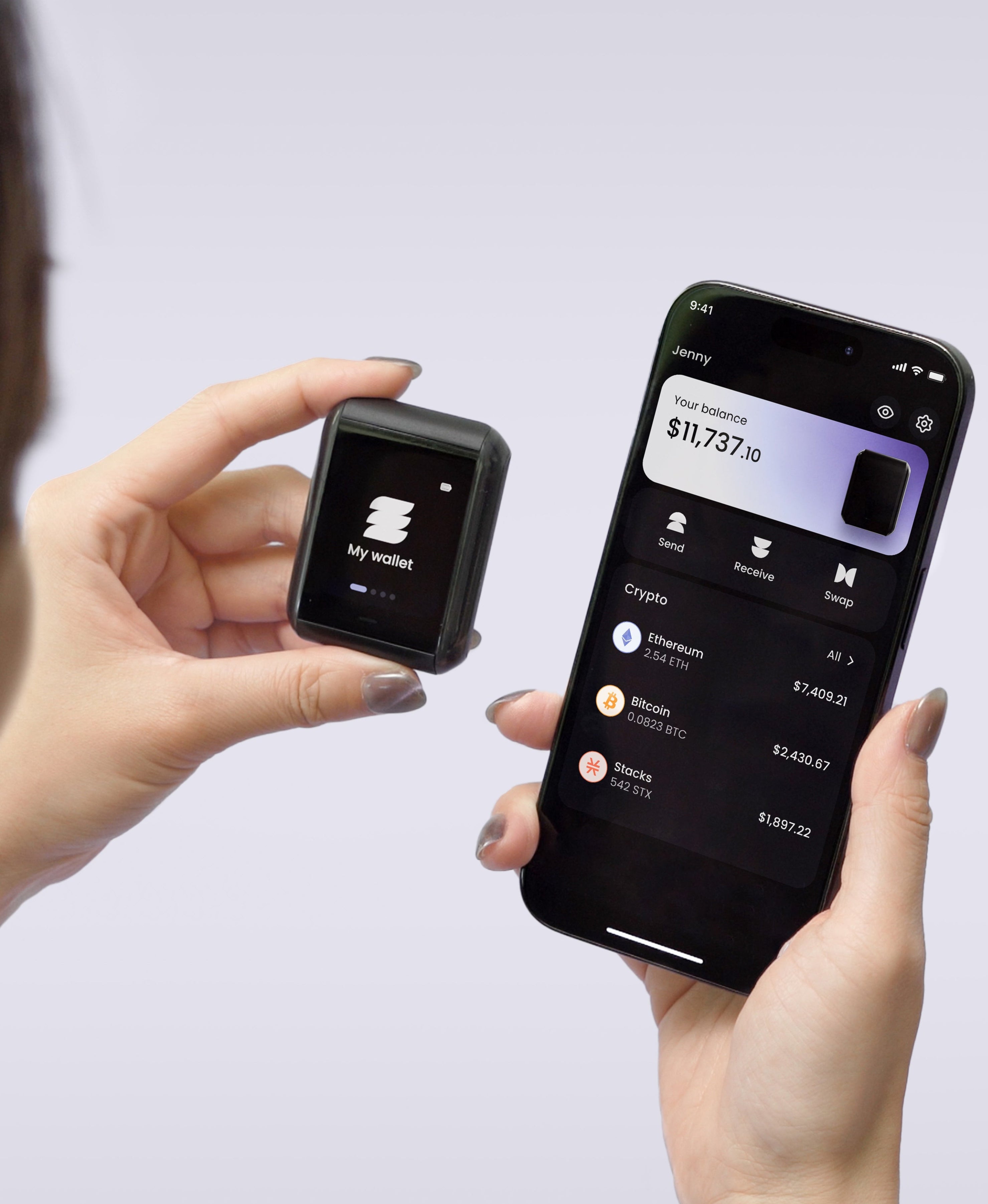
If you want your coins to be yours regardless of which exchange goes public next, the answer is a wallet where you hold the keys. Ryder One keeps your private keys offline on an EAL6+ Infineon SLC38 secure element, so the keys are generated inside the chip and never leave it. Every transaction is verified on the 1.6-inch AMOLED touchscreen before you sign. NFC-only communication means no USB port, no Bluetooth radio, and no wireless data path a remote attacker could use while you're moving funds off an exchange.
TapSafe Recovery handles the backup problem the way exchanges handle liquidity: layered, so no single point of failure sinks you. The Recovery Tag holds 50% of the recovery secret. Your paired phone holds the other 50%, encrypted in iCloud or Google Drive (not on the phone itself), so losing the phone doesn't lose the backup. You can optionally hand 25% to each of up to four Recovery Contacts, who can't see anything about your wallet and only matter if you've lost both the device and the tag. The BIP-39 seed phrase stays accessible on-device as a last resort, so you're never locked to Ryder hardware. The wallet ships at $229 with the Recovery Tag, Qi wireless charging pad, and travel pouch in the box.
If your read on the Kraken IPO is that public listings improve custodial exchanges but don't fix custodial exchanges, then the natural companion move is a hardware wallet for the balances you don't need to trade this week. Sit on Kraken for the flow you're moving; hold your own keys for the rest.
The bottom line
The Kraken IPO is a milestone for the exchange business and a step forward for the transparency of one large U.S. crypto company. It gives regulators, institutional investors, and customers a better view of the platform's books, and it puts Kraken alongside Coinbase as a Nasdaq or NYSE listed crypto operator whose financials can be read the same way you'd read any other public company's. What it doesn't do is convert an exchange balance into self-custody, and no future filing will. If FTX taught crypto anything, it's that the layer between your funds and their disappearance is the custody model, and the custody model at every trading exchange (public, private, U.S., offshore) is the same.
The move worth making around any exchange IPO is unglamorous. Keep on the platform what you're trading; move the rest to a wallet you control. That way the answer to "what happens to my coins if the exchange has a bad quarter" isn't a courtroom question.
Hold your own keys. Trade what you like. Ryder One keeps your bitcoin, ether, and stablecoins offline on an EAL6+ secure element, with TapSafe Recovery as the backup.
SEO
- Target keyword: kraken ipo
- SEO title: Kraken IPO 2026: What Going Public Means for Your Coins (55 chars)
- Meta description: Kraken's 2026 IPO is a big step for the exchange, but it doesn't change custody. Here's what a public listing means for your coins. (131 chars)


Share: