

Bitget Wallet comes up often for people who want one app that handles a lot of chains without much setup. It is non-custodial, it supports an enormous list of networks, and it is backed by a large exchange with money to spend on security. Those are points in its favour.
It also carries a history worth knowing about and a structural limit that no amount of engineering removes. We build hardware wallets, so read this with that in mind. We have tried to be accurate about what this wallet does well.
The short answer
Bitget Wallet is a non-custodial wallet, which means your keys are generated and held on your own device rather than by the company. If Bitget the exchange were to freeze withdrawals tomorrow, the assets in Bitget Wallet would still be yours to move, and that separation matters more than most marketing about it suggests.
What it cannot change is where those keys sit. They live in software, on a phone or in a browser, on a device that also runs your email, your messages and whatever you installed last month. Everything below follows from that.
The BitKeep hack, and what it does and does not prove
Bitget Wallet was previously called BitKeep, and in December 2022 BitKeep users lost over 8 million USD. The detail matters here. Halborn's breakdown shows attackers distributed tampered Android APK files through phishing sites, and those modified builds stole private keys from anyone who installed them. Copies downloaded from the Google Play Store were not affected.
BitKeep reimbursed the people who lost funds, confirming 11,090 compensated wallets by the end of March 2023. Bitget then acquired the company in March 2023, rebranded it, and brought in new management and security processes alongside a 30 million USD raise.
So the incident was not a break in the wallet's cryptography, and holding it up as proof the wallet is badly made would be unfair. What it does illustrate is the attack surface a software wallet lives on: the security of your keys depended on where you downloaded an app from, and thousands of people got that decision wrong in a way that cost them everything in the wallet.
What the audits cover
Bitget Wallet points to work by CertiK, SlowMist and Netcraft, and those are respected names doing legitimate work. An audit examines the code the company wrote and looks for flaws in it. That is worth having and you should prefer an audited wallet to an unaudited one.
An audit says nothing about the phone the audited code runs on. If your device has malware with the right permissions, or you install a build from the wrong place, or a poisoned library ends up in something else you run, the wallet's own code can be flawless while your keys walk out the door. This is the gap between securing an application and securing a key, and it is the gap hardware exists to close.
MPC, and the recovery question
Bitget Wallet offers an MPC option where the key is split into shares instead of sitting behind one recovery phrase, so you can restore access without ever writing down a mnemonic. The thinking is sound, and splitting a key across places is close to how we approach the same problem.
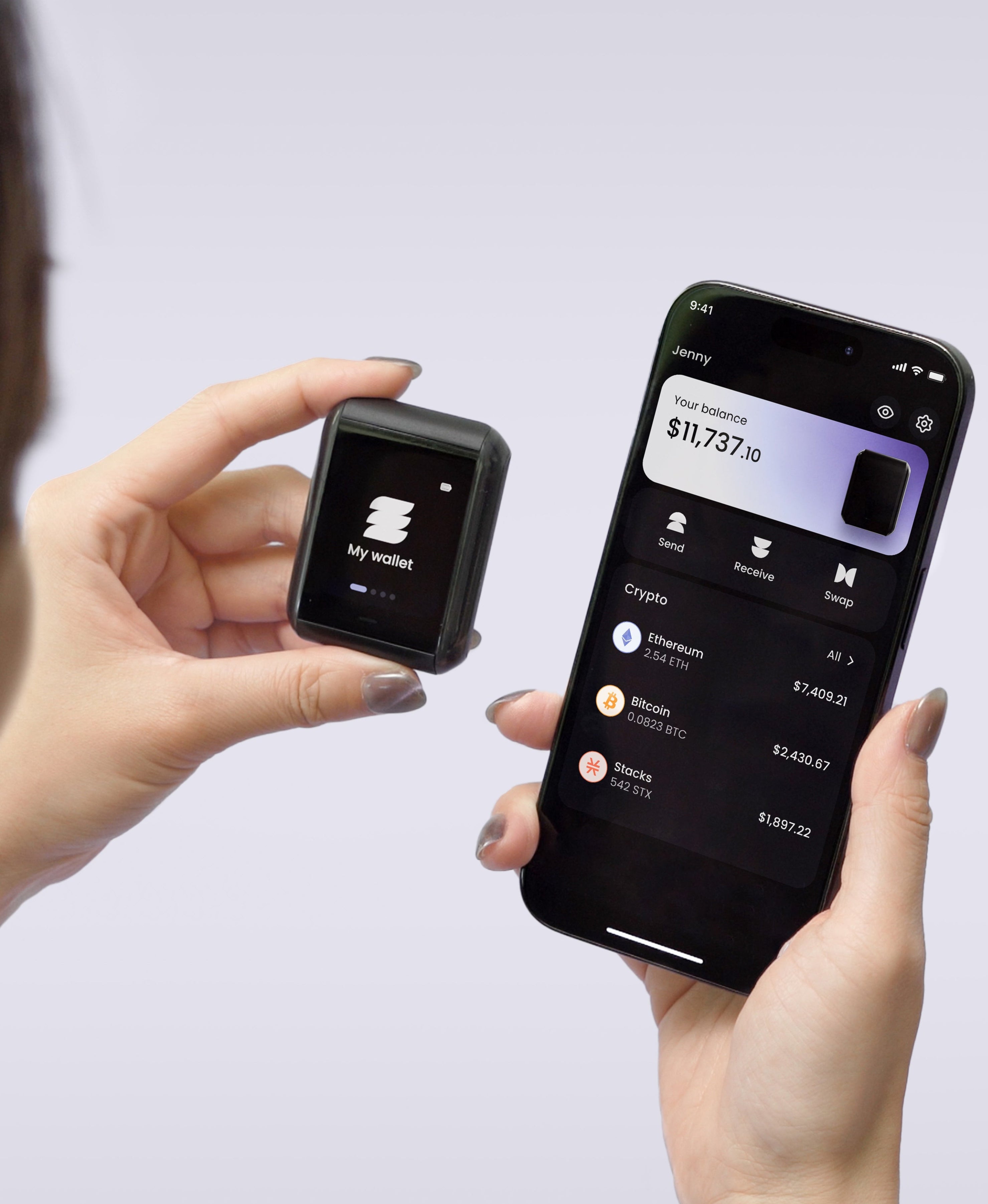
Our version differs in where the shares live and what they are protecting. With TapSafe Recovery on Ryder One, the key itself never exists in software at all: it is generated inside the secure element, and what gets split is the ability to restore it. A Recovery Tag carries 50%, your paired phone carries 50% stored encrypted in your iCloud or Google Drive rather than on the handset, and optional Recovery Contacts hold 25% each while seeing nothing about your wallet. It runs on a custom implementation of Shamir's Secret Sharing, and the BIP-39 seed phrase stays on the device as a last resort, so you can always leave for other hardware. An MPC scheme that keeps every share on internet-connected devices has split the key without moving it out of software's reach.
The protection fund
Bitget publicises a 300 million USD protection fund, held on-chain and traceable, that sits behind its products. Funds like this have paid out before, including the BitKeep reimbursements, and the willingness to cover users is a point in the company's favour.
Treat it as goodwill rather than insurance. A protection fund pays when a company decides a given loss qualifies and the company is still solvent and operating when you make the claim. It is not a policy you can enforce, and the cases it covers are defined by the people writing the cheque. Useful to have, unwise to plan around.
The limit no feature removes
Every improvement above is real work, and none of it changes the fact that a software wallet keeps your key in memory on a general-purpose computer whenever you use it. Code running with your permissions on that machine can reach what you can reach. That is why the 2022 losses happened through an app download rather than through any weakness in the cryptography, and why hot wallets keep losing money in ways that have nothing to do with how well they were built.
On Ryder One, private keys are generated inside an EAL6+ certified Infineon SLC38 secure element and never leave the chip. Communication is NFC-only, with no USB data transfer, no Bluetooth and no WiFi. Every transaction appears in full on the 1.6-inch AMOLED touchscreen, receive addresses can be verified on the device to defeat address substitution, and the confirmation button is wired directly to the secure element so nothing signs without a press. The firmware is audited by Halborn with the report published in full.
So where does it fit
Bitget Wallet is a reasonable choice for what a hot wallet is for: interacting with a lot of chains, trying things, moving smaller amounts around without friction. Judged against other software wallets it is better resourced than most, and the company has paid people back when it went wrong, which is more than several competitors managed.
Judged as somewhere to keep savings, it has the same ceiling as every other app of its kind. Use it for the amount you would be irritated to lose, download it only from the official store listing, and keep the balance you would be sick about somewhere your phone cannot give away. That is not a knock on Bitget specifically, since it applies to every wallet whose keys live in software. The Ryder app is a companion to the device and never holds your keys itself, which is the whole reason the hardware exists.
Ready to move the part you cannot afford to lose? Get your Ryder One for 149 USD.
Meta description: Is Bitget Wallet safe? Non-custodial, audited, and backed by a 300M USD fund. What the BitKeep hack showed, what audits miss, and where the keys still live.
Target keyword: is bitget wallet safe


Share: