


If you swap Bitcoin on Coinbase in 2026, a broker statement lands in your mailbox next February. If you swap Bitcoin on Uniswap through a MetaMask session that same afternoon, no statement lands anywhere. The IRS still wants both gains on your return. Form 1099-DA took effect for 2025 broker activity under the IRS final regulations, and Congress rescinded the parallel DeFi broker rule when President Trump signed H.J.Res.25 in April 2025, as CoinDesk covered when the resolution passed. US crypto holders now live in a split reporting world where the paperwork depends on where you traded.
In this piece, we walk through what Form 1099-DA is, what brokers must report and when, why the DeFi broker rule was rescinded, how per-wallet FIFO shapes your lot math, how to keep records for self-custody trades, and where Ryder One fits.
What Form 1099-DA is
Form 1099-DA is the Digital Asset Proceeds From Broker Transactions statement that crypto brokers now send both to the IRS and to the taxpayer. It is the digital-asset counterpart to the 1099-B that equity brokers have issued for decades, and it exists because Section 80603 of the 2021 Infrastructure Investment and Jobs Act extended broker reporting to digital assets. The IRS finalized the rules in mid-2024 and set the first reporting year at 2025, with statements delivered to holders and to the IRS by Feb. 17, 2026 for that year's activity.
The form itself carries the fields you would expect from a broker statement. Gross proceeds, dates of sale, quantity, and a line for wash-sale disallowed (currently unused for crypto since the wash sale rule under IRC Section 1091 still applies only to securities). What it does not fully carry, at least this year, is cost basis. The IRS phased in basis reporting so brokers report cost basis for "covered" assets purchased on or after Jan. 1, 2026 and held on-platform. That means your first 1099-DA in early 2026 lists what you sold without the price you paid, unless you happened to buy and sell inside a single platform in ways the phased-in rules already reach.
What brokers must report now
The current reporting boundary is drawn around custodial platforms that handle both sides of a customer's trade. Coinbase, Kraken, Gemini, PayPal Crypto, Robinhood Crypto, and other US-facing custodial exchanges are on the list. Payment processors that facilitate digital-asset purchases, hosted wallet providers where a company holds the keys, and platforms that effect trades on a customer's behalf all fall inside the scope. Coinbase's own guidance confirms it began issuing 1099-DAs for 2025 activity, with other US custodial exchanges following suit.
For the 2025 tax year, the form covers gross proceeds, which is the sale price minus fees paid to the broker. Cost basis is added in the 2026 tax year for covered assets, which the IRS defines narrowly as digital assets acquired on-platform after Jan. 1, 2026 and held there through disposal. If you deposited BTC to Coinbase from an external address in 2024 and sold it in 2026, Coinbase will report the proceeds but may not have your basis, so the responsibility to reconstruct that basis on Form 8949 stays with you.
Why the DeFi broker rule got rescinded
The Biden Treasury issued a final rule in December 2024 that would have extended 1099-DA reporting to certain DeFi front-ends, including trading interfaces sitting on top of AMMs and aggregators. Congress used the Congressional Review Act to overturn that rule in early 2025. The House passed H.J.Res.25 on March 11 by a 292-132 vote, the Senate followed on March 26, and President Trump signed the resolution into law on April 10, 2025. It was the first crypto-specific bill ever signed by a US president.
The effect for holders is direct. DeFi protocols and non-custodial front-ends do not send 1099-DAs. Peer-to-peer trades, DEX swaps executed from a self-custody wallet, and on-chain protocol interactions sit outside broker reporting, and under the CRA a future administration cannot reintroduce the same rule without fresh legislation. That does not exempt the underlying activity from tax. The IRS still treats every crypto disposal as a taxable event under Notice 2014-21; what changed is only which party is reporting to whom.
Per-wallet FIFO, a quick recap
The other piece of the current landscape is Revenue Procedure 2024-28, which went live on Jan. 1, 2025. Cost basis is now tracked per wallet or per account rather than in one universal pool. Every wallet is its own ledger, and when you sell from a specific wallet the basis comes from lots held in that wallet. FIFO is the default, and specific identification is allowed only when the identification happens at or before the moment of sale. The safe harbor for reallocating pre-2025 basis across wallets closed on the earlier of your first 2025 disposal or the 2025 return due date, so anyone already filed has that decision locked in.
For a self-custody holder, the practical read is that a 1099-DA from Coinbase now covers only the lots that lived on Coinbase. Trades executed from MetaMask, Rabby, or a hardware wallet through a DEX are entirely off the 1099-DA grid, and the wallet's own transaction history is the only record the IRS will have if it asks. Portfolio trackers help, but they help by ingesting the same on-chain history you would rebuild by hand.
Self-custody record-keeping playbook
Bring your own records is the operating principle for anyone trading outside custodial platforms in 2026. A workable ledger has four columns per lot: acquisition date, quantity, USD price at receipt, and the transaction hash. When you dispose of a lot, add the disposal date, the effective USD proceeds after any DEX fee or slippage, and the transaction hash of the outbound trade. Portfolio tools like Koinly, CoinTracker, and CoinLedger can ingest addresses directly, though internal transfers between your own wallets have to be tagged so they are not counted as taxable events. Kiplinger's year-end tax planning guide covers the calendar side for investors coming from a traditional brokerage frame.
The bifurcated world also changes reconciliation. If you deposit ETH from a self-custody wallet into Coinbase and sell it, Coinbase reports the proceeds on the 1099-DA, but your basis lives in the wallet's ledger. Your Form 8949 has to pull that basis forward or the IRS reads gross proceeds as gross gain. The same goes in reverse: withdrawing from an exchange to a self-custody wallet resets the reporting party but leaves the basis untouched, and forgetting to log the outbound transaction hash is where holders lose track by March.
Where Ryder One fits
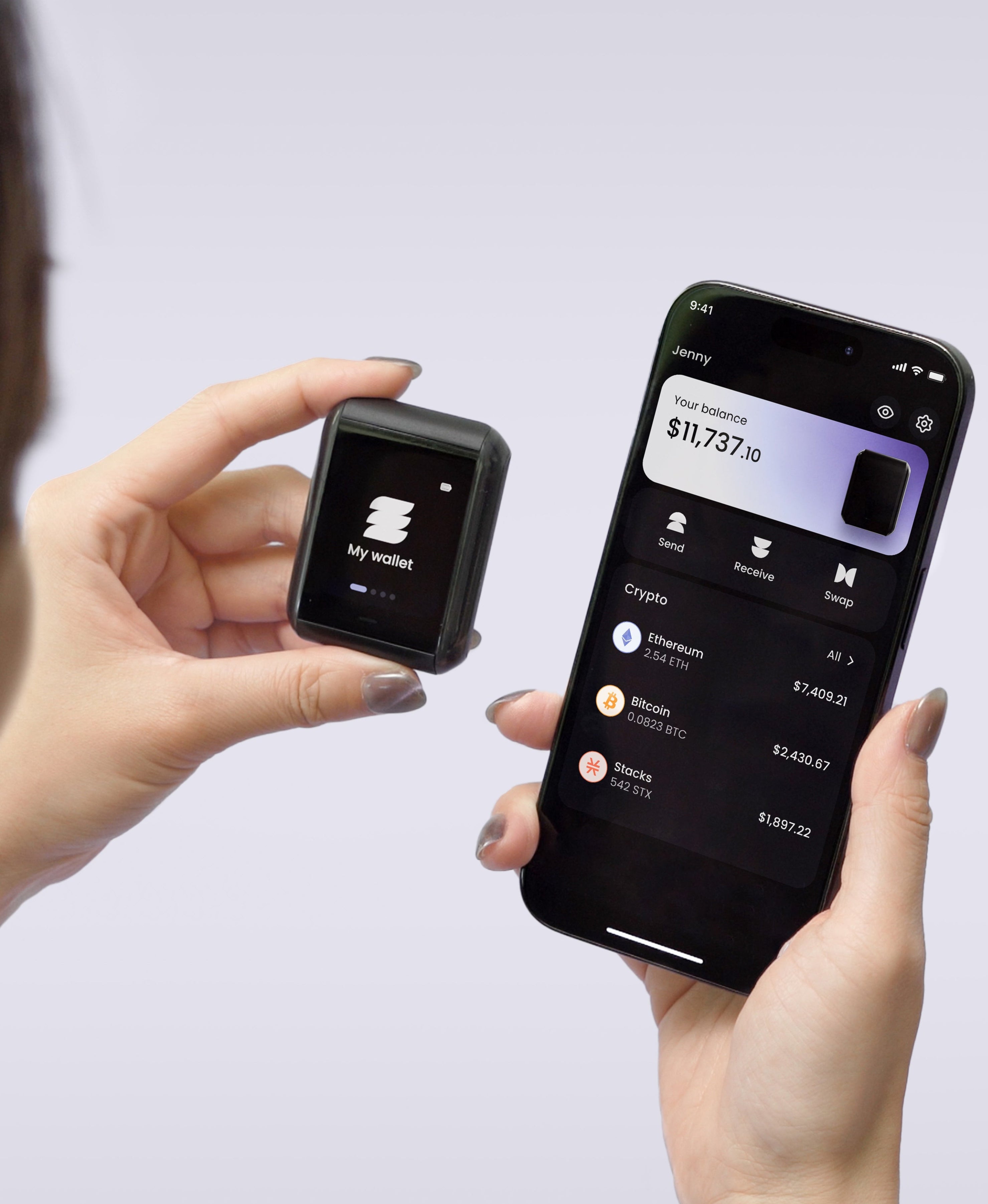
Ryder One keeps your private keys inside an EAL6+ Infineon SLC38 secure element and verifies every transaction on a 1.6-inch AMOLED touchscreen with a button wired directly to the chip. NFC-only communication means there is no USB path or Bluetooth radio between your keys and the outside world. For a holder navigating the split reporting world, the device sits at the point where ledger discipline pays off. The destination address and amount render in full on the screen before you sign, so the transaction hash you write into your ledger corresponds to a transfer you saw and approved on the device.
TapSafe Recovery is the backup layer we built so a lost device does not put your entire history behind a paper seed phrase written five years ago. The Recovery Tag holds 50% of the recovery share, your paired phone holds the other 50% encrypted in iCloud or Google Drive rather than on the phone itself, and up to four optional Recovery Contacts can each hold 25%. Your BIP-39 seed phrase stays accessible on-device as a last resort, so the wallet never locks you to Ryder hardware. Ryder One ships at $229 with a Recovery Tag, Qi wireless charger, and travel pouch.
For a self-custody holder, the wallet itself doesn't file your return, and no hardware wallet does. What it does is give you a signing surface you can read and a backup posture that survives the physical failure modes that break paper-based records. The tax paperwork still runs through your CPA and your accounting software, and the wallet is the anchor those records point to.
Bottom line and CPA disclaimer
Form 1099-DA is now in circulation for 2025 broker activity, and cost-basis reporting begins for 2026 trades held inside custodial platforms. DeFi front-ends and self-custody wallets stay outside broker reporting after Congress rescinded the DeFi rule in April 2025. Per-wallet FIFO is the accounting frame across both worlds. The IRS treats a DEX swap and an exchange sell as the same taxable event; only one arrives at your address as paperwork.
This article is informational and is not tax advice. Consult a CPA before executing trades for tax purposes. Federal and state rules can shift on short notice, and a professional who has seen your full return will catch things a general guide will miss.
Hold your keys, and hold your records. Ryder One keeps Bitcoin, ETH, and SPL tokens on an EAL6+ secure element, with TapSafe Recovery as your backup and every transaction verified on the device before you sign.
SEO
- Target keyword: irs crypto tax
- SEO title: IRS 1099-DA 2026: What Crypto Holders Owe This Year (51 chars)
- Meta description: Form 1099-DA is here for 2025 exchange trades; DeFi rule rescinded. Self-custody holders still owe: per-wallet FIFO, DEX swaps, and how to record them. (152 chars)



Share: