


# Internet Computer (ICP) Explained: Web-Speed Blockchain
For anyone tracking the layer-1 conversation over the past five years, ICP is one of the weirdest and most ambitious L1 designs still shipping. Where most L1s treat the chain as a settlement layer and leave the frontend to AWS, DFINITY set out to build a chain that serves the whole application stack: compute, storage, and HTTP delivery. The years since have gone into multi-chain signing, native Bitcoin support, and a governance system that holds the keys to protocol upgrades directly.
In this piece we walk through what Internet Computer is, how Chain Key cryptography lets ICP sign for other chains, how canisters and the reverse gas model change the developer experience, and where a hardware wallet like Ryder One fits.
What ICP and Internet Computer are
Internet Computer is a proof-of-stake layer-1 network run by DFINITY Foundation, a nonprofit research team founded in 2016 by Dominic Williams. The mainnet launched on May 10, 2021, and the network's design departs from most L1s in one big way: it treats the chain as a distributed cloud that runs full applications, not just financial contracts. The unit of compute is a canister, a WebAssembly module that can hold state, respond to messages, and even serve HTTP requests back to a browser without going through a traditional web host.
The chain is organized into subnets, each a separate blockchain running its own consensus while hosting a slice of the network's canisters. Subnets talk to each other through a threshold-signature scheme that makes cross-subnet messages verifiable without any bridging contract. Validators are called node providers, and the current node map shows several hundred machines across dozens of data centers on multiple continents. The ICP token pays for governance and staking, and it eventually gets burned into cycles that fund canister execution.
Chain Key cryptography and native multi-chain signing
The piece that sets ICP apart from other L1s is Chain Key cryptography. Every subnet holds a single threshold signature key that only exists in fragments across the nodes in that subnet, and no single node ever sees the whole key. When a subnet wants to sign a message, the nodes run a distributed protocol that produces a valid signature without ever assembling the key in one place. That primitive is what lets ICP verify itself with a single public key that anyone can hard-code, and it is what makes native cross-chain signing possible.
DFINITY extended the scheme so that a subnet can produce signatures for other blockchains directly. Chain Key Bitcoin shipped in 2022 and lets ICP canisters hold and spend Bitcoin natively, with the signing key fragmented across subnet nodes and no bridge or wrapped-asset custodian in the middle. In 2023 the same scheme extended to Ethereum through threshold ECDSA, and native Solana integration through chain-key EdDSA followed as the next milestone under the Chain Fusion umbrella. A canister can now sit on ICP, receive user instructions, and issue a real Bitcoin, Ethereum, or Solana transaction under a threshold-signed key without a bridge contract standing in the middle.
Canisters and the reverse gas model
Canister smart contracts are WebAssembly modules that ICP nodes execute on-chain, and they carry two properties most L1 contracts do not. First, they can serve HTTP directly to a browser, which means a full application (frontend, backend, database) can live entirely inside a canister and be reached at a URL without any AWS or CDN in the path. Second, canisters pay their own gas via a resource called cycles, and cycles come from ICP tokens that a developer or a canister owner has already converted and locked into the canister's balance.
Under the reverse gas model, the user does not need a wallet or a token to interact with an application built on ICP. They open a page, click a button, and the canister on the other end pays for the computation out of its cycle balance. For consumer applications, that removes a big onboarding friction the rest of Web3 has been fighting for a decade. It also means developers have to watch their canister's cycle balance the way a Web2 team watches a cloud bill, because a canister that runs out of cycles gets frozen and eventually deleted.
Canisters can be written in Rust, Motoko (a language DFINITY built for the platform), or any language that compiles to WASM, and the Internet Computer developer documentation covers the full stack from local testing to mainnet deployment.
The NNS and ICP tokenomics
Governance runs through the Network Nervous System, an on-chain body that anyone with staked ICP can vote inside. Users lock their ICP into a construct called a neuron for a chosen dissolve period between six months and eight years, and each neuron carries voting weight proportional to its stake and its lock length. Every protocol upgrade, every new subnet configuration, and every node provider payment schedule goes through an NNS vote, and the outcome executes automatically without a human developer pushing code afterward.
Voting neurons earn ICP rewards for participating, and node providers earn ICP for the hardware and bandwidth they contribute to the network. Both flows come from token issuance that expands supply over time, and cycles used by canisters get burned in the other direction. Because neurons can follow other neurons for voting delegation, most day-to-day proposal traffic gets routed through named neurons run by ecosystem teams, and the concentration effects of that delegation have been an ongoing thread inside the DFINITY forum for years. The NNS front end lets any holder browse the full proposal history.
The self-custody read on holding ICP
Here is the piece that matters if you are holding ICP or planning to. An ICP account is different from an EVM address in shape and in cryptography. Identities on the network are derived from principal IDs, and those principals come from public keys generated under either secp256k1 or ed25519 depending on how the account was created. Ledger-style accounts on the ICP ledger canister use one derivation scheme, while accounts created against Internet Identity use another, and the two do not interchange addresses.
BIP-39 seed phrases can produce keys for ICP through wallets that follow the chain's derivation path in the ICP interface spec, and the same seed will regenerate the same principal on any wallet that follows those rules. What you cannot do is take an Ethereum seed, load it into an ICP wallet at the same path, and expect to see your ETH or your ICP show up under one identity.
The custody threat model looks the same as any other holding. Keys inside a browser extension are exposed to phishing, extension malware, and clipboard swaps; keys on an exchange face that exchange's operational risk. Moving the signing key onto a device with a secure element cuts most of that surface off, because the private key sits inside a chip that will never release it to the host computer.
Where Ryder One fits
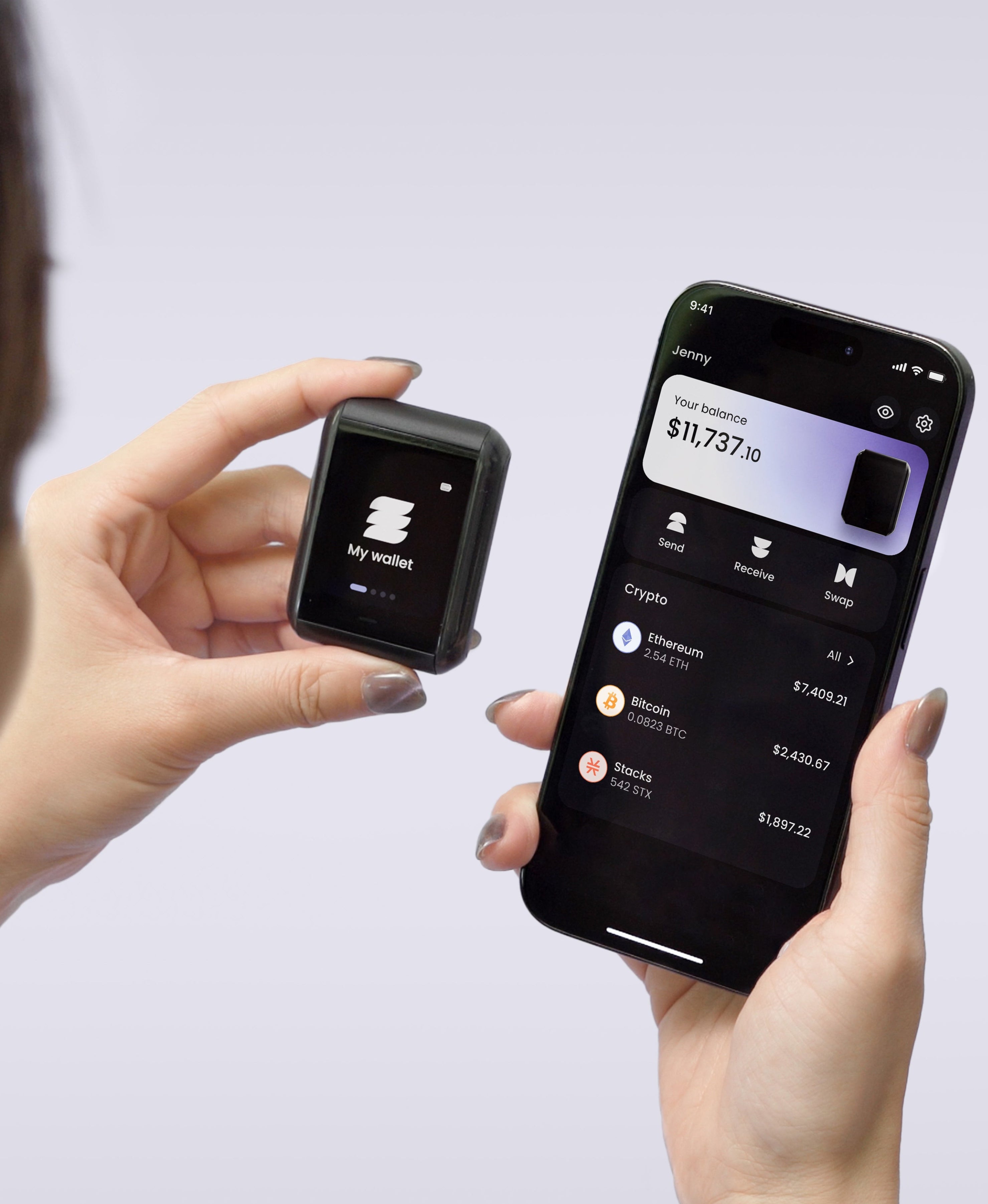
Ryder One is a compact hardware wallet built around an EAL6+ Infineon SLC38 secure element, a 1.6-inch AMOLED touchscreen, and NFC-only communication. It has no USB port, no Bluetooth radio, and no Wi-Fi. The device signs Bitcoin, Ethereum, Solana, and a growing list of top ERC-20 and SPL tokens today, and ICP sits outside that current supported set. If you are picking a hardware wallet for a portfolio that includes ICP, check the current supported-chain list on the Ryder One product page before you order so the device you buy matches the tokens you hold.
The general self-custody frame still applies across chains. Every transaction renders on the device screen in full readable detail before you tap the button to sign, and the button wires directly to the secure element so no software path can move funds without your input. Recovery uses TapSafe rather than a written paper backup: the Recovery Tag holds 50 percent of the wallet share and carries an IP69K rating for high-pressure water, and a phone backup encrypted into your iCloud or Google Drive holds the other 50 percent. Optional Recovery Contacts add 25 percent shares apiece, paired in person over NFC, and none of those contacts can see your balance or your keys. The BIP-39 seed phrase sits on-device as a last resort, so you are never locked to Ryder hardware. Ryder One ships at $229 with the Recovery Tag, a Qi wireless charger, and a pouch in the box.
The recovery model and the on-device confirmation flow hold across chains, and that is the part the hardware is built to do. What waits on firmware is the specific list of chains the device can sign directly.
The bottom line
ICP is one of the more ambitious L1 designs still in the market, with Chain Key cryptography that lets the chain sign for Bitcoin, Ethereum, and Solana without bridges; canisters that turn the chain into a full application runtime; and a governance body that holds the keys to protocol upgrades. The design has trade-offs around subnet centralization and reverse-gas discipline, and both threads have been open topics on the DFINITY forum for years.
For anyone holding ICP, the hardware-wallet decision is the same as for every chain since Bitcoin. Keys on a computer or a phone belong to the machine they sit on, and the machine can be compromised by malware or a SIM swap. A device with a secure element keeps the keys yours and shows every transaction on screen before you sign. Confirm the chain you hold is in the current firmware, then let the hardware do what it was built to do.
SEO
Target keyword: icp crypto
SEO title: Internet Computer (ICP) Explained: Web-Speed Blockchain
Meta description: Internet Computer (ICP crypto) runs full apps on-chain and signs Bitcoin, ETH, and Solana natively. Here is how ICP works and the self-custody read.
Hero alt text: Internet Computer ICP blockchain 2026 — Ryder self-custody hardware wallet


Share: