


Options on BlackRock's iShares Bitcoin Trust ETF (IBIT) began trading on Nasdaq on November 19, 2024, the first US-listed derivatives written directly against a spot bitcoin ETF. Volume on day one was extraordinary: 354,000 contracts changing hands and roughly $1.9 billion of notional exposure, enough to land IBIT options in the top 1% of all options products traded that session. Nasdaq itself confirmed the top-1% finish and the 5th-place ranking by ETF underlier volume. Nearly two years later, IBIT sits at roughly $45 billion in assets, and its options complex has grown into one of the largest venues for expressing a bitcoin view on Wall Street. For anyone holding BTC in a wallet, the interesting question isn't the volume chart. It's what a US-cleared derivatives market built on top of a fund built on top of bitcoin means for the coin itself.
In this piece, we cover what IBIT options are, why the November 2024 launch mattered, how institutions and retail traders use them, what those options do and don't change about custody, and where a hardware wallet fits when the derivative stack keeps growing.
What IBIT options are
An IBIT option is a listed contract, cleared through the Options Clearing Corporation (OCC), that gives its holder the right to buy (call) or sell (put) 100 shares of BlackRock's spot bitcoin ETF at a set strike before a given expiry. The reference asset is IBIT rather than bitcoin itself; the fund holds BTC on behalf of shareholders, and each share represents a fractional claim on the pool. That distinction matters when you trace what a call buyer owns at every layer.
The mechanics look identical to any US-listed equity option. Expiries run weekly, monthly, and quarterly. Contracts are physically settled into IBIT shares on exercise. Market makers hedge their books using IBIT shares, CME bitcoin futures, and offshore spot venues, which is how price signals from the options market feed back into the underlying BTC price. Nasdaq ISE lists the contracts alongside options on other high-volume ETFs; Cboe, NYSE American, MIAX, and BOX picked up cross-listings in the weeks after launch.
Why the November 2024 launch mattered
Before that Tuesday, the only regulated way to express a bitcoin options view inside a US brokerage account was through options on CME bitcoin futures, or options on BITO, ProShares' futures-based ETF. Both routes carried tracking error against spot and both catered to institutional users. IBIT options opened a direct path: a retail account with options-trading approval could type IBIT into a broker screen and see a strike chain the same way an Apple options chain appears.
The SEC approved the listing in September 2024 after months of exchange filings, and the OCC cleared its side of the plumbing in the days before launch. Initial position limits were held at 25,000 contracts per side, an unusually tight cap that Nasdaq ISE flagged as ready for revision as liquidity built. As CoinDesk noted at the time, those limits were the main constraint on how large a book any single desk could run against IBIT.
Position limits climbed through 2025. Nasdaq ISE raised the cap to 250,000 contracts in the spring, and by late 2025 the exchange proposed lifting it further toward 1 million contracts, with the SEC weighing amendments through the first quarter of 2026. Each expansion pulled in a wider set of participants: proprietary trading firms writing volatility, wealth advisors selling covered calls against IBIT positions, and asset managers building yield-oriented ETFs that trade the options directly.
Volume followed. IBIT options open interest surpassed Deribit's bitcoin options book in April 2026, reaching around $27.6 billion against Deribit's $26.9 billion. That handoff is worth reading twice. For most of bitcoin's history, the deepest options market on the asset was Deribit, an offshore, crypto-native venue. Two years into IBIT's derivatives life, more open interest now sits inside a US-regulated, OCC-cleared wrapper.
How institutions and retail traders use them
Options give holders three things that spot shares do not. Directional exposure with less capital: a call option costs a fraction of the underlying and moves more per dollar of BTC price change. Hedging: a long IBIT position paired with a put creates a floor for a defined premium. Yield generation: selling calls against IBIT shares harvests premium in exchange for capping upside.
Institutional flow leans heavily on the second and third uses. Pension funds, endowments, and family offices that added IBIT to portfolios during 2024 and 2025 use puts to bound drawdowns without selling shares (and without triggering a taxable event in most cases). Covered call writing has grown into a product category of its own: BlackRock's own iShares Bitcoin Premium Income ETF (BITA) systematically sells IBIT calls to harvest option premium, and several competitors run similar overlays. Bitcoin's implied volatility, elevated relative to equities, makes the premium worth collecting.
Retail traders lean on the first two uses. A call spread on IBIT can express a directional view with capped downside and a known cost. A protective put on an existing IBIT holding gives the reader inside a tax-advantaged account a hedge that spot shares alone can't produce. The lower notional per contract compared to CME futures options also puts the market in reach of accounts that never opened a futures agreement.
The trade-off across every use is the same at heart. Any position built with IBIT options is a claim on an option that references a fund that holds bitcoin. Three layers of counterparty stack between the position and the coin: the broker, the OCC clearing chain, and BlackRock plus its custodians (Coinbase Custody and Anchorage). None of those layers is loose or careless; each carries a well-known operating record. They are still layers, and the layers are the point.
What options don't change about custody
A derivatives market on top of a spot ETF makes bitcoin easier to price, easier to hedge, and easier to size inside a traditional brokerage account. It doesn't change what a share of IBIT gives its holder. That share is a claim on a fund; the fund holds coins at institutional custodians; those custodians hold the private keys. A reader looking at the brokerage statement holds none of those keys.
An IBIT options position adds a fourth layer above the coin: the option contract sits above the share, the share sits above the fund, the fund sits above the custodian, and the custodian sits above the key. Every one of those layers earns a fee or a spread. None of them can be moved between wallets, sent to a counterparty on-chain, staked, or used in DeFi. On expiry, the exercised contract delivers more IBIT shares, and those shares stay parked at the same custodian.
Contrast that with a self-custody holder. Bitcoin held on a hardware wallet lives at the protocol layer. No fund, no share, no clearing chain, no option contract sits between the reader and the coin. The Ryder self-custody explainer walks through what direct key ownership covers, which is worth reading if this is the first time the term appears in a financial context. The point isn't that IBIT is bad; the point is that the two products serve different needs, and a holder ought to know which layer they are buying at.
Where Ryder One fits
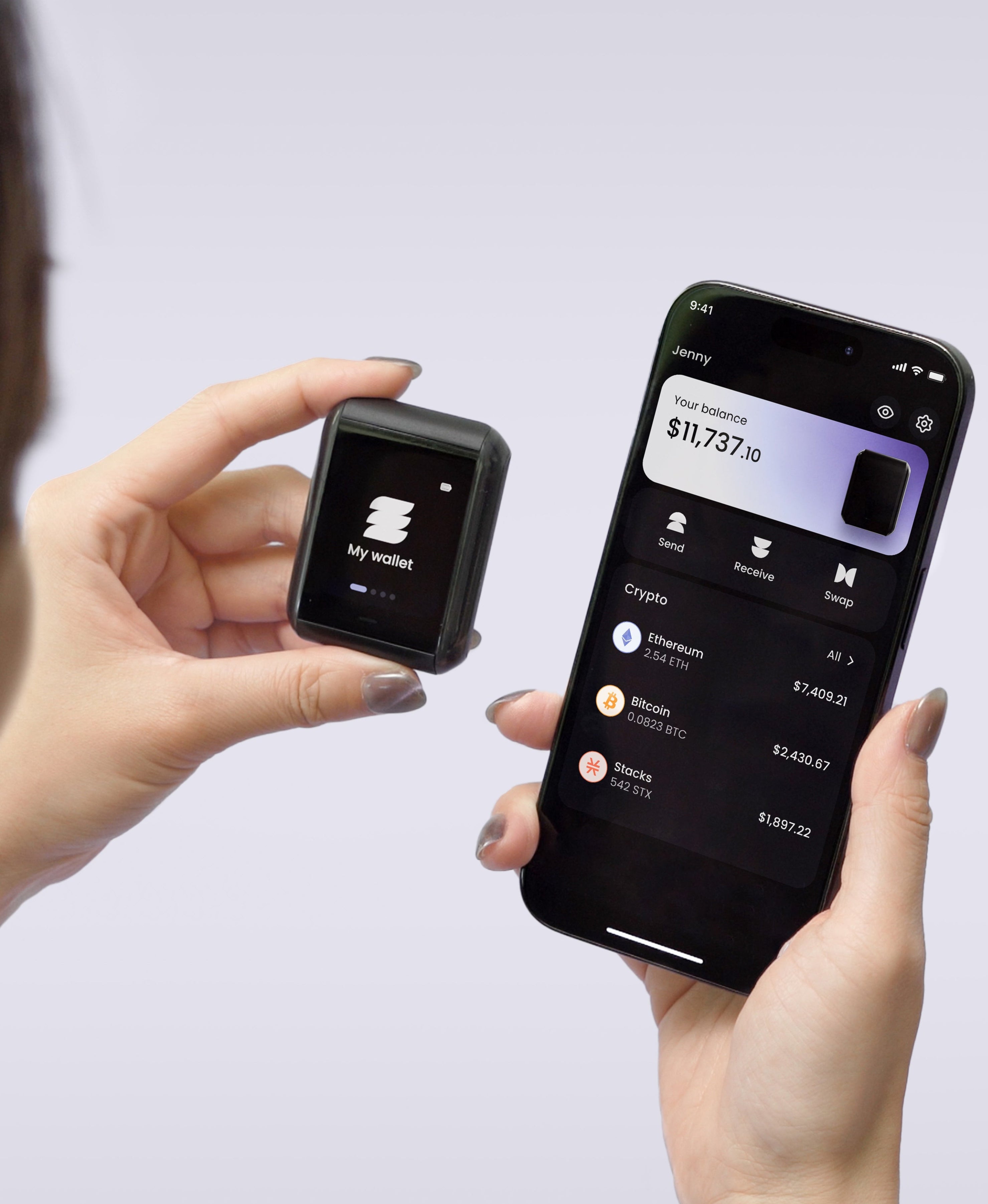
An options chain doesn't move BTC on-chain. A hardware wallet does. Ryder One sits at the protocol layer, where private keys sign transactions that settle on Bitcoin itself. Keys are generated inside an EAL6+ Infineon SLC38 secure element and never leave the chip. Every signature happens after the reader presses a button wired directly to that element, so no software path can approve a transaction without an on-device confirmation.
We built the device around a 1.6-inch AMOLED touchscreen so every transaction shows full readable detail before it's signed. NFC-only communication keeps wireless data paths out of the picture; Qi wireless charging handles the 200 mAh battery without exposing a data port. Ryder One ships at $229 with a Recovery Tag, wireless charger, and travel pouch.
Backup lives inside TapSafe Recovery, our answer to writing a seed phrase on paper and hoping it survives. The Recovery Tag holds 50% of the recovery share; the paired phone holds the other 50% encrypted in iCloud (iOS) or Google Drive (Android) rather than on the phone itself. Up to four Recovery Contacts can each hold a 25% share for redundancy, and the BIP-39 seed phrase remains accessible on-device as a last resort, so the wallet is never locked to Ryder hardware.
If the reader wants IBIT options for hedging, yield, or a directional trade inside a brokerage account, the tools are there and the market has enough depth to use them. If the reader also wants to hold bitcoin outside every counterparty layer, that requires a private key on hardware the reader controls. The two aren't a substitution; they cover different jobs.
The bottom line
IBIT options opened for trading on November 19, 2024, cleared 354,000 contracts on day one, and by April 2026 held more open interest than the largest offshore bitcoin options venue. Position limits climbed from 25,000 contracts at launch toward a million as the SEC signed off on successive amendments. Institutions use the chain for hedging and covered calls; retail traders use it for directional trades and defined-risk positions. Every one of those uses builds on a share that builds on a fund that builds on a custodian that holds the coin. That's how derivatives work; the layering is the price of admission. Bitcoin itself sits underneath all of it, and the way to hold bitcoin at the protocol layer is to hold the key that controls the address it lives on. Whichever wrapper a reader chooses on top, the layer they own is defined by the key.
Own the coin itself. Ryder One keeps your bitcoin private key offline on an EAL6+ secure element, with TapSafe Recovery as the backup layer.
SEO
- Target keyword: ibit options chain
- SEO title: IBIT Options Chain in 2026: What BTC Holders Should Know (56 chars)
- Meta description: IBIT options launched Nov 2024 and now top Deribit in open interest. Here's what they mean for BTC holders and self-custody in 2026. (131 chars)



Share: