


# How to Use a Bitcoin ATM in 2026 (And Why the Fees Will Surprise You)
Bitcoin ATMs have become a fixture at gas stations, grocery stores, and shopping malls across the US. If you've walked past one and wondered what the process looks like, this guide covers how to use a bitcoin atm from start to finish: what to bring, the step-by-step process, what it costs, and a detail most guides skip entirely: where your bitcoin lands after the transaction confirms.
How Many Bitcoin ATMs Are There in 2026?
As of mid-2026, roughly 28,300 bitcoin ATMs are operating worldwide, with the US accounting for about 71.5% of that total. The global count fell 27.7% in the first half of 2026, largely because rising regulatory compliance costs and declining transaction volumes pushed smaller operators out of the market. The machines still running tend to belong to established networks like CoinFlip, Bitcoin Depot, and Coinhub, which have clearer fee disclosures and stronger consumer protections than independent kiosks.
To find your nearest machine, Coin ATM Radar tracks current locations, operators, and fee rates. Filtering by fee percentage before you leave the house can save you a meaningful amount per transaction.
What to Bring Before You Visit
Bitcoin ATMs accept cash only. No debit cards, no credit cards. Bring the bills in the amount you plan to spend, keeping in mind that fees come on top of the bitcoin value you want. At the rates common in 2026, planning for 15% overhead is a sensible starting point.
You'll also want your wallet's receive address ready as a QR code before you arrive. If you're using a wallet app on your phone, open it and navigate to the "Receive" screen in advance. The machine will ask you to scan it, and searching through an unfamiliar app with people waiting behind you is a frustrating way to start.
For purchases above roughly $900, most operators require a government-issued ID, and Bitcoin Depot now requires identification for every transaction regardless of amount following a 2026 policy update that tightened its KYC requirements across all locations. Bringing a driver's license or passport removes that variable entirely and prevents a wasted trip if the machine won't process your transaction without it.
How to Use a Bitcoin ATM: Step by Step
The process follows the same pattern across most major networks:
- Select "Buy Bitcoin" on the home screen. Many machines also support selling bitcoin for cash.
- Enter your phone number. The machine sends a verification code by SMS. Type it in on screen.
- Show your ID if the operator or your purchase amount requires it.
- Scan your wallet's QR code. The machine's camera reads your receive address. This is the destination for your bitcoin.
- Insert cash. Feed bills in one at a time while the screen shows the running bitcoin total.
- Review and confirm. The screen displays your final bitcoin amount after fees are deducted.
- Take the receipt. It contains your transaction ID, which you can use to track the transfer on a block explorer.
Transfers typically confirm within 10 to 30 minutes, though network congestion can stretch that. Once confirmed, the transaction is irreversible, so double-check the wallet address before pressing confirm.
The Real Cost: What Bitcoin ATM Fees Look Like
Most first-time users don't realize how much they're about to pay until the screen confirms the transaction: Bitcoin ATM fees in 2026 range from roughly 10% to 25% depending on the operator and location, which means a $200 cash purchase might yield only $150 to $180 in bitcoin once fees are deducted.
The cost has two layers. The visible fee appears on screen before you confirm. On top of that is the spread: the ATM's bitcoin price is set above the live market rate, so you receive less bitcoin than the spot price would suggest. Coincub's analysis puts the spread at an additional 2% to 5% over the stated fee in many cases. Large networks tend to sit at the cheaper end; independent machines in convenience stores can push past 20%.
For context, most mainstream exchanges charge under 1% for the same conversion. The ATM surcharge is the price of cash-to-crypto conversion without needing a bank account, a verified exchange profile, or a multi-day wait. If speed and cash payment matter, the cost might be worth it. If you're converting a larger amount, checking Coin ATM Radar for the lowest-fee machine near you before you go is worth the extra few minutes.
Several states have introduced bitcoin ATM consumer-protection rules, including mandatory fee disclosure before you insert money, daily limits for new users, and in some cases caps on how much operators can charge. The rules vary by state, so a quick search before your first visit is a good habit.
KYC Requirements: How Much Identification Do You Need?
Federal law classifies bitcoin ATM operators as money services businesses, which means they must comply with Know Your Customer (KYC) and anti-money laundering (AML) requirements. In practice, this breaks down by purchase size:
- Phone number verification is required for nearly every transaction.
- A government-issued ID is typically required above $900, though some operators set the threshold lower. Bitcoin Depot requires ID for all transactions.
- Amounts above $10,000 may require additional verification or exceed machine limits entirely.
Any machine advertising fully anonymous transactions for any amount at any level is either operating outside regulatory requirements or not disclosing its entire process. Unlicensed operators carry more legal exposure for the buyer and have less accountability if something goes wrong.
Where Your Bitcoin Goes After the Transaction
Here is the detail most ATM guides leave out, and it matters more than the fee question. When you scan a QR code at a bitcoin ATM, the machine sends bitcoin to that address. It has no idea whether that address belongs to a hardware wallet, a software wallet, or an exchange.
If you scan a receive address from Coinbase or another exchange, your bitcoin lands in their custody. The exchange holds the private keys. You have a balance on their platform, but you don't hold the bitcoin directly. When FTX collapsed in 2022 with roughly 8 billion dollars in customer funds at stake, the users who lost access were the ones whose bitcoin sat on the exchange. Self-custody, holding your own private keys, is the direct answer to that kind of counterparty risk.
If you scan a receive address from a hardware wallet instead, the bitcoin arrives under your control from the moment the transaction confirms. The ATM becomes a cash-to-self-custody pipeline. You already paid a premium for the ease of cash conversion; keeping custody of what you bought doesn't add any cost.
Deciding where your bitcoin will live before you arrive at the machine makes the whole transaction cleaner and leaves less room for error at the kiosk.
Take Custody of What You Buy
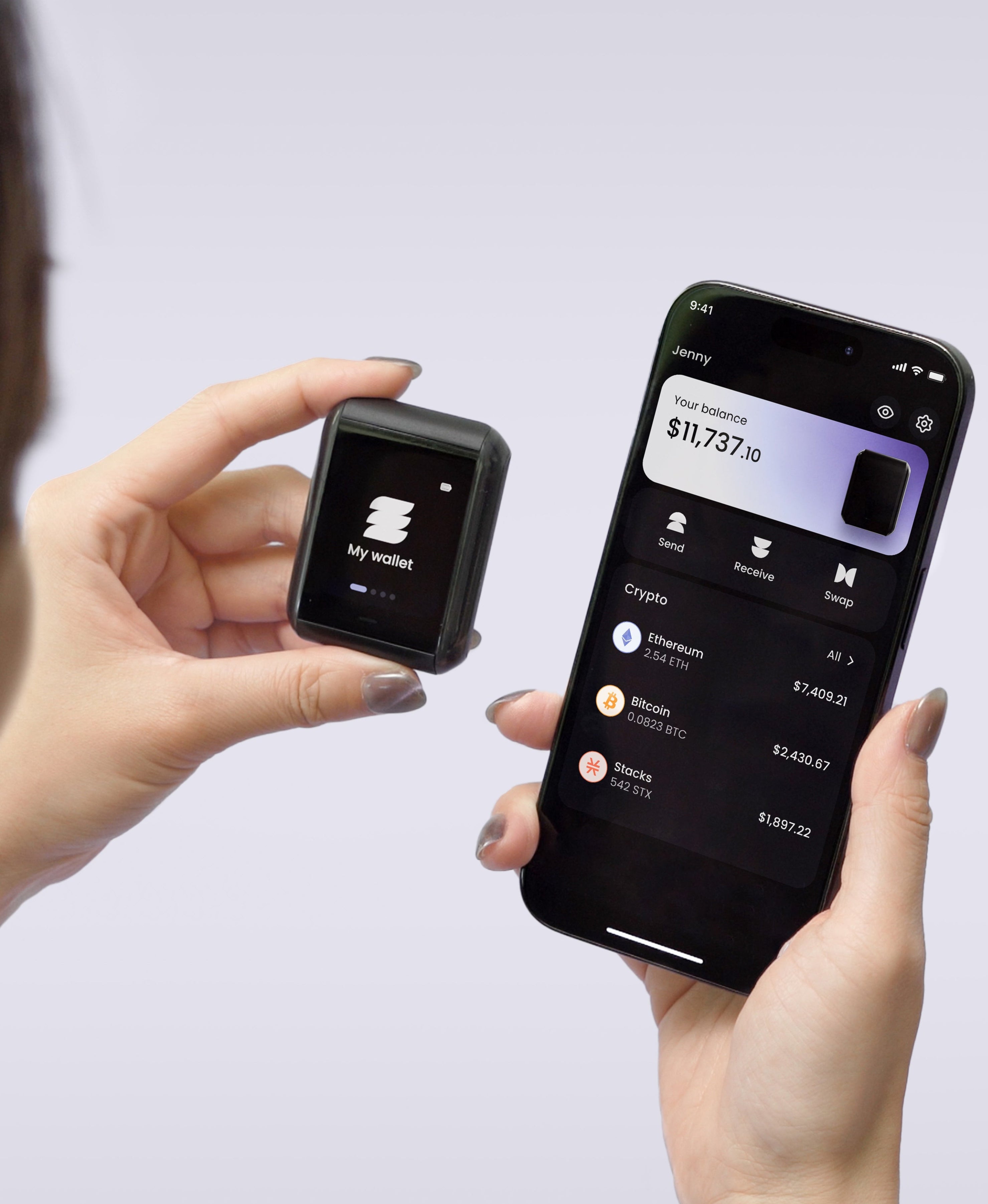
If you're ready to move bitcoin off exchanges and into self-custody, Ryder One is built for that. For $229, you get a compact hardware wallet with an EAL6+ certified secure element, a 1.6-inch AMOLED touchscreen, and NFC-only communication, so your seed phrase and private keys never travel over USB, Bluetooth, or Wi-Fi. Every transaction shows its full details on-device before you sign, which means what you see on screen is exactly what you're approving.
Recovery is handled by TapSafe, which distributes your backup across three layers: a Recovery Tag, your phone backup (stored encrypted in iCloud or Google Drive), and optional Recovery Contacts. No single component grants complete access on its own, which removes the single point of failure that comes with a paper seed phrase. Setup takes under 60 seconds.
Spending $15 to $25 in ATM fees to buy bitcoin in cash, and then leaving that bitcoin on an exchange, doesn't make much sense. Scan a Ryder One receive address instead, and that ATM fee becomes the price of owning your bitcoin outright from the moment it confirms.
Get the Ryder One for $229 → ryder.id/products/ryder-one
SEO
- Target keyword: how to use bitcoin atm
- SEO title: How to Use a Bitcoin ATM in 2026 (And Why the Fees Will Surprise You)
- Meta description: Bitcoin ATM fees in 2026 run 10% to 25%. Here's how to use a bitcoin ATM step by step, what ID requirements apply, and why your wallet address matters.
- Hero alt text: Person scanning a hardware wallet QR code at a Bitcoin ATM kiosk, with Ryder One self-custody hardware wallet displayed on phone screen


Share: