

Most people who own crypto bought it on Coinbase, Binance ,or Kraken first. The path looked like this: open a brokerage-style account, complete KYC, deposit dollars, click buy, leave the crypto on the exchange because moving it elsewhere felt like a separate project. In the FTX case, U.S. prosecutors said Sam Bankman-Fried stole over \$8 billion in customer money (DOJ statement). Most of those customers never planned to leave it there. They just hadn't gotten around to moving it or frankly, didn't know better. You don't have to take that route. A hardware wallet with a built-in buy feature lets you buy crypto without ever opening an exchange account. The crypto arrives in your wallet directly, where your private keys protect it. KYC happens once if you go through an on-ramp partner (which is optional). There's no "send to your wallet later" step, because there's no exchange holding it. This piece walks through how to buy crypto without an exchange using a hardware wallet app, what the trade-offs are, and what to watch for in fees.
Why exchanges became the default
Exchanges came first. Long before hardware wallets had buy features, the only way to convert dollars to Bitcoin was through Coinbase, Bitstamp, or one of the few platforms with a banking license that could move fiat. They built the infrastructure, the KYC flow and the on-ramp. Hardware wallets, on the other hand, were built for storage, not purchasing. The split made sense in 2015 but by 2026 it doesn't. The wallet ecosystem has matured to the point where most major hardware wallets ship with at least one fiat on-ramp partner integrated directly into the companion app, so the exchange step is no longer required. What the exchange step costs you is two things: the spread between what the exchange charges you and the spot price, and the fact that for any time the crypto sits on the exchange, the exchange owns it. Your account balance is a database entry on their server. If the exchange fails (FTX), pauses withdrawals (Celsius, Voyager), or gets hacked (Mt. Gox, and a long list), you're a creditor in a bankruptcy proceeding. The people who learned that lesson the expensive way are the same people now buying via on-ramp.
What "buy in your wallet app" means
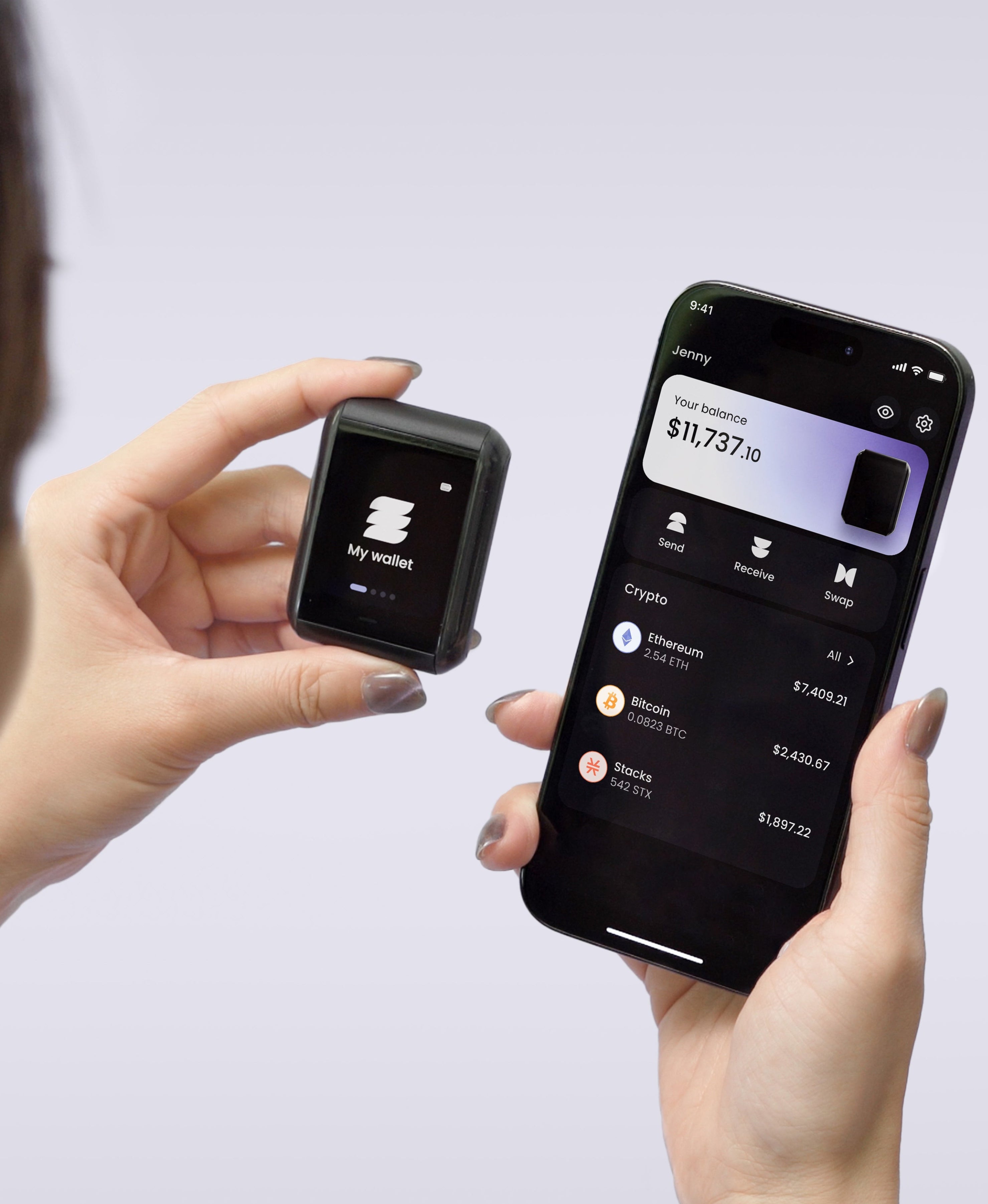
The hardware-wallet-app path uses a payment processor like MoonPay or Transak to handle the dollar side, and the wallet to handle the crypto side. It looks like this. You open the wallet app on your phone. You tap Buy. You choose Bitcoin or Ethereum or whatever you want. You enter the amount. The first time, the app sends you to the on-ramp provider's KYC flow: an ID upload, a selfie, and a few address questions. That's roughly the same KYC every exchange does, just done once, by one provider. You enter card details, or a bank transfer for larger amounts. You authorize and verify the payment after which the on-ramp pulls the dollars and, on the back end, sends crypto directly to your hardware wallet's receive address. You see the funds appear in your wallet within minutes. You never opened a separate brokerage account or let your crypto sit in a third party's custody. In fact, the first place the crypto exists in your name is in your wallet.
The Ryder One version
Ryder One ships with MoonPay integrated into the companion mobile app. The flow above is what you do, end to end. The crypto arrives at your Ryder One's receive address, which you can verify on the device's 1.6-inch AMOLED touchscreen before signing anything. Every transaction is verified on-device with full readable detail, so you see the address you're receiving to, not just a confirmation message in an app. All of this, in under a minute. Coverage is currently Bitcoin, Ethereum, Solana, and a growing list of top ERC-20 and SPL tokens.
The security upside
There's a moment in every exchange-then-transfer flow that's the riskiest part of the whole exercise: typing your wallet's receive address into the exchange withdrawal form, or copying it from your wallet app and pasting it into the exchange. This is where address-substitution attacks happen. Malware swaps the address on your clipboard for the attacker's. You confirm. The crypto goes to the wrong wallet. Buying directly to your wallet skips that step entirely. The wallet app and the on-ramp talk to each other behind the scenes. Your address is passed programmatically. There's no copy-paste moment. Even on a compromised computer, you can buy crypto without a clipboard hijacker getting between you and your funds. This isn't theoretical. Address-substitution attacks have moved hundreds of millions of dollars over the past few years, so removing the moment where the attack is possible is better than getting cleverer about defending it.
What to watch for
Three things to think about before you treat your wallet's buy button as the default. Limits: On-ramps have daily and weekly purchase caps, especially for new accounts. They tend to start in the low thousands and scale up over time as you transact. If you want to buy 50,000 USD of Bitcoin in one go, the on-ramp probably can't do that on day one. Regional support: On-ramps don't cover every country. If you live somewhere off the main payment-processor map, you may still need an exchange. Fees compared to scale: For amounts under 100 USD, the fee gap between on-ramp and exchange is small in dollars. For amounts over 5,000 USD, the gap is real money. Match the path to the size of the buy.
The bottom line
Buying crypto without an exchange isn't an edge case anymore. It's the path most hardware wallet companies built precisely so their customers never have to trust an exchange in the first place. You take a small premium on fees in exchange for never having crypto in someone else's custody, never having to do a manual transfer, and never typing your address into a withdrawal form. For anyone who reads about another exchange collapse and wonders if there's a way to skip that step entirely: there is.
If you want to skip the exchange detour, Ryder One lets you buy Bitcoin, Ethereum, Solana, and major tokens directly into your wallet via MoonPay, with every transaction verified on the device's screen and TapSafe Recovery protecting the backup, which makes it impossible for you to lose your crypto. See how it works.


Share: