


The Fidelity Ethereum Fund began trading on the Cboe BZX Exchange on July 23, 2024, one of nine spot ether ETFs that went live that morning after the SEC's landmark approval. FETH launched with a 0.25% expense ratio (waived through the end of 2024) and pulled in roughly $2.2 billion of ether during its opening weeks. Two years later, the product sits at around $746 million in assets under management as of late June 2026, well off its peak but still one of the four largest US spot ETH vehicles. For anyone holding ETH in a wallet, the more interesting question isn't the AUM chart. It's what the arrival of Fidelity, BlackRock, and Grayscale as regulated custody counterparties means for the coin sitting on your address.
In this piece, we cover how FETH is structured, how its flows compare against BlackRock's ETHA and Grayscale's ETHE, where SEC-approved staking now stands, what institutional demand has done to ETH's holder base, and what a self-custody holder should take from a Wall Street giant custodying billions of dollars of ether on their behalf.
What FETH is and how it works
The Fidelity Ethereum Fund is a spot exchange-traded product that holds ether directly. Every share represents a fractional claim on a pool of ETH held by Fidelity Digital Assets, a custody arm chartered by the New York Department of Financial Services since 2019. When new shares are created, an authorized participant delivers cash or ETH to the fund; when shares are redeemed, ether comes back out. The reference price tracks the Fidelity Ethereum Reference Rate, an aggregate of major spot exchange quotes.
Structurally, FETH looks similar to Fidelity's Wise Origin Bitcoin Fund (FBTC), which launched with the January 2024 batch of spot BTC ETFs. Same custody arm, same reference-rate methodology, same 0.25% headline fee. The difference matters at the token level. Ether isn't just a digital commodity in the way bitcoin is; it's a staking asset whose native yield sits between 2.5% and 4% depending on network conditions. The original FETH prospectus did not include staking, and that omission created a competitive gap that the rest of 2025 and early 2026 worked to close.
FETH inside the spot ETH ETF field
Nine products opened for trading on July 23, 2024, from BlackRock (ETHA), Fidelity (FETH), Grayscale (ETHE and the Mini Trust ETH), VanEck (ETHV), Bitwise (ETHW), 21Shares (CETH, later renamed TETH), Franklin Templeton (EZET), and Invesco/Galaxy Digital (QETH). All except Grayscale's flagship ETHE priced their expense ratios between 0.15% and 0.25%, with several waiving fees during a promotional window.
Two years in, the pecking order has settled. BlackRock's ETHA leads the field by a wide margin, holding more than $6.5 billion in AUM and drawing over $11.9 billion in cumulative inflows since inception. Fidelity's FETH sits in the second tier alongside Bitwise's ETHW and Grayscale's Mini Trust. Grayscale's original ETHE, priced at 2.5%, spent much of 2024 and 2025 bleeding assets as holders rotated into cheaper vehicles, mirroring the exact pattern GBTC showed after the bitcoin ETF launch.
Cumulative net inflows across the whole category reached roughly $12.9 billion during 2025 before turning choppy in the first half of 2026. May 2026 produced about $401 million of net outflows, with June continuing the softer tape. Those swings track price more than they drive it: institutional wrappers give existing ETH holders a tax-friendly way to size positions up or down without touching a private key, which pulls flow in both directions.
The staking question SEC has now answered in pieces
For the first eighteen months of the spot ETH ETF category, staking sat off the table. Issuers wanted staking approval so they could pass a share of native yield to holders, and the SEC declined to approve it under the prior chair. That standoff broke in stages during late 2025 and early 2026.
Grayscale went first. The SEC cleared staking amendments for ETHE and the Mini Trust in late 2025, and Grayscale distributed $9.4 million of staking rewards to shareholders on January 6, 2026, the first US-listed ETF payout of that kind. Grayscale then rebranded ETHE to the "Grayscale Ethereum Staking ETF" on January 5, 2026, signaling that yield had become the pitch. BlackRock followed with a separate product, ETHB (iShares Staked Ethereum Trust), which went live in March 2026.
The rest of the field, Fidelity, Franklin Templeton, Invesco, 21Shares, and VanEck, filed staking amendments and now sit in review windows. A March 17, 2026 joint interpretive release from the SEC and CFTC classified staking rewards as non-securities, removing the last legal barrier, so Fidelity's staking amendment for FETH is expected to clear during 2026 unless the agency withdraws consent.
The practical effect for FETH holders is that until Fidelity's amendment lands, an FETH share earns zero of the 3% or so staking yield that a native ETH holder can capture. A share of BlackRock's ETHB earns a portion of that yield (net of fees and validator take), while a self-custody holder running or delegating a validator captures the full amount. Two years into the ETF era, the yield gap between a "regulated wrapper" and native possession is now the most concrete line separating the two paths.
What institutional demand has done to ETH's holder base
Reserve holdings across US spot ETH ETFs peaked near 5% of circulating supply during 2025 before the outflow phase in mid-2026 pulled the figure back below 4%. That's a smaller share of supply than spot BTC ETFs hold of bitcoin (over 6% at peak), and the gap tells you something about the ether market. A larger portion of ETH sits inside staking contracts, DeFi protocols, and Layer 2 bridges, which reduces the free float available for ETF creations to absorb.
The concentration story still matters. Between the top four issuers (BlackRock, Fidelity, Grayscale, Bitwise), the majority of ETH held in ETF wrappers now sits at Coinbase Custody. Fidelity is the exception: FETH uses Fidelity Digital Assets, keeping custody in-house. That single-custodian setup is one reason FETH has drawn allocations from wealth advisors who want a non-Coinbase counterparty for diversification purposes. It's also a reason ETF holders who care about custody diversification tend to split their allocation across two or three issuers rather than concentrate.
For a retail holder deciding between "buy ETH on Coinbase and self-custody" and "buy FETH in a brokerage account," the trade-off comes down to what you want from the exposure. FETH gives you price tracking inside a tax-advantaged account with zero setup effort and zero on-chain footprint. Native ETH gives you the ability to stake, use DeFi, sign transactions on-chain, and hold the coin outside any counterparty. Nothing prevents doing both; plenty of holders do.
Where Ryder One fits
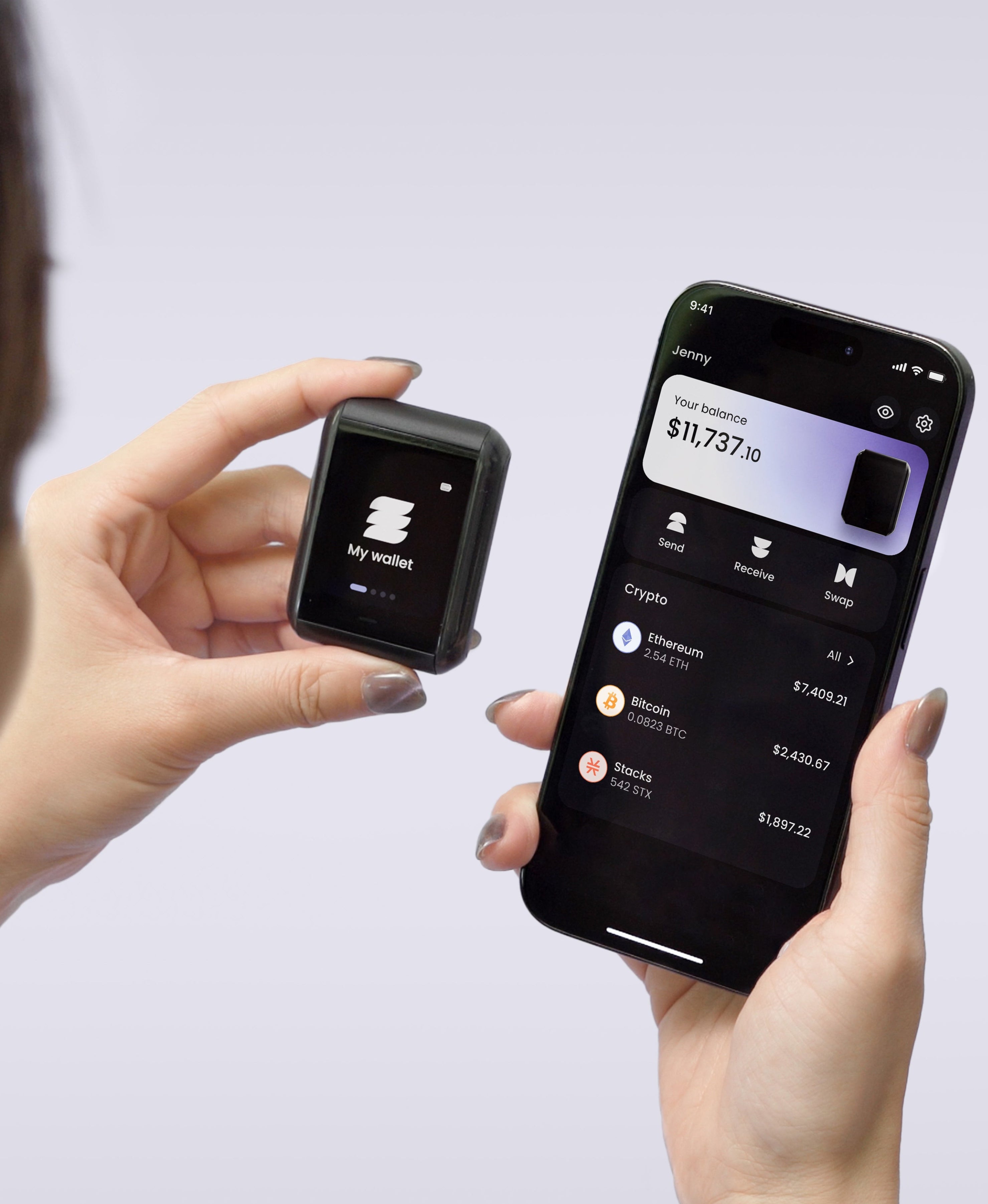
The core distinction between owning FETH and owning ETH is the same distinction that separates an exchange balance from a self-custody wallet. Holding FETH means holding a share of a fund that holds ether; the ether itself lives on Fidelity Digital Assets' balance sheet. Holding ETH in your own wallet means holding the private key that controls the coin at the protocol layer. Ryder One sits at that second layer: it stores the key on an EAL6+ Infineon SLC38 secure element, and every signature happens inside the chip after you press a button wired directly to it.
We built the device around a 1.6-inch AMOLED touchscreen so every transaction can be verified with full readable detail before you approve. NFC-only communication keeps wireless data paths out of the picture, and Qi wireless charging handles the 200 mAh battery without exposing a data port. Ryder One ships at $229 with a Recovery Tag, Qi wireless charger, and travel pouch.
Backup lives inside TapSafe Recovery, our answer to the seed-phrase-on-paper problem. The Recovery Tag holds 50% of the recovery share; your paired phone holds the other 50% encrypted in iCloud (iOS) or Google Drive (Android) rather than on the phone itself. You can add up to four Recovery Contacts, each holding a 25% share, for additional redundancy. The BIP-39 seed phrase remains accessible on-device as a last resort, so the wallet is never locked to Ryder hardware. Readers newer to the model can start with our self-custody explainer, which walks through what direct key ownership covers and doesn't cover.
If you plan to stake, run validators, use L2s, or move between DeFi positions on Ethereum, holding native ETH is the path that lets you do those things. FETH doesn't. If you want ETH exposure inside an IRA or a tax-advantaged brokerage account and nothing else, FETH does that cleanly. The two products serve different needs, and a holder can size positions in each.
The bottom line
Fidelity's spot ether product launched on July 23, 2024 alongside eight other issuers, opened with $2.2 billion in AUM, and sits near $746 million today at a 0.25% expense ratio custodied by Fidelity Digital Assets. BlackRock's ETHA leads the category by a wide margin, Grayscale's ETHE has bled to cheaper vehicles, and staking has moved from prohibited to selectively approved thanks to the March 2026 SEC and CFTC interpretive release. Fidelity's staking amendment for FETH is expected to clear during 2026. For an ETH holder, the split is now clear: an ETF wrapper gives you exposure without on-chain access, while a self-custody wallet gives you the key that controls the coin. Whichever path you pick, the layer you own is defined by the key, and the key belongs on hardware you control.
Own the keys that control your ETH. Ryder One keeps your private key offline on an EAL6+ secure element, with TapSafe Recovery as the backup layer.
SEO
- Target keyword: fidelity ethereum etf
- SEO title: Fidelity Ethereum ETF (FETH): What It Means in 2026 (50 chars)
- Meta description: Fidelity's FETH ether ETF holds $746M at 0.25% fees. Here is how it compares to ETHA, ETHE, and self-custody for ETH holders in 2026. (132 chars)



Share: