


Ethereum staking rewards have settled into a defined range in 2026, and for ETH holders weighing whether to stake, the question is no longer whether the mechanism works. It is which method fits your position size, your risk tolerance, and how much control you want to keep over your funds while they are at work.
This piece covers how ethereum staking rewards are generated, what current yields look like by venue, the main staking approaches and their trade-offs, the risks worth understanding, and why custody during staking deserves as much thought as the yield itself.
How Ethereum Staking Works
Ethereum runs on proof-of-stake. Instead of miners competing with computing power, the network relies on validators who lock up ETH as collateral to propose and attest to blocks. Every epoch, correctly participating validators earn a small issuance reward drawn from newly minted ETH. The protocol also processes a portion of transaction fees, some of which flow back to validators through MEV (maximal extractable value), the priority-fee tips and ordering revenue embedded in each block.
To run a validator yourself, you need exactly 32 ETH. That minimum hasn't changed since the Merge in September 2022. Your private key controls a withdrawal address where rewards land and where your 32 ETH returns when you exit. As of mid-2026, around 39 million ETH is staked across more than 900,000 active validators, representing roughly 32% of total supply. That participation level directly compresses per-validator yield: more ETH in the pool means each validator earns a smaller slice of a fixed issuance budget.
What You Earn: Staking APY in 2026
Current ethereum staking rewards sit in the 3% to 4% range annually, varying by method and configuration.
Native staking APR averages roughly 2.78% to 3.3% as of mid-2026, with MEV-Boost adding approximately 0.5% to 1% on top for validators who opt in to the software. A well-configured solo validator running MEV-Boost can land in the 3.5% to 4% range over time.
Centralized exchanges clip a larger fee than most holders realize. Coinbase, Kraken, and Binance each take 25% or more of gross staking rewards, pushing net yield toward 2.5% to 3%. That convenience has a clear price, and the fee is not the only cost.
Liquid Staking for Smaller Holders
Thirty-two ETH is a steep minimum for many holders. Liquid staking protocols solve that by pooling ETH from many depositors, running validators on their behalf, and issuing a tradeable receipt token in return. Lido issues stETH; Rocket Pool issues rETH. Both let you stake any amount, keep a liquid position you can sell or use across DeFi, and earn yield on the underlying ETH throughout.
Lido currently holds around 28% of all staked ETH, making it the dominant protocol by a wide margin. Its annual fee is 10% of staking rewards, leaving depositors with a net APR of roughly 2.5% to 3%. Rocket Pool charges a variable fee and offers somewhat better decentralization because node operators must bond their own ETH alongside delegated deposits.
One trade-off with liquid staking is smart-contract exposure. Both Lido and Rocket Pool have undergone multiple independent audits and have years of live operation behind them. The risk hasn't materialized at scale on either platform, but a bug in the contract or a governance failure could affect depositor funds. Understanding that exposure before committing a large position is worth the time.
The SEC ETF Staking Decision
Institutional demand for staked ETH cleared a regulatory hurdle in early 2026. A joint SEC and CFTC interpretive release on March 17, 2026 classified ETH staking rewards as non-securities activity, removing the barrier that had blocked ETF issuers from passing yield to shareholders.
BlackRock launched its iShares Staked Ethereum Trust on Nasdaq on March 12, 2026, staking 70% to 95% of holdings and distributing monthly yield under the ticker ETHB. Gross staking returns on the product run 3.1% to 3.3%, but after fund fees and custody costs, net distributions to shareholders land at 1.9% to 2.6%. For self-custody holders, it illustrates the fee layer that disappears when you stake your own ETH without an intermediary.
Risks Worth Understanding
Slashing. Validators that double-sign a block or make certain configuration errors, most commonly during infrastructure migrations, get slashed: a portion of their 32 ETH is destroyed and they are forced to exit the validator set. Most historical slashing events on Ethereum have traced back to misconfigured setups rather than attacks. A properly maintained solo validator or a reputable liquid staking provider carries low slashing risk, but it is not zero.
Withdrawal queues. Ethereum imposes a rate limit on validator exits to protect network stability. During periods of elevated exit demand, withdrawal timelines can stretch to days or even weeks, which means your ETH may not be accessible at the moment you most want it. Liquid staking tokens sidestep the exit queue under normal conditions, but if the secondary market for a token like stETH seizes up during broader market stress, you are trading one form of locked capital for another.
Counterparty risk on exchanges. When you stake through a centralized exchange, the exchange holds the validator keys. If the exchange fails, freezes withdrawals, or is compromised, your staked ETH sits inside that counterparty's infrastructure with no recourse on your own. The FTX collapse in 2022 destroyed roughly 8 billion USD in customer funds. Binance paid 4.3 billion USD in a Department of Justice settlement in 2023. That risk is not abstract.
Custody During Staking: Who Holds the Keys
The ownership question in staking comes down to who controls the withdrawal credentials. Those credentials determine where staking rewards land and where your 32 ETH goes when you eventually exit. An exchange holding those keys means depending on that exchange to return what is yours; keeping them on a hardware wallet means you control the exit regardless of what happens to any third party.
For years, staking and self-custody existed in tension. Moving ETH to an exchange introduced counterparty risk at the exact moment your funds were locked up and hardest to move, while managing validator withdrawal addresses from a hardware wallet remained cumbersome for most holders.
Stake ETH Directly From Ryder One
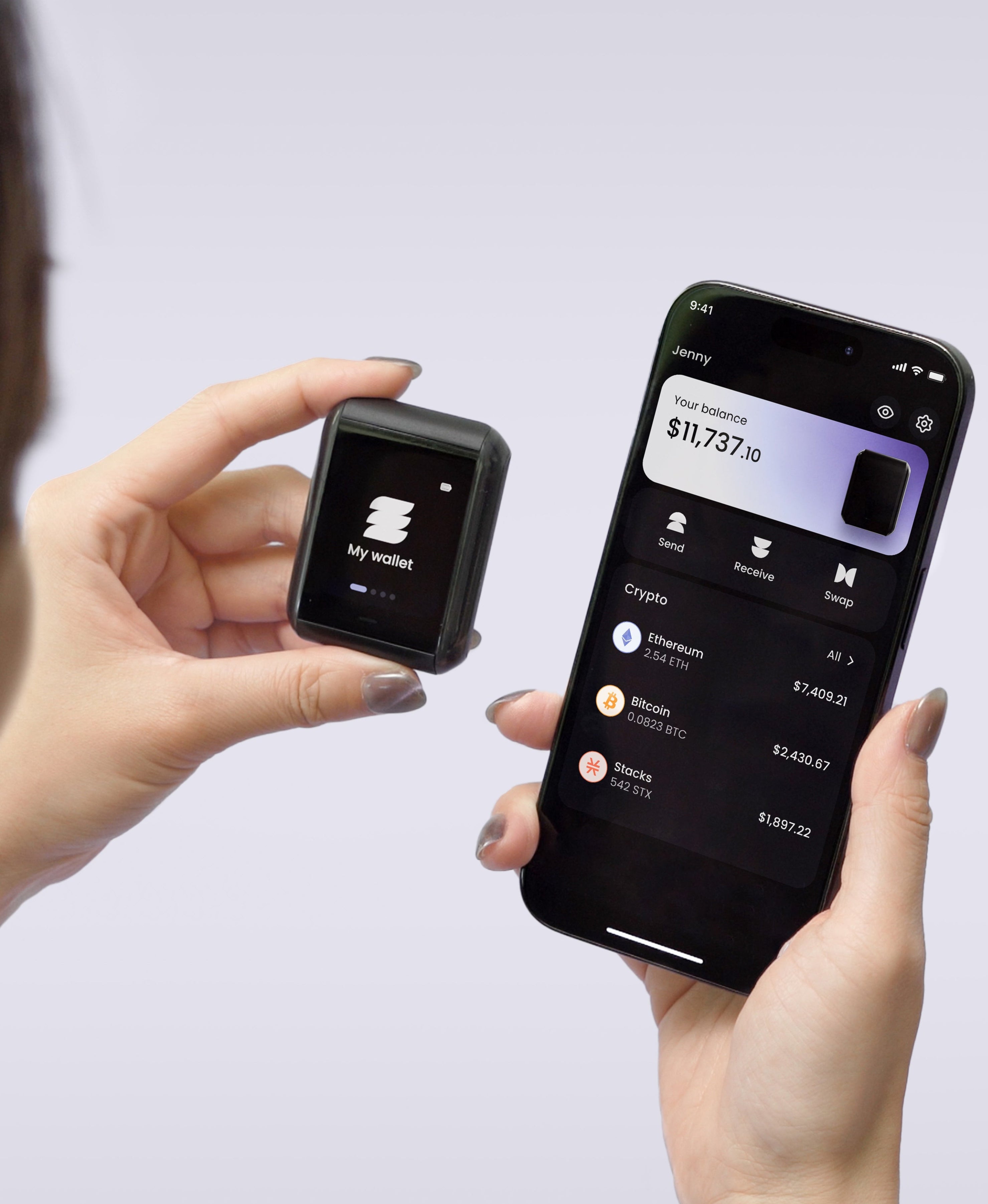
We addressed that tension in Ryder One. As of August 2026, ETH staking is live on the Ryder One and accessible directly from the Ryder app. Your keys never leave the EAL6+ Infineon SLC38 secure element during the staking process. You do not send your ETH to an exchange. You do not hand withdrawal credentials to a third party. The keys stay on the chip, the chip stays with you, and you control where staking proceeds land.
Every transaction is confirmed on Ryder One's 1.6-inch AMOLED touchscreen before it is signed. The physical button on the device is wired directly to the secure element, so no software path can authorize a signature without your explicit press. Firmware has been independently audited by Halborn, one of the most respected blockchain security firms, with the full report publicly available.
TapSafe Recovery handles the backup layer. Your wallet's recovery information distributes across a Recovery Tag, a phone backup encrypted to iCloud or Google Drive, and optional Recovery Contacts. No single piece grants full access on its own, so losing the tag does not mean losing the wallet. The BIP-39 seed phrase remains accessible on-device as a last resort, compatible with any BIP-39 wallet so you are never locked to our hardware.
Ethereum staking rewards in 2026 offer a tangible return for long-term holders who want to put their ETH to work. The question worth asking before you stake isn't just what the APY is. It's who controls the keys while your ETH is locked.
Stake ETH while keeping full control of your keys. Ryder One now supports ETH staking directly from the app. Your private keys never leave the EAL6+ secure element. $229, includes Recovery Tag, wireless charger, and travel pouch.
SEO
- Target keyword: ethereum staking rewards
- SEO title: Ethereum Staking Rewards in 2026: What You Earn and How to Do It Safely
- Meta description: Ethereum staking rewards sit at 3-4% APY in 2026. Learn how staking works, what you earn, the main risks, and how to stake ETH without giving up custody.
- Hero alt text: Ryder One hardware wallet with AMOLED touchscreen showing Ethereum staking interface, compact aluminium device on dark surface


Share: