

Tax season is harder for self-custody holders than for exchange users. Not because the rules are different, but because the records aren't built in. When you buy crypto on an exchange, the exchange tracks your cost basis, your trades, and your gains. For 2025 digital-asset transactions, brokers must send taxpayers a copy of the information they report to the IRS on Form 1099-DA by Feb. 17, 2026, per the IRS. When you self-custody, the wallet shows you balances. It doesn't tell you what you owe. This piece walks through what self-custody holders need to track for taxes in 2026, where exchange-style records fall short, and how to keep the kind of paper trail that makes filing easier. We're not tax advisors and none of this is tax advice. What we are is people who self-custody our own crypto, so we know what record-keeping has to look like to survive an audit.
What changed for crypto taxes
The big change of the past few years was reporting. US-based exchanges now file 1099-DA forms for transactions, the same way brokerages have always reported stock trades. If you sell Bitcoin on Coinbase, Coinbase tells the IRS. The IRS knows what you owe. Self-custody is outside that reporting net. There's no exchange filing a 1099 on your behalf, because there's no exchange. The taxable events still exist. The IRS still expects you to report them. The bookkeeping is on you. This isn't a loophole. The rules are the same: gains from selling crypto are capital gains, swaps from one token to another are taxable events, and mining and staking rewards are generally treated as taxable income when received, per the IRS's digital assets guidance. What's different is who keeps the records. Exchange holders get a system. Self-custody holders build one.
The taxable events worth tracking
Five categories cover most of what a self-custody holder needs to track. Buying crypto: Buying with fiat is not a taxable event. It establishes cost basis. You note the date, the amount of fiat spent, the amount of crypto received, and any fees paid. That's the basis you'll subtract from the sale price later to compute gain. Selling crypto for fiat: This is a taxable event. The gain or loss is the difference between sale price and cost basis. If you held the asset for more than a year, your profit is taxed at the long‑term capital gains rates (0%, 15%, or 20%, depending on taxable income); otherwise it is taxed at ordinary income rates. Source: 2026 capital gains tax rates Swapping one crypto for another: This is also a taxable event in the US, even though no fiat changes hands. Swapping ETH for USDC means you sold ETH (gain or loss) and bought USDC (new cost basis). Many self-custody holders forget this one and end up under-reporting. Earning crypto: Staking rewards, mining proceeds, airdrops, and yield from DeFi protocols all count as ordinary income at fair market value on the day received. That value also becomes the cost basis for the new crypto. When you later sell it, the gain or loss is calculated against that basis. Sending crypto to a wallet you control: Not a taxable event. Moving Bitcoin from your hardware wallet to your other hardware wallet is not a sale, it's a transfer. The cost basis carries over. Some software tools mistakenly classify these as taxable events: this is the most common reason self-custody users get nervous about their records.
What self-custody adds to the work
Three things that exchange users don't have to think about. Cost basis on transferred funds: If you bought Bitcoin on Coinbase in 2022 and moved it to your hardware wallet in 2024, the cost basis stays at the 2022 purchase price. The wallet has no idea what that price was. You have to keep that record yourself, usually in a spreadsheet or a portfolio tracker. Wallet labels and counterparties: Every blockchain transaction has a counterparty address. The blockchain doesn't know if that address belongs to your friend, your DeFi protocol, your other wallet, or an exchange you withdrew from. You do. Labeling addresses as you transact is the difference between a tax return that takes an hour and one that takes a weekend. Multiple chains and tokens: A self-custody holder ends up with positions on Bitcoin, Ethereum, Solana, and a handful of L2s. Each chain has its own format for transaction histories. Aggregating them into one set of records takes a tool.
What records to keep
For each transaction, record: - Date and time - What happened (buy, sell, swap, send, receive, stake, claim) - Amounts on both sides (crypto in, crypto out, fiat if any) - Counterparty address or platform - USD value at the time of the transaction - Fees paid, denominated in whichever asset paid them - A short note explaining context ("sent to my Lightning channel," "airdrop from project X," "swap on Uniswap") A spreadsheet handles the first year or two. After that, most self-custody holders move to a dedicated crypto tax tool. CoinTracker, Koinly, TokenTax and CoinLedger are the most popular options, but the major US options shift year to year.
The Ryder One angle
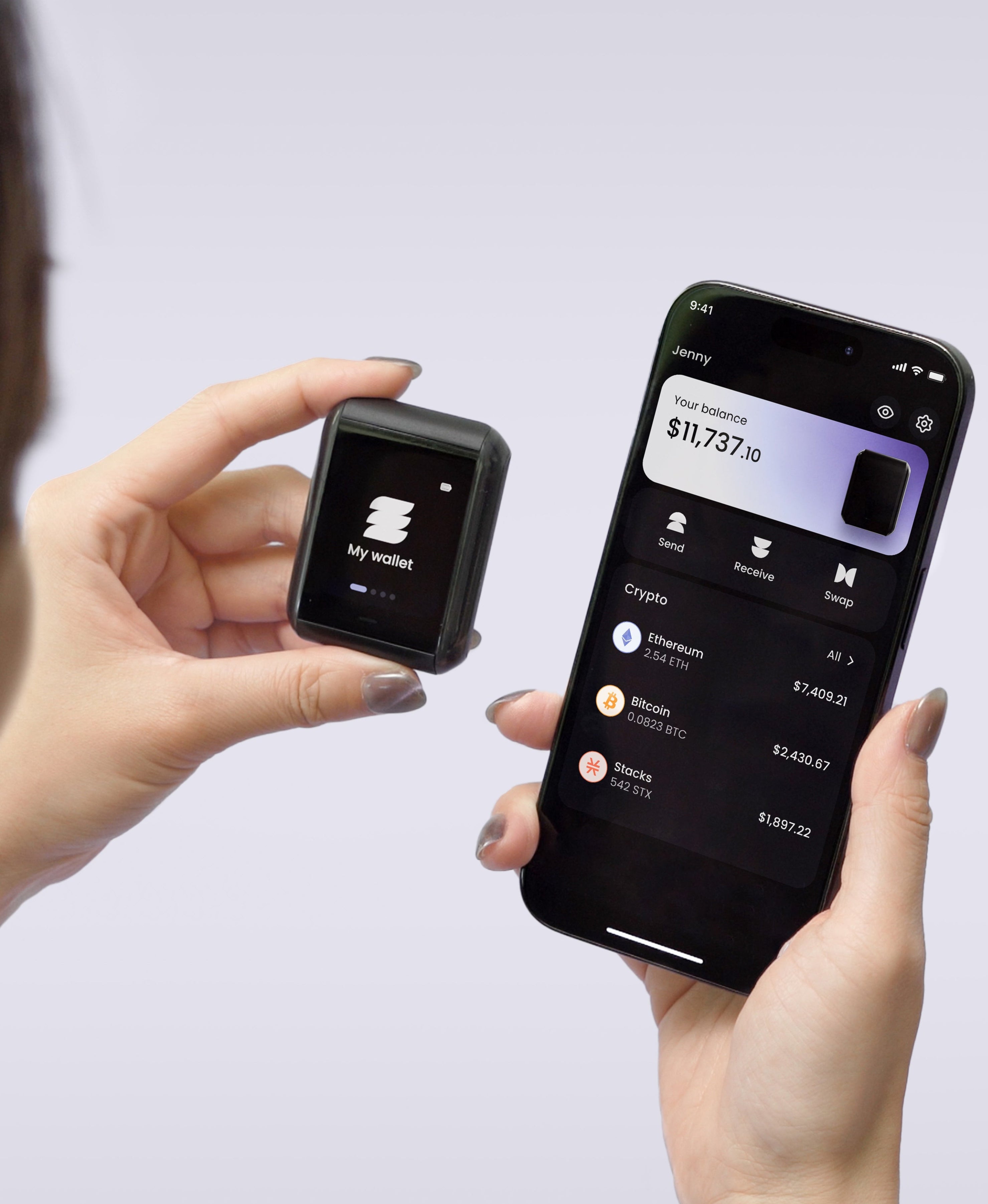
A hardware wallet is good at keeping keys safe. It isn't a bookkeeping system. What Ryder One does is keep your transaction history clean and verifiable: every transaction signed on the device shows up in your account history, with the address you sent to or received from. That's the source of truth for your records. The on-device address book lets you label frequently-used addresses (yours, family members, exchange address you withdraw to). When you export transaction history later for tax software, those labels survive the export, which makes the categorization step shorter. We also recommend exporting your transaction history quarterly, not yearly. A yearly export forces you to remember twelve months of context. A quarterly export forces you to remember three. The work is the same and the recall is much easier.
Common mistakes
Three to flag. 1. Treating wallet-to-wallet transfers as sales: Some tax software defaults to treating every outgoing transaction as a sale. Verify how the tool handles internal transfers before trusting its numbers. 2. Forgetting to track swaps: Token-to-token swaps are taxable. If you've spent the year hopping between memecoins on Solana, every hop is a taxable event. 3. Losing access to old wallet records: A common scenario: you held some ETH in a software wallet in 2021, sent it to a hardware wallet, and forgot the original purchase price. If the original records are gone, basis becomes hard to establish. The IRS's guidance is blunt: you need records to determine basis (cost) in digital assets, and without support, it becomes difficult to substantiate what you paid.Digital assets — Keep records / Determine your basis Keep your records.
The bottom line
Self-custody changes who keeps the records. It doesn't change the rules. The rules are the same as for exchange users: trades, swaps, and yield are taxable events, transfers between your own wallets are not, and the IRS expects an honest accounting either way. The holders who make this easy on themselves are the ones who track as they go, label addresses as they create them, and export transaction history more often than they need to. The holders who don't end up with a stack of CSVs in April and a long weekend.
Hold the keys, keep the records. Ryder One keeps a clean, verifiable transaction history with on-device address labels so your tax records have a single source of truth. See how it works.



Share: