


Crypto tax loss harvesting became a live year-end conversation for self-custody holders after the IRS finalized its per-wallet cost basis regime on January 1, 2025, then rolled out Form 1099-DA reporting for brokers on the same schedule. The core mechanic hasn't changed: you sell a position at a loss to offset capital gains, then apply up to 3,000 USD of net loss against ordinary income and carry the rest forward. What has changed is the record-keeping burden on holders who keep their coins off exchanges. If a broker isn't handing you a statement in January, the lot math is on you, and it has to line up wallet by wallet.
In this piece, we walk through what tax loss harvesting is, why crypto still sits outside the wash sale rule, what per-wallet FIFO means for your ledger, how to document a harvest from a hardware wallet, and where Ryder One fits.
What crypto tax loss harvesting is
Tax loss harvesting is the practice of selling an asset at a loss to offset capital gains you've realized elsewhere in the year. If you sold ETH in March at a 40,000 USD gain and your SOL position is down 25,000 USD in December, harvesting that SOL loss shrinks your taxable gain to 15,000 USD. Losses first offset gains of the same term (short-term against short-term, long-term against long-term), then cross over, and any leftover can offset up to 3,000 USD of ordinary income per year with the balance carried into future tax years. Fidelity's crypto tax guide walks through the mechanics for holders coming from a traditional brokerage frame.
Two thresholds matter for how a loss gets taxed. Short-term applies to positions held one year or less and is taxed at ordinary income rates; long-term applies to positions held longer than a year and is taxed at 0%, 15%, or 20% depending on your bracket. The character of the loss follows the character of the sale, so the holding period on every lot you dispose of is part of the math. Sloppy lot selection can turn a good harvest into a poor one.
The move that makes crypto harvesting different from equities is what happens after the sale.
Why crypto is different from stocks in 2026
The wash sale rule under IRC Section 1091 disallows a loss on a security if you buy the same or a substantially identical security within 30 days before or after the sale. The rule applies to stocks and securities. Under IRS Notice 2014-21, the agency treats virtual currency as property for federal tax purposes, and property isn't a security. That's the door crypto has walked through for a decade, and as of mid-2026 the door is still open.
What that gets you in practice: you can sell BTC at a 10,000 USD loss on December 20, buy the same amount back on December 21 at roughly the same price, and still book the loss on your return. The Build Back Better Act tried to close this in late 2021 by adding digital assets to Section 1091, but the provision didn't survive. Congress has revisited the idea in committee hearings, and Form 1099-DA already includes a "Wash Sale Disallowed" reporting field, so treat the exemption as a current-year advantage rather than a permanent fixture. Reuters covered the last major push and it has kept resurfacing.
Two guardrails still apply. The IRS can invoke the economic substance doctrine when a transaction has no purpose beyond the tax benefit, and repetitive mechanical harvests against the same lot can draw scrutiny. Waiting a few hours or shifting size between two related assets keeps the position clearly economic. Most CPAs offer the same advice: harvest with a straight face, document the price you sold and rebought at, and don't build a strategy around round-trip tax cycling.
The per-wallet FIFO rule
The bigger change for self-custody holders sits in cost basis accounting. Before 2025, the IRS accepted universal tracking, where every unit of BTC you owned lived in one imaginary pool no matter which wallet held it. Under Revenue Procedure 2024-28 and the final digital asset regulations under Section 1.1012-1(j), that pool is gone. Every wallet and every exchange account is its own ledger. When you sell from a specific wallet, the cost basis has to come from lots held in that same wallet.
FIFO (first in, first out) is the default. Unless you specifically identify a different lot at the time of sale, the IRS assumes the oldest coins in that wallet went out the door first. Specific identification is allowed, but the identification has to happen at or before the moment of the transfer rather than being reconstructed at tax time. HIFO and LIFO can be applied within a wallet with proper records, but only if your accounting software has been tracking to that method consistently.
The reallocation window for taxpayers who held mixed pools before January 1, 2025 was a one-time safe harbor that had to be exercised by the earlier of the first disposal after that date or the due date of the 2025 return. That decision is now locked in for anyone who has filed. Bloomberg Tax reported on the transition when the safe harbor first dropped, and the mechanics haven't gotten simpler with age.
For a harvester, this changes the shape of the decision. Selling BTC from your Coinbase account uses only the lots on Coinbase, and the highest-cost lot you bought two years ago on your hardware wallet can't be pulled across to shrink a Coinbase gain. If you want to realize a loss against those older, higher-cost lots, you sell from the wallet that holds them.
How to document a harvest from a hardware wallet
Exchanges hand you a 1099. Your hardware wallet hands you a signed transaction and an on-chain record. The gap between those two artifacts is where most self-custody holders lose track of what they owe. Closing that gap is where the harvest lives or dies.
A workable documentation flow has four parts. First, keep a running lot ledger per address, with each acquisition tagged with date, quantity, USD price at receipt, and a link to the transaction hash. Portfolio tools like Koinly, CoinTracker, and CoinLedger can ingest addresses directly and reconstruct lots from on-chain history, though internal transfers between your own wallets need to be flagged so they don't get counted as taxable events. Second, when you plan a harvest, pull the wallet's lot history and pick the lots you intend to sell. Third, execute the sale on-chain and write the transaction hash back into your ledger next to the identified lots. Fourth, if you rebuy, log the new acquisition in the same wallet with its own basis, since that lot's clock starts fresh.
Q4 is when this gets pressure-tested. Volumes rise into year-end as holders rebalance, and Kiplinger's year-end tax planning lays out the calendar side for investors. The crypto version is stricter because your counterparty isn't a broker who reconciles the trade for you. Miss the settlement date and the trade lands in the following tax year, which can be the right answer or the wrong one depending on where your gains sit.
A hardware wallet lets you sign a sale without handing your keys to an exchange, but the sale usually routes through a DEX or swap layer, and the price you receive is the price on that route. Log the effective USD value of the disposal alongside the token amount. If the swap fee eats 30 basis points, the loss you book should reflect the net proceeds; the IRS wants the actual number rather than the mid-market quote you saw before signing.
Where Ryder One fits
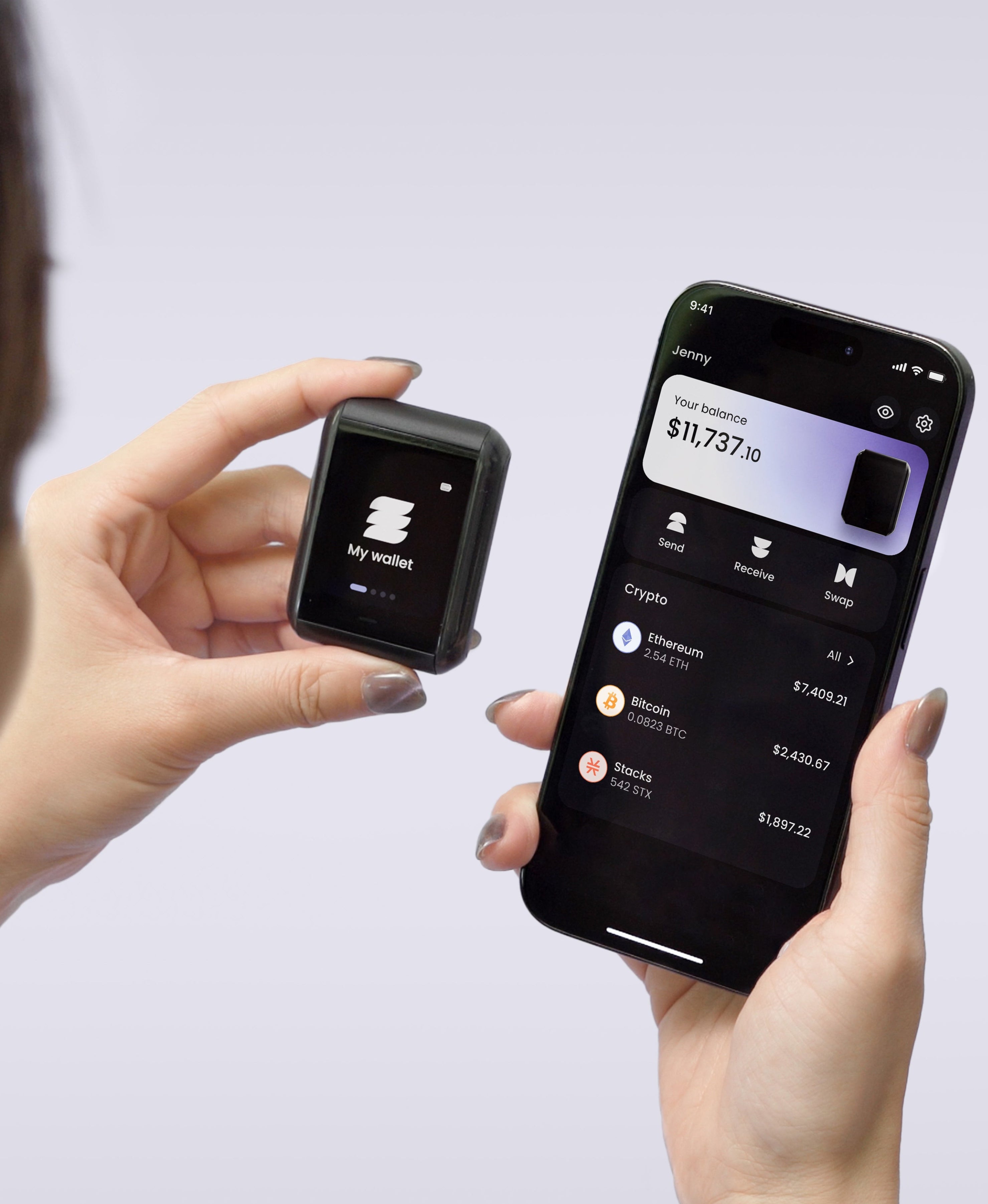
Ryder One keeps your private keys inside an EAL6+ Infineon SLC38 secure element and verifies every transaction on a 1.6-inch AMOLED touchscreen with a button wired directly to the chip. NFC-only communication means there is no USB path or Bluetooth radio to intercept a signing flow. For a harvester, that matters at two points in the year. On the sell, the destination address and amount render in full on the device screen, so you can confirm the swap route before pressing the button. On the rebuy, the new lot lands back in a wallet you control, and the receiving address gets verified on-device before you commit anything.
TapSafe Recovery is the backup layer we built so a lost device doesn't force you to reconstruct lot history from a seed phrase written on paper five years ago. The Recovery Tag holds 50% of the recovery share, your paired phone holds the other 50% encrypted in iCloud (iOS) or Google Drive (Android) rather than on the phone itself, and up to four optional Recovery Contacts can each hold 25%. Your BIP-39 seed phrase stays accessible on-device as a last resort, so the wallet never locks you to Ryder hardware. Ryder One ships at $229 with a Recovery Tag, Qi wireless charger, and travel pouch.
For a self-custody holder running a Q4 harvest, self-custody on Ryder One keeps the keys under your control while your ledger stays yours to maintain. The device doesn't file your return, and no hardware wallet does. What it does is give you a signing surface you can read and a backup posture that survives the physical failure modes that break paper-based records.
Bottom line and CPA disclaimer
Tax loss harvesting in crypto still carries the wash sale advantage in mid-2026, which lets self-custody holders realize losses without a 30-day cooldown. The per-wallet FIFO regime that took effect on January 1, 2025 changes the record-keeping side of the equation: every wallet is its own ledger, specific identification has to happen at the point of sale, and the safe harbor for reallocating pre-2025 basis has closed for anyone who's filed. Bring receipts, tag your transactions as you go, and price your disposals on effective proceeds rather than screen quotes.
This article is informational, not tax advice. Consult a CPA before executing trades for tax purposes. Rules can change quickly at the federal and state level, and a professional who has seen your full picture will catch things a generic guide can't.
Hold your keys, and hold your records. Ryder One keeps Bitcoin, ETH, and SPL tokens on an EAL6+ secure element, with TapSafe Recovery as your backup and every transaction verified on the device before you sign.
SEO
- Target keyword: crypto tax loss harvesting
- SEO title: Crypto Tax Loss Harvesting in 2026: Year-End Playbook (52 chars)
- Meta description: Crypto tax loss harvesting in 2026: wash sale still exempt, per-wallet FIFO now mandatory. What self-custody holders need to document before year-end. (150 chars)


Share: