


# Cosmos (ATOM) in 2026: IBC and the Interchain Ecosystem
Ask any DeFi builder what half of the top layer-1 chains run under the hood and one answer keeps coming back: the Cosmos SDK. It is the invisible plumbing behind Injective, Celestia, dYdX, Sei, Osmosis, Kava, and dozens more, while its consensus partner Tendermint (renamed CometBFT in 2023) settles blocks on all of them. For an ecosystem whose flagship token often flies under the radar, Cosmos has quietly become one of the most-adopted tech stacks in crypto.
Below we cover what Cosmos and ATOM are, the SDK and CometBFT in plain terms, how IBC moves assets, the Cosmos ecosystem in 2026, ATOM tokenomics with Interchain Security, the self-custody read on bech32 addresses, and where Ryder One fits.
What Cosmos and ATOM are
Cosmos launched its mainnet on 13 March 2019 after a 17 million USD ICO in 2017 raised the funds to build it. Co-founders Jae Kwon and Ethan Buchman pitched the network as an "Internet of Blockchains," where every application chain runs its own sovereign consensus while talking to peers through a shared communication protocol. The project sits under the Interchain Foundation, a Swiss non-profit that coordinates funding for the core stack.
ATOM is the native token of the Cosmos Hub, the original chain in the family. Validators stake ATOM to secure the Hub, transactions pay fees in ATOM, and governance proposals resolve through ATOM-weighted voting. The design bet from day one was that many chains would emerge with their own tokens while the Hub sat at the center as a coordination point, and that thesis has partly played out: the SDK spawned hundreds of chains, though ATOM's role inside that map has stayed slimmer than the token's fans would like.
Cosmos SDK and CometBFT consensus
The Cosmos SDK is a Go framework for building app-specific blockchains. Instead of writing a smart contract inside someone else's chain, a team using the SDK ships an entire chain tailored to one application, with pre-built modules for staking, governance, IBC transfers, token issuance, and slashing. The Cosmos SDK docs walk through the architecture: a client, a state machine in Go, and a consensus engine wired in beneath.
That consensus engine used to be called Tendermint. In 2023 the Interchain Foundation forked the codebase into CometBFT, which is the maintained version most Cosmos chains ship with today. CometBFT is a Byzantine Fault Tolerant algorithm that finalizes each block once two-thirds of the validator set signs off, and finality lands inside the same block rather than after a probabilistic waiting period. Cosmos-family chains quote block times of one to seven seconds with instant finality; once the block is signed by two-thirds of stake, the state is settled and cannot be reversed without a hard fork.
IBC: the interchain transfer layer
IBC, or Inter-Blockchain Communication, is the protocol that lets Cosmos-family chains send messages and tokens to each other without a trusted bridge in the middle. Two chains that speak IBC set up a channel by exchanging cryptographic proofs of each other's validator sets, and after that channel is open, one chain sends a packet the other verifies against those proofs. If the proof passes the packet is accepted; if it fails the packet drops and the sender is refunded.
The design matters because most cross-chain bridges built on other stacks route through a small multisig or a relayer network that holds custody of user funds during transit. IBC skips that layer: transfers ride on-chain proofs the whole way, and no third party ever custodies the assets during the hop. A user sending ATOM from Cosmos Hub to Osmosis sees the ATOM leave the Hub, get locked into an IBC escrow, and appear as an IBC-denominated token on Osmosis inside the next block. The IBC channel graph spans more than 100 chains and settles hundreds of millions in monthly volume across the interchain.
The Cosmos ecosystem in 2026
The clearest way to see Cosmos's reach is to look at which chains carry the SDK inside them. Injective is a Cosmos SDK chain built around a native orderbook module, and by 2026 its perps DEX Helix has cleared north of 30 billion USD in cumulative volume. Berachain runs its EVM execution layer on top of BeaconKit, a Cosmos SDK-based consensus module, so even a chain positioning itself as EVM-native leans on the Cosmos stack under the hood.
Celestia took the SDK in a different direction and used it to build a modular data availability layer, launched in late 2023, that other rollups pay to store their transaction data. dYdX made the most-cited migration in the family: after running on StarkEx through 2023, the team ported dYdX v4 to a purpose-built Cosmos chain in October 2023 to gain a fully decentralized orderbook, and the trading engine has been Cosmos-native since. Sei is a high-throughput SDK chain tuned for trading, Osmosis is the flagship DEX and IBC router of the interchain, and Kava and Kujira handle lending, stablecoins, and margin across the family.
ATOM tokenomics and Interchain Security
ATOM's inflation is elastic and tuned to a staking-ratio target. When less than two-thirds of ATOM is staked, inflation climbs toward 20% annually to pull more stake onto the validator set; when the staking ratio rises past the target, inflation drops toward 7%. The Cosmos Hub docs describe the schedule, and the unbonding period sits at 21 days, so anyone unstaking ATOM waits three weeks before the tokens are transferable again. That window is the price validators pay for slashing enforcement: misbehavior can be punished long after the block that caused it.
Interchain Security, launched in 2023, extends ATOM staking to secure other chains. A "consumer chain" like Neutron or Stride opts in to be validated by the same set running the Cosmos Hub, so ATOM stakers earn fees from the consumer chain while still validating the Hub. Mesh security, still in research through 2025 and into 2026, aims to let chains cross-stake each other's tokens for shared validator sets without one Hub acting as coordinator. The Atom 2.0 whitepaper proposed a broader tokenomics overhaul in 2022 that governance rejected, and later proposals have picked at pieces of the same design without one clean successor emerging.
Self-custody read on Cosmos-family chains
Cosmos-family addresses use bech32 encoding with a chain-specific human-readable prefix, so the same key produces `cosmos1...` on the Hub, `osmo1...` on Osmosis, `inj1...` on Injective, and `celestia1...` on Celestia. Under the hood the signing curve is secp256k1, the same curve Bitcoin and Ethereum use, so one private key derives valid addresses across every Cosmos-family chain a wallet configures.
Two habits follow from this. First, check the prefix before sending: routing ATOM to an `osmo1...` address on the Hub by mistake produces a delivery mismatch even though the key material is compatible. Second, prefer IBC transfers over external bridges between two IBC-enabled chains, since proof-based routing removes an entire class of custody risk the bridged-token path carries.
Where Ryder One fits
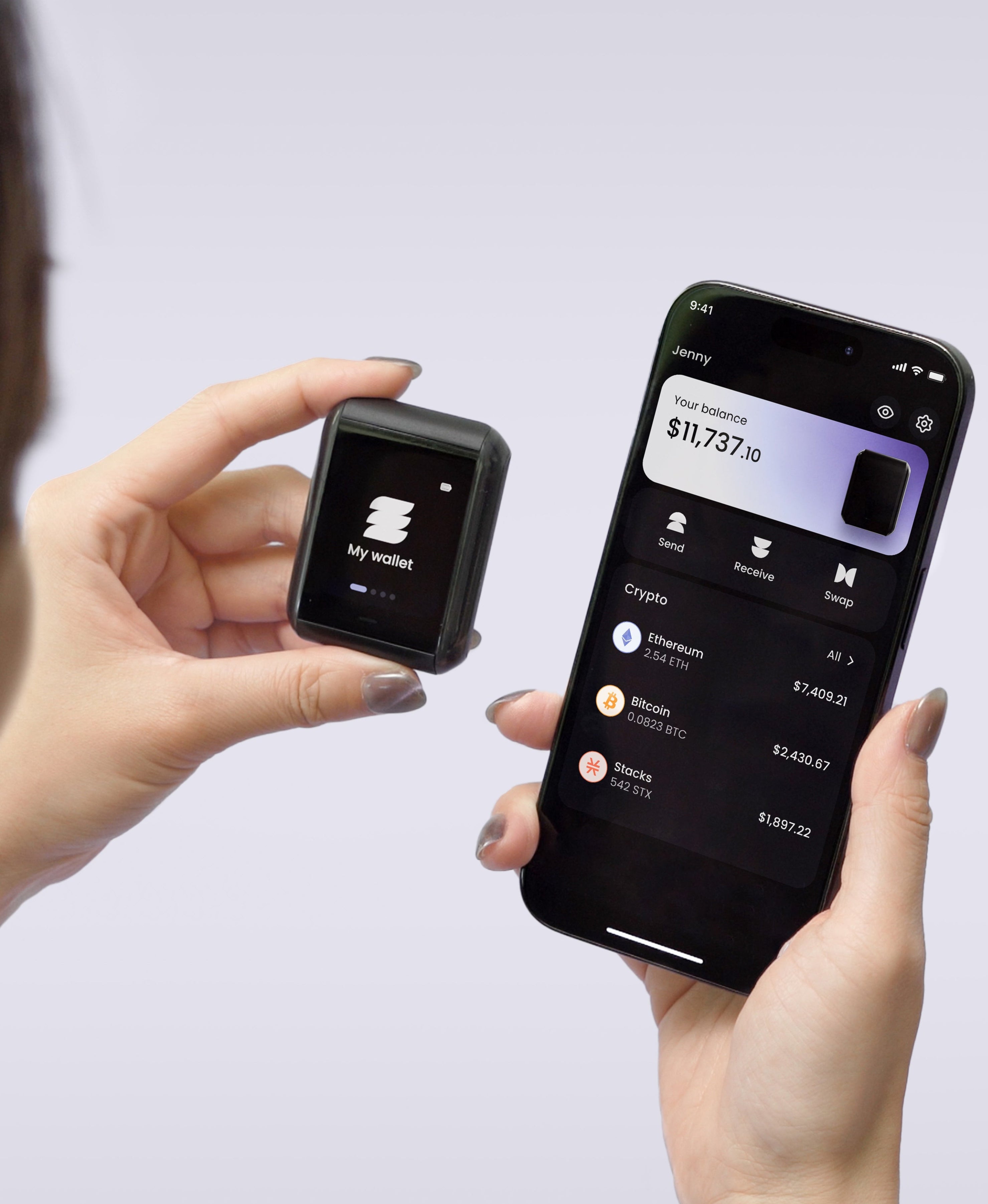
Ryder One currently supports Bitcoin, Ethereum, Solana, and a growing list of top ERC-20 and SPL tokens, so native ATOM and other Cosmos-family chains sit outside the current chain list. The self-custody discipline the device is built around still applies to any Cosmos holder: a hardware key kept offline, transaction detail reviewed before signing, and a backup that survives losing any one component.
Inside Ryder One, private keys are generated inside an EAL6+ certified Infineon SLC38 secure element and never leave the chip. The 1.6-inch AMOLED touchscreen renders the destination address and amount for every transaction the device signs, so a swapped clipboard or a spoofed dApp cannot slip an unfamiliar address past the confirmation step. Communication runs over NFC only, with no USB data port, no Bluetooth radio, and no Wi-Fi, shrinking the remote attack surface that browser-based hot wallets carry by default. The device is IP67 rated, and the included Recovery Tag is IP69K rated for high-pressure water jets, dust, and temperature swings.
Backup shifts away from the paper-and-metal playbook. Paper seed phrases tear, fade, and get misplaced during a house move, while metal plates hold up better yet still leave your security tied to one object surviving everything. TapSafe Recovery splits the recovery secret across a Recovery Tag, your paired phone (encrypted into iCloud or Google Drive), and up to two optional Recovery Contacts who never see the wallet balance. The BIP-39 seed phrase stays accessible on-device as a last resort, and Ryder One ships at $229 with the Recovery Tag, a Qi wireless charging pad, and a travel pouch in the box.
The bottom line
Cosmos in 2026 is the framework whose success shows up across the ecosystem more than on its own price chart. The Cosmos SDK, CometBFT consensus, and IBC are the three components worth carrying in your head, because those pieces power a large share of the biggest chains in crypto today: Injective, Celestia, dYdX, Sei, Osmosis, and more. ATOM sits at the center of the Hub with Interchain Security giving it a staking role beyond the founding chain, though the token's economic story stays quieter than the tech's reach. For any Cosmos-family holder, the mental model is: bech32 addresses per chain, secp256k1 keys shared across the family, IBC as the routing layer, and a hardware key discipline that keeps a layer-1 asset out of an attacker's reach. A signing device that shows every transaction detail before it commits is the pattern Ryder One was built around.
SEO
Target keyword: cosmos crypto / atom crypto
SEO title: Cosmos (ATOM) in 2026: IBC and the Interchain Ecosystem
Meta description: Cosmos (ATOM) in 2026: how the Cosmos SDK, CometBFT, and IBC power Injective, Celestia, dYdX, and Sei, plus the self-custody read on ATOM.
Hero alt text: Cosmos ATOM IBC interchain 2026 — Ryder self-custody hardware wallet


Share: