

Ledger stopped calling its devices hardware wallets. When the company introduced the Ledger Nano Gen5 at its Op3n event in Paris on 23 October 2025, it retired the category name it had spent a decade building, and every device in the range became a "signer" instead. Most people read that as a marketing exercise. The reasoning behind it holds up better than you would expect, and it says something worth knowing about what these devices have quietly turned into.
What Ledger said, and why it isn't wrong
Ledger's stated position is that the old term no longer reflects what the devices do. People reach for them daily now to sign transactions, verify logins, and interact with apps and smart contracts, so "wallet" undersells the job.
As a description of how the category drifted, that lands. A hardware wallet in 2015 was a box you plugged in twice a year to push coins into cold storage and then forgot about. The same box in 2026 sits beside your laptop while you approve a token allowance, confirm a swap, and sign into a marketplace, all before lunch. A wallet sounds like a container that holds something; what you own is closer to a stamp, because it holds the authority to approve and the coins themselves live on a chain nobody keeps in a pocket.
The rename doesn't move the security model in either direction. It does put a useful question in front of buyers: if the device's job is approving things, how well does it show you what you are approving?
What 179 dollars buys
The Gen5 is the cheaper end of Ledger's touchscreen range. It carries a 2.8-inch monochrome E Ink touchscreen that stays readable in bright light, a CC EAL6+ certified secure element, roughly ten hours of battery, and three ways to talk to your other devices: a wired port, Bluetooth Low Energy, and NFC. In the box you get a Ledger Recovery Key along with three paper recovery sheets. Ledger's Transaction Check reads a transaction or contract before you approve it and flags anything that looks hostile on the device screen, which is the same problem Clear Signing has been chipping at for years.
Trezor announced its own flagship the day before at an event in Prague. The Trezor Safe 7 runs 249 dollars and pairs an auditable TROPIC01 chip with a second EAL6+ element, adds Bluetooth and Qi2 wireless charging, and ships with what the company calls a quantum-ready bootloader so the device can take post-quantum updates later rather than being replaced.
| Ledger Nano Gen5 | Trezor Safe 7 | Ryder One | |
|---|---|---|---|
| Price | 179 USD | 249 USD | 149 USD Starter Combo, 179 USD Super Safe Combo |
| Screen | 2.8-inch monochrome E Ink touch | colour touch | 1.6-inch AMOLED touch |
| Connectivity | wired port, Bluetooth LE, NFC | wired port, Bluetooth LE | NFC only |
| Secure element | CC EAL6+ | TROPIC01 plus EAL6+ | EAL6+ Infineon SLC38 |
| Recovery model | 24 words on paper sheets, optional Recovery Key | 24 words on paper | TapSafe: Tag, phone, optional contacts |
Ledger Nano Gen5 is best for someone who signs on both a desktop and a phone across a wide range of chains and wants the largest asset list in the category. Worth knowing: Ledger has had two customer data breaches, in 2020 and again in 2026, and the addresses from those leaks keep resurfacing in phishing letters and doorstep threats years later.
Trezor Safe 7 is best for buyers who want to inspect the silicon rather than take a vendor's word for it, and who will pay 70 dollars more for that. Worth knowing: its parent company confirmed in August 2026 that a shipping provider breach exposed customer names, phone numbers and home addresses, which is a separate class of harm from anything touching keys.
On assets, Ryder One covers Bitcoin, Ethereum, Solana and a growing list of top ERC-20 and SPL tokens, which is a shorter list than either competitor supports, so check the coins you hold against it before you choose.
Three radios, one attack surface
Here is the part the spec sheet states without commenting on it. The Gen5 can be reached over a cable, over Bluetooth, and over NFC. Each of those paths exists because it makes the device pleasant to use, and each one is another route that has to be right, in firmware, forever.
We took the opposite decision on the Ryder One and shipped NFC as the only channel. There is no Bluetooth radio listening in the background and no data path over a cable, so interacting with the device means holding it against your phone on purpose. Short range, one path, nothing to leave switched on by accident.
That choice costs something and it would be dishonest to pretend otherwise: you can't drive a Ryder One from a desktop the way you can drive a Gen5. What you get back is a smaller set of things that can go wrong while the device sits in a drawer.
What the screen is for
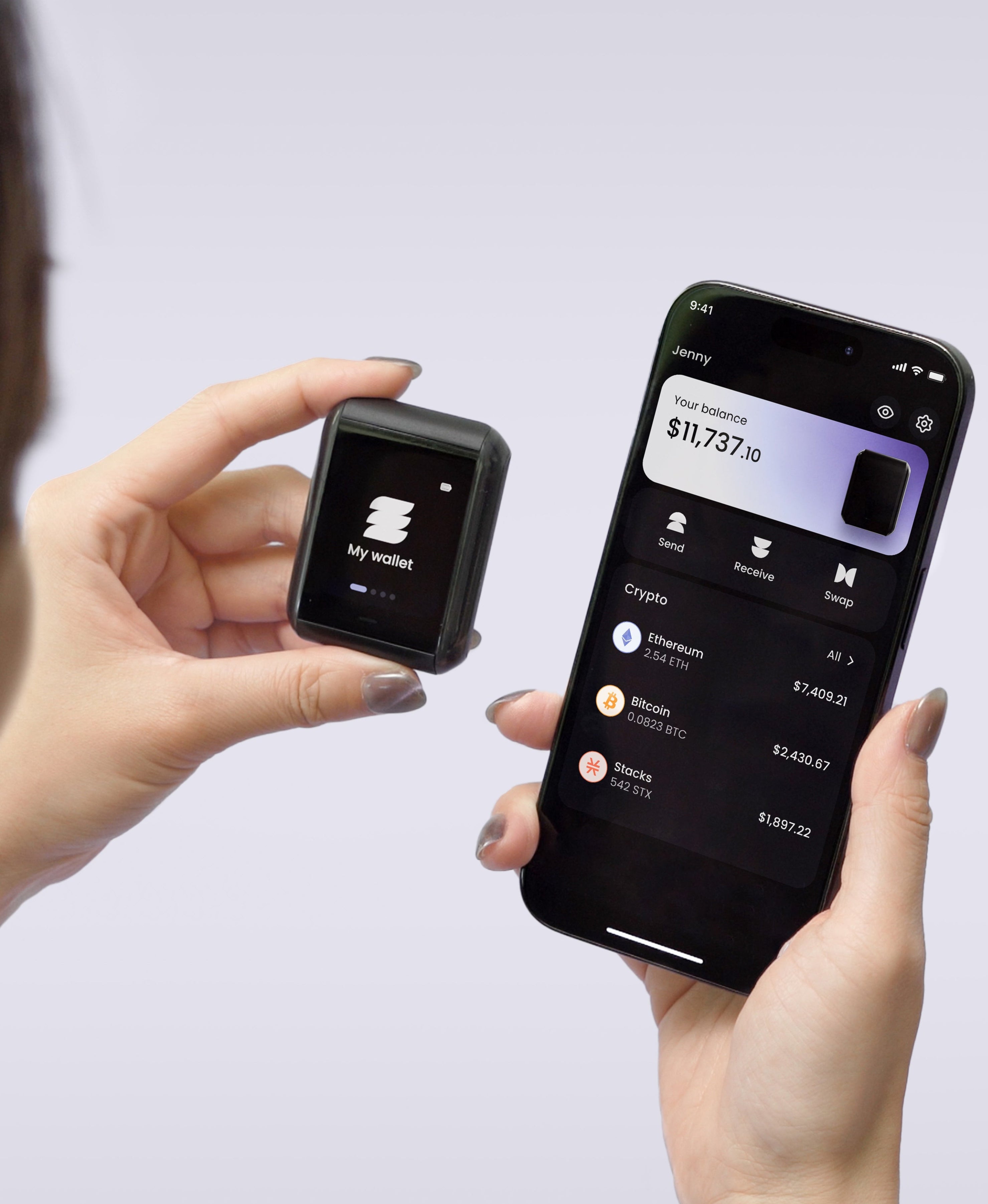
If the device's role is approving, the screen carries the whole argument. Ryder One renders every transaction on a 1.6-inch AMOLED touchscreen in full readable detail before anything is signed, so what appears on the glass is what the button commits you to. That button is wired straight into the EAL6+ Infineon SLC38 secure element, meaning no software path can produce a signature without a human pressing it, and the keypad shuffles its digits on every unlock so somebody watching your fingers learns nothing. Halborn audited the firmware and published the report in full.
Recovery is where the designs diverge
Both competitors above hand you a set of words on paper and wish you luck. The Gen5's Recovery Key is a step up on a paper sheet, and Trezor's approach is the same 24 words it has always been, and in each case one object holds a complete secret that has to survive decades and stay unread by everyone who ever enters your house.
TapSafe Recovery breaks that object apart. A Recovery Tag holds half of what recovery needs, your paired phone holds the other half encrypted into your own iCloud or Google Drive rather than sitting on the handset, and optional Recovery Contacts hold a quarter each while learning nothing about your balances. Two pieces have to come together, which means losing one is a bad afternoon instead of a funeral. The seed phrase stays available on the device as a last resort under the BIP-39 standard, so you keep the escape hatch and the freedom to move to another vendor whenever you like.
Which one fits you
If you sign constantly across many chains from a desktop, the Gen5 at 179 dollars is a reasonable buy and the E Ink screen is a marked improvement on the old Nano line. If auditability is the thing that keeps you up, the Safe 7 is the more interesting device.
If the question is what happens when your house floods, or when you are the one who isn't there to explain the drawer, that is a recovery question rather than a signing one, and it is the question the whole category answers worst. Get your Ryder One.
Meta description: Ledger renamed its hardware wallets to "signers" and shipped the 179-dollar Nano Gen5. What the Gen5 offers, how it compares to Trezor Safe 7 and Ryder One.


Share: