


# Injective (INJ) in 2026: The Finance-Focused L1 Explained
Most Layer 1s pitch themselves as general compute. Injective picked the opposite lane at inception and built its chain around orderbooks, derivatives, and the plumbing that finance-grade dApps need to route price discovery on-chain. Close to five years after mainnet, the chain runs sub-second blocks, sub-cent fees, and hosts a perps DEX called Helix that has cleared more than 30 billion USD in cumulative volume by mid-2026.
Below we cover what Injective and INJ are, the native orderbook module and MEV-resistant matching, how inEVM and inSVM extend the execution stack, the 2026 ecosystem around Helix and Neptune, the INJ burn auction, the self-custody read on Cosmos-family addresses, and where Ryder One fits.
What Injective and INJ are
Injective launched its mainnet in November 2021 after an incubation cycle at Binance Labs that began in 2018. Co-founders Eric Chen and Albert Chon designed the chain around a specific thesis: on-chain finance needs an orderbook the same way it needs a chain, so both belong at the protocol layer. Injective is built with the Cosmos SDK, runs Tendermint-style BFT consensus, hits block times around 0.65 seconds, and prices gas in fractions of a cent.
INJ is the network's staking, governance, and gas token. Validators stake INJ to secure the chain and delegators earn a share of block rewards for locking with them, while every transaction pays a small fee in INJ. The token has a fixed maximum supply of 100 million with a weekly burn auction that pulls INJ out of circulation on a regular cadence, a design that ties token scarcity to dApp activity rather than to arbitrary emission cuts.
Native orderbook and MEV-resistant matching
The design choice that sets Injective apart is where the orderbook lives. On most chains an orderbook is a smart contract that a single DEX writes, deploys, and maintains for itself. Injective moves the orderbook up one level into a native chain module so any dApp can post orders against shared liquidity, and the state of every open bid and ask is a chain-level object rather than a private data structure inside one contract.
That shared orderbook drives Helix, Injective's flagship perps and spot DEX, and any team can build on top of the same limit-order primitives without cold-starting liquidity. Matching happens through a mechanism called frequent batch auctions: instead of taking orders one at a time in the sequence they arrive, the chain groups incoming orders inside each block and clears them at a single uniform price. That structure removes the head-of-block advantage searchers use for sandwich attacks and front-running, because there is no ordering benefit to being first inside the batch.
inEVM, inSVM, and the multi-VM roadmap
Injective began as a Cosmos SDK chain with CosmWasm smart contracts. In 2024 the team shipped inEVM, an Ethereum Virtual Machine environment that runs on Injective and settles into the same consensus, so Solidity contracts port over without a rewrite and Ethereum wallets sign transactions using their existing tooling. That opened Injective to the deep pool of EVM developers who would otherwise stay on Ethereum, Arbitrum, or Base.
The team followed with inSVM, a Solana Virtual Machine layer that lets Solana programs run on Injective under the same settlement design. Between inEVM, inSVM, and CosmWasm, Injective has become a multi-VM chain where builders pick whichever execution model suits their app while sharing liquidity through the native orderbook module. A native oracle module rounds the stack out by pulling price feeds from Chainlink, Pyth, and Band directly into chain state, so pricing for on-chain derivatives comes from redundant sources rather than a single provider.
Helix, Neptune, and the 2026 ecosystem
Helix is the DEX that most Injective users touch first. It runs perpetual futures on majors and long-tail assets, spot markets, and pre-launch futures markets, and its cumulative trading volume passed 30 billion USD by mid-2026 according to the app's own dashboard. Helix uses the native orderbook module, so liquidity that flows into Helix is available to any other Injective app that queries the same order state.
Around Helix sits the rest of the DeFi stack. Neptune Finance operates as the money-market layer where users lend and borrow against INJ, USDT, and a rotating set of collateral assets. Hydro Protocol offers liquid staking, giving stakers a tradable claim while their INJ secures the chain. Talis handles NFTs on Injective, and a growing group of RWA issuers use the chain to tokenize treasuries and credit products. Injective also hosts on-chain AI agent frameworks including deployments built on the ELIZA agent stack, positioning the chain as a settlement layer for automated trading strategies.
INJ tokenomics and the burn auction
The INJ token supply model is what long-term holders study first. Every week a share of protocol fees collected by Injective dApps gets bundled into a basket, and that basket is auctioned to bidders who pay in INJ. The winning bidder receives the basket, and the INJ paid is burned on-chain. That mechanism creates a direct link between usage across the ecosystem and INJ scarcity, because more app activity means a larger fee basket and more INJ retired per auction.
The INJ 3.0 tokenomics upgrade raised the burn rate further by tightening the emission schedule and expanding the fees eligible for the weekly auction. Injective's Volan mainnet upgrade in early 2024 added the RWA module and refined the burn mechanics, and the Altaris upgrade later in 2024 introduced further core changes for permissionless developer access and tokenization primitives. According to CoinGecko's INJ page, circulating supply sat under 100 million heading into mid-2026, with the weekly burn pulling additional INJ out on every cycle.
Self-custody read on INJ
INJ addresses use the Cosmos-family bech32 encoding, so a valid Injective address starts with the `inj` prefix and looks nothing like an Ethereum `0x` address or a Bitcoin address. Under the hood, Injective signs with secp256k1 keys, the same curve Bitcoin and Ethereum use, and its interchain accounts model connects to other Cosmos chains through IBC (Inter-Blockchain Communication) for direct transfers without an external bridge.
Two practical points follow from that. Any INJ holder needs to make sure the destination address prefix matches the chain they intend to reach: sending to an `inj` address on the base Injective chain is a different operation from sending to an inEVM `0x` address, and the two live in different execution environments even though they share consensus. Anyone storing INJ off exchanges also needs the same discipline as with any other layer 1 asset: keep the private key offline, verify the receiving address on a screen you trust, and back up recovery material in a place a fire, flood, or family emergency cannot erase in one hit.
Where Ryder One fits
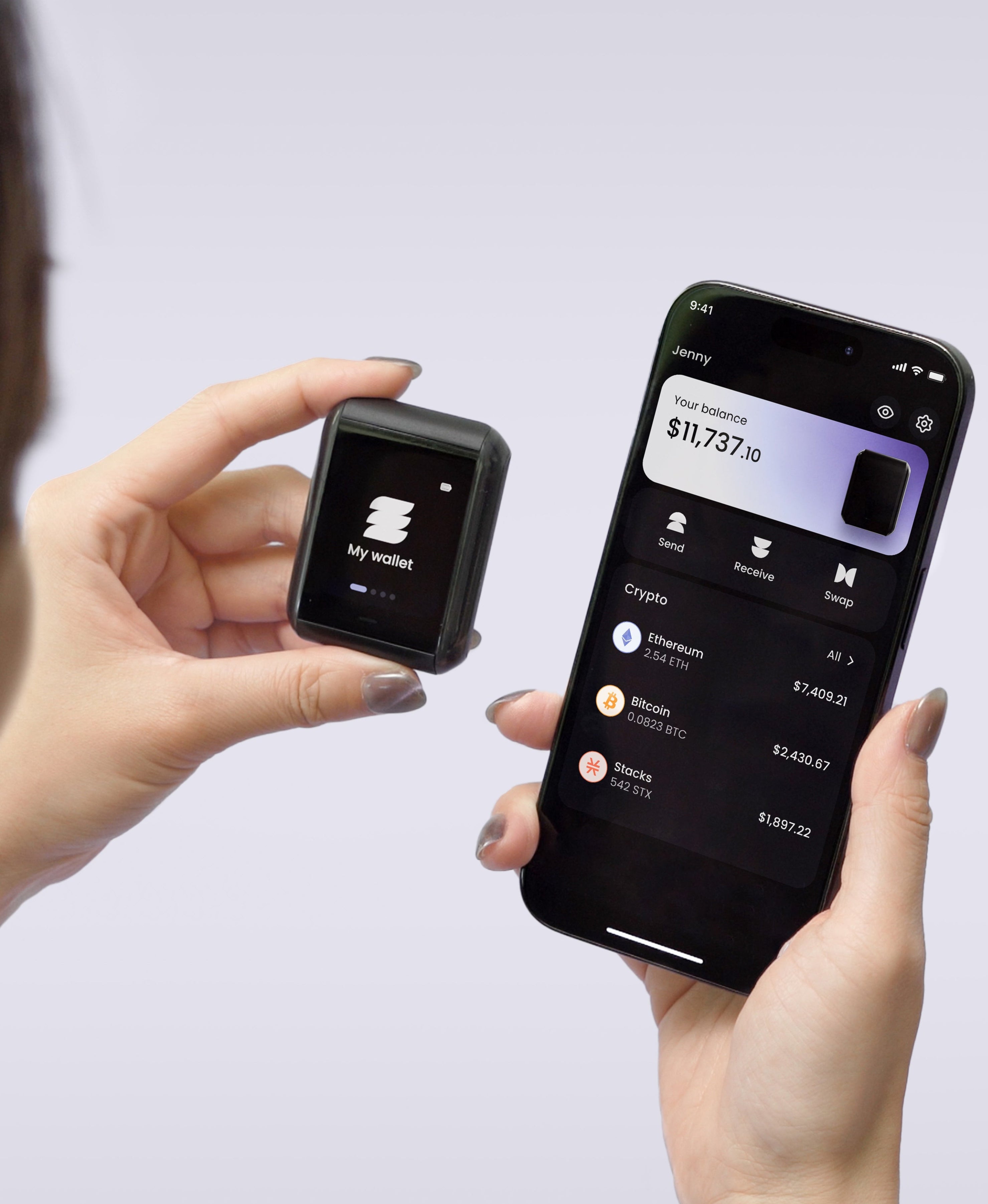
Ryder One currently supports Bitcoin, Ethereum, Solana, and a growing list of top ERC-20 and SPL tokens, so native INJ on the Cosmos side of Injective sits outside the current chain list. Anyone using INJ through the inEVM environment interacts with Ethereum-style signing, and the general self-custody pattern the device is built around applies: a hardware key kept in an offline chip, on-device transaction review before any signature, and a backup system that survives losing one component.
Inside Ryder One, private keys are generated inside an EAL6+ certified Infineon SLC38 secure element and never leave the chip. The 1.6-inch AMOLED touchscreen renders the destination address and amount for every transaction the device signs, so a swapped clipboard or a spoofed dApp cannot slip an unfamiliar address past the confirmation step. Communication runs over NFC only, with no USB data port, no Bluetooth radio, and no Wi-Fi, which shrinks the remote attack surface that browser-based hot wallets carry by default.
Backup shifts away from the paper-and-metal playbook. Paper seed phrases tear, fade, and get lost in a house move; metal plates hold up better but still leave your security tied to one object surviving everything. TapSafe Recovery splits the recovery secret across an IP69K rated Recovery Tag, your paired phone (encrypted into iCloud or Google Drive), and up to two optional Recovery Contacts who never see the wallet balance. The BIP-39 seed phrase stays accessible on-device as a last resort, so a Ryder One holder is never locked to our hardware. The device ships at $229 with the Recovery Tag, a Qi wireless charging pad, and a travel pouch in the box.
The bottom line
Injective in 2026 is a Cosmos-based Layer 1 that decided finance was the product from day one and built the chain around it. The native orderbook module, frequent batch auction matching, inEVM and inSVM execution paths, and the weekly INJ burn auction are the four design choices worth carrying in your head. For anyone holding INJ, the mental model is: bech32 address for the native chain, `0x` address for inEVM, weekly burn tied to fee activity, and no shortcut around the hardware key discipline that keeps any layer 1 asset out of an attacker's reach. A signing device that shows the full transaction detail on screen and keeps keys off the internet is the pattern Ryder One was built around for every asset it supports today.
SEO
Target keyword: injective crypto / inj crypto
SEO title: Injective (INJ) in 2026: The Finance-Focused L1 Explained
Meta description: Injective is a Cosmos SDK L1 built for finance with a native orderbook, inEVM, and INJ burn auction. Injective crypto in 2026 and the self-custody read.
Hero alt text: Injective INJ finance L1 2026 — Ryder self-custody hardware wallet


Share: