

Chainlink's Cross-Chain Interoperability Protocol (CCIP) went live on mainnet in July 2023 with Aave and Synthetix as early adopters. Three years later, the story is no longer about DeFi bridges. In November 2025, SWIFT moved its work with Chainlink from pilot to live production, letting more than 11,000 member banks route tokenized asset instructions through CCIP over ISO 20022 messages. In parallel, DTCC's Smart NAV pilot with JPMorgan, BNY Mellon, and Franklin Templeton showed how mutual fund net-asset-value data can be published on-chain through CCIP for use inside tokenized funds. It's a striking shift for a piece of infrastructure whose closest peers, cross-chain bridges, have lost more than 2.5 billion USD to hacks over the last several years.
In this piece, we'll walk through what Chainlink CCIP is, how its risk model differs from earlier bridges, which traditional finance names have been building on it, why cross-chain routing is still the highest-risk piece of the stack for self-custody holders, and where a hardware wallet like Ryder One fits into that picture.
What Chainlink CCIP is
CCIP stands for Cross-Chain Interoperability Protocol. It's a generalized messaging and token-transfer layer built by Chainlink Labs that lets a smart contract on one blockchain call a smart contract on another and move tokens along with the message. Think of it as a settlement rail sitting between chains, so an application on Ethereum can trigger an action on Base, Arbitrum, Avalanche, or a permissioned bank chain without the user routing funds through a wrapped-token bridge by hand.
At launch, CCIP connected Ethereum, Optimism, Polygon, and Avalanche. By 2026, the protocol connects more than 60 networks including Base, Arbitrum, Solana, and several institutional chains. Competitors include LayerZero, Wormhole, and Axelar; each takes a different position on how messages get validated and who runs the validators. CCIP's differentiator has been its risk model, which we'll unpack next.
How CCIP works and why the risk model matters
Every cross-chain protocol has the same core problem: chain A has to trust a claim about what happened on chain B. Because chain A can't see chain B directly, some off-chain committee has to observe, sign, and relay the message. This is where most bridge hacks have happened. If the committee's keys get compromised or a bug lets an attacker forge a signature, the destination chain accepts a fake message and releases live funds.
CCIP tries to reduce that risk by splitting the job in two. The transactional layer, a Decentralized Oracle Network of Chainlink nodes, observes the source chain and produces a signed Merkle root of the messages. A second, entirely separate group of nodes runs the Risk Management Network, reimplemented in a different programming language (Rust) with a different codebase and a different set of node operators. The Risk Management Network re-checks every message independently, and only when both networks agree does the destination contract "bless" the root and execute the transfer.
The point is defense-in-depth. Both networks would have to be compromised at once for a fraudulent transfer to land, and the Risk Management Network can pause specific lanes if it detects anomalies. That's a stronger security posture than a single multisig, which is how many earlier bridges were structured before they were exploited. None of this makes CCIP unhackable, but it does make the attack surface narrower than the nine-of-fifteen multisig that secured the Ronin bridge before its 620 million USD hack in 2022, and it explains why banks and clearinghouses have been comfortable building tokenized-asset pilots on top of it.
Why traditional finance chose CCIP for tokenized assets
Tokenized assets need a way to move between the venue that issued them and the venue where they get used. A tokenized money-market fund on one bank chain is only useful if it can post as collateral on another, or settle against fiat that still lives inside SWIFT's messaging network. That routing problem is what CCIP has been positioned to solve.
The clearest example is the SWIFT collaboration. Starting with a 2024 pilot alongside UBS Asset Management under the Monetary Authority of Singapore's Project Guardian, SWIFT, Chainlink, and UBS demonstrated that a tokenized fund subscription could be initiated over the SWIFT network, with CCIP handling the on-chain leg. In November 2025, that pilot moved into production as the Digital Transfer Agent standard, with UBS the first global asset manager routing live tokenized-fund flows through it. The banks aren't replacing SWIFT with a chain; they're using CCIP as a translation layer between chains and their existing rails.
DTCC's Smart NAV pilot took a related angle. DTCC, which clears the majority of US securities trades, tested whether it could push mutual-fund NAV data on-chain through CCIP so tokenized funds and smart contracts could read it directly. Participants included American Century Investments, BNY Mellon, Edward Jones, Franklin Templeton, Invesco, JPMorgan, MFS, Mid Atlantic Trust, State Street, and U.S. Bank: ten of the largest names in US asset management working through a CCIP-based data layer.
ANZ Bank has been another visible adopter. Working with Visa, Fidelity International, and ChinaAMC on Phase 2 of the Hong Kong e-HKD pilot, ANZ used CCIP to connect its permissioned DASChain to public networks and settle a cross-border, cross-currency tokenized asset purchase. Ondo Finance's Ondo Bridge, which moves the USDY yield-bearing stablecoin between chains, also runs on CCIP.
Every one of these programs shares a shape: an institution issues a token on one chain, and CCIP settles it against something on another chain or against fiat over SWIFT. The story for CCIP in 2026 is less about DeFi and more about the plumbing under a slow migration of traditional assets to public rails.
Why cross-chain routing is still the risky part for self-custody
Now the part that matters for a self-custody holder. Even with a well-engineered protocol underneath, the moment your wallet touches a cross-chain contract you're signing transactions with consequences hard to read. Bridges have been the single largest source of stolen funds in crypto history: Chainalysis and industry researchers estimate more than 2 billion USD lost to bridge exploits in 2022 alone across Ronin, Wormhole, Nomad, and Harmony, with the cumulative total from 2021 through 2023 crossing 2.5 billion USD.
Most of those losses came from smart-contract bugs and key compromises inside the bridge itself. CCIP's Risk Management Network makes that class of failure less likely, but the risk hasn't disappeared for the user. What replaces it is a different failure mode: signing a transaction you don't understand.
When you approve a cross-chain swap in a browser wallet, the popup usually shows a hex payload and a "confirm" button. If your wallet is a browser extension on a laptop, the whole trust chain sits on a machine that might have malware, a compromised extension, or a phishing overlay changing what you see. An attacker doesn't need to break CCIP to drain you. They need you to sign an approval that hands them unlimited access to your tokens, or to sign a "bridge" transaction that sends funds to their address instead. The bigger the tokenized-asset market gets, the more valuable those approvals become.
This is why self-custody hygiene isn't a solved problem just because the underlying bridge got safer. The user layer, the point where a human clicks confirm, is where funds now go missing.
Where Ryder One fits
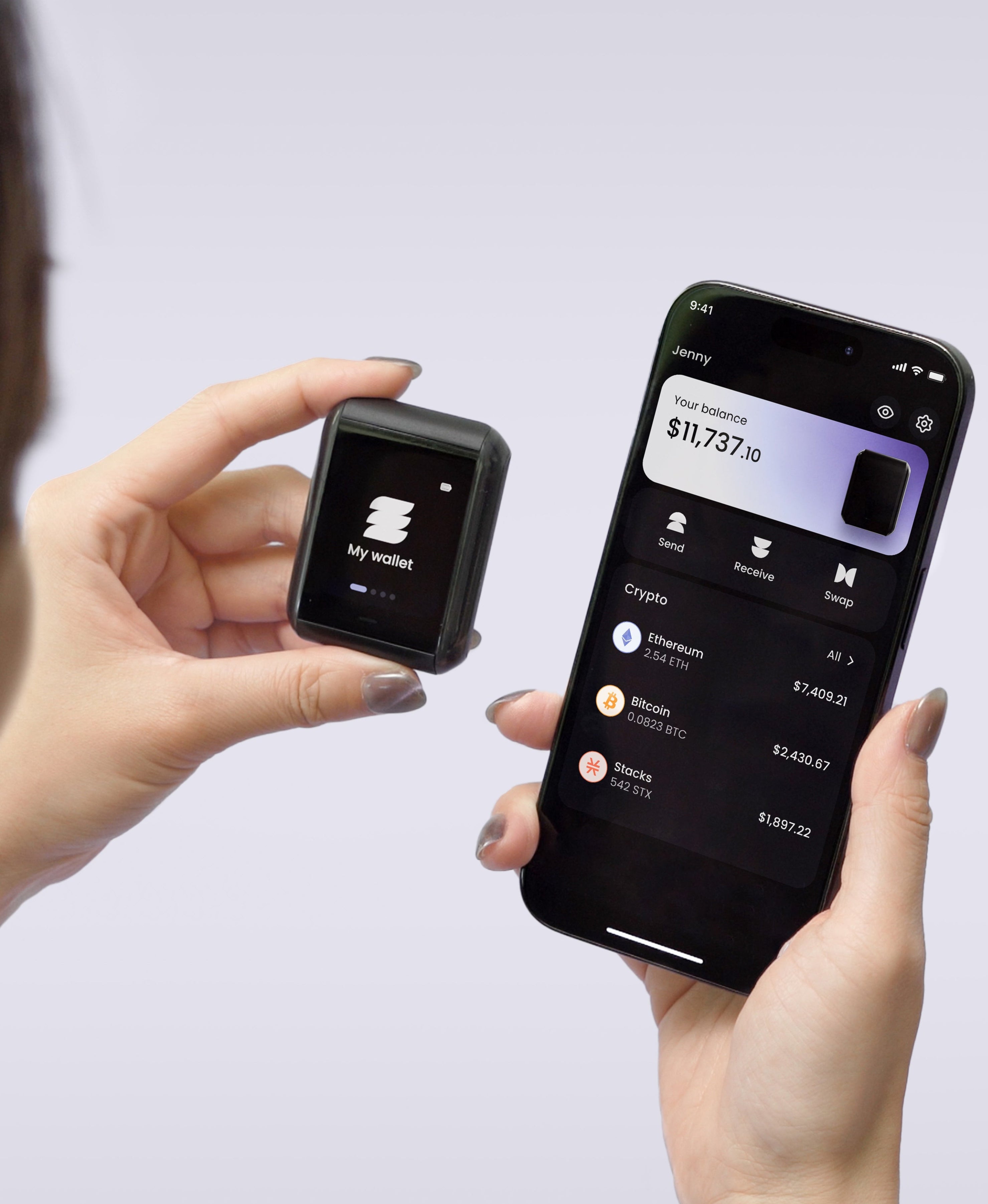
Ryder One is built to close that user-layer gap. Your private keys stay inside an EAL6+ certified Infineon SLC38 secure element, which was independently audited by Halborn. Keys are generated on the chip and never leave it. When a transaction needs signing (a CCIP swap, an ERC-20 approval, a bridge deposit), the details render on a 1.6-inch AMOLED touchscreen so you can read the destination address, the amount, and the contract call before you commit. The physical confirm button is wired directly into the secure element, so no software path can sign without a deliberate press.
The device talks to your phone over NFC only. There's no USB port, no Bluetooth radio, no wireless data path for a remote attacker to work through while you're routing tokens across chains. What you see on the screen is what you sign, which is the shortest path to catching a phishing swap or a poisoned approval before it settles.
Backup is where we tried something different from the standard playbook. Paper seed phrases fail to fire, water, and misplacement. Metal seed plates upgrade the durability, but your security still hinges on one object surviving everything. TapSafe Recovery removes that single point of failure by splitting your recovery secret across a Recovery Tag (IP69K rated), your paired phone (encrypted into iCloud or Google Drive rather than the device itself), and up to two optional Recovery Contacts, none of whom ever see your wallet contents. The BIP-39 seed phrase stays available on-device as a last resort, so you're never locked to our hardware. Ryder One ships at $229 with the Recovery Tag, Qi wireless charging pad, and travel pouch in the box.
The bottom line
CCIP has become the interoperability layer that traditional finance is choosing when tokenized assets need to move between chains. SWIFT, DTCC, UBS, JPMorgan, BNY Mellon, Franklin Templeton, ANZ, Visa, and Fidelity International have all put weight behind pilots or production deployments on the protocol, and the Risk Management Network's separation-of-concerns design is a step forward from the multisig bridges that lost billions between 2021 and 2023.
For a self-custody holder, that improvement matters, but it isn't the whole picture. The bridge can be the safest layer in the stack and still not save you if you sign an approval blindly, mistype an address, or trust a phishing site that looks like the router you meant to use. A hardware wallet with on-device transaction display, an isolated secure element, and a backup story that doesn't collapse into one object closes that gap. As more value moves across chains through CCIP, that layer gets more important, not less.
Cross-chain routing only works if the wallet on your end is trustworthy. Ryder One holds your keys inside an EAL6+ secure element, verifies every transaction on-device, and backs it up with TapSafe Recovery so no single object holds your crypto hostage.
SEO
- Target keyword: chainlink ccip
- SEO title: Chainlink CCIP in 2026: What Cross-Chain Means for Self-Custody (61 chars)
- Meta description: Chainlink CCIP is now the cross-chain layer SWIFT and DTCC are using for tokenized assets. Here's what that means for self-custody holders. (140 chars)


Share: