

The question of whether you can hold Bitcoin in a retirement account has a real answer in 2026, and the answer is more nuanced than the marketing copy from crypto IRA providers makes it sound. Yes, you can hold Bitcoin in an IRA. The path to doing it (through a major broker like Fidelity, through a specialized crypto IRA provider, or through a spot Bitcoin ETF held in a regular IRA) involves trade-offs around custody, taxes, and what you give up by holding crypto inside the retirement wrapper. This piece walks through what a Bitcoin IRA looks like in 2026, the three main paths to getting one, the custody question that matters most, and how it compares to holding Bitcoin in self-custody outside a retirement account.
What a Bitcoin IRA is
A Bitcoin IRA is an individual retirement account that holds Bitcoin (or other crypto) as one of its assets. The wrapper is the same Roth or Traditional IRA that holds stocks and bonds; what changes is the asset class inside it. Roth IRAs are funded with after-tax dollars and grow tax-free, with withdrawals tax-free in retirement. Traditional IRAs are funded with pre-tax dollars, with taxes paid at withdrawal. For Bitcoin specifically, the Roth structure is what most holders gravitate toward, because Bitcoin's potential price appreciation inside a Traditional IRA gets taxed at withdrawal as ordinary income, while a Roth IRA captures the appreciation tax-free.
The three main paths
Path 1: A major broker's crypto IRA. Fidelity Crypto for IRAs is the most accessible option in 2026. The account holds Bitcoin, Ethereum, Litecoin, and Solana, with Fidelity Digital Assets handling custody and Fidelity Management Trust Company serving as the IRA custodian. Opening a Fidelity Crypto IRA also requires opening a traditional brokerage Roth IRA as a funding source. The account is unavailable in California and Oregon as of 2026. Path 2: A specialized Bitcoin IRA provider. Companies like BitcoinIRA, iTrustCapital, and Unchained offer crypto-focused IRA products with broader asset support and sometimes different custody options. Setup fees, trading fees, and custody fees vary. Some specialized providers allow self-directed approaches where the holder has more control over how the crypto is held. Path 3: A spot Bitcoin ETF inside a regular IRA. A regular Fidelity, Schwab, or Vanguard IRA can hold spot Bitcoin ETFs like IBIT or FBTC the same way it holds stocks. The user gets price exposure to Bitcoin without holding actual crypto, with the ETF issuer (BlackRock, Fidelity) handling custody. This is the simplest path mechanically, and it works inside any brokerage IRA that allows ETF trading.
The custody question
Bitcoin IRAs share one structural feature: the holder doesn't hold the keys. IRS rules require IRA assets to be held by a qualified custodian, which means Fidelity Digital Assets, the specialized provider's custody partner, or the ETF issuer's custodian (usually Coinbase Custody, sometimes others) holds the Bitcoin on the IRA's behalf. From a self-custody perspective, this changes the security profile. The holder isn't responsible for keys, seed phrases, or hardware wallet operation. The custodian handles all of that, with the holder's account interface showing balances and trade history. The holder also can't move the Bitcoin off the platform. IRS rules prohibit transferring crypto from your exchange account or personal wallet into a crypto IRA, so funding has to happen with cash, and the crypto purchased through the IRA stays within the custodial structure. For holders who came to crypto through self-custody, the trade-off can feel uncomfortable: the tax benefit comes at the cost of custodial counterparty exposure. For holders who came to crypto through exchanges and find self-custody intimidating, the trade-off is reasonable: the tax benefit is substantial and the custody is similar to what they were already using.
What you give up
A few things the IRA wrapper takes from you. You give up the ability to spend Bitcoin directly. The Bitcoin in your IRA can only be sold for cash within the IRA, with the proceeds reinvested in other assets. You can't use it to pay for things, send it peer-to-peer, or move it on-chain. You give up custody flexibility. The custodian controls how and where the Bitcoin is held. If the custodian fails, your IRA position becomes part of a bankruptcy process the same way any other custodial account would. You give up some withdrawal flexibility. Roth IRA earnings can be withdrawn tax-free only after age 59.5 and a five-year holding period. Traditional IRA withdrawals before 59.5 incur a 10% penalty plus ordinary income tax. The retirement-account benefit comes with the retirement-account restrictions.
What you get
The tax benefit is the headline feature. A Roth Bitcoin IRA that grows over twenty years captures appreciation tax-free, which on a position that compounds significantly is meaningful. Compared to holding Bitcoin in a regular brokerage account where every sale triggers capital gains tax, the Roth wrapper compounds into significant savings over time. You also get the same custody-and-compliance setup that institutional Bitcoin holders use, with insurance, audit trails, and the operational separation that comes with a regulated custodian. For holders who want exposure without managing keys themselves, the package is reasonable.
The hybrid setup most large holders use
For Bitcoin holders with both substantial active positions and a retirement timeline, the common 2026 pattern is to run both: a Bitcoin IRA for the tax-advantaged portion of the position, and a self-custody hardware wallet for the portion they want to control directly. The reasoning is structural. The IRA captures the tax benefit on the long-term portion. A self-custody position handles everything else: spending Bitcoin, sending peer-to-peer, running DeFi positions, keeping a portion of holdings outside any custodian's books in case of an exchange failure or bankruptcy. Neither setup replaces the other. The hybrid uses each one for what it's designed for.
Where Ryder One fits
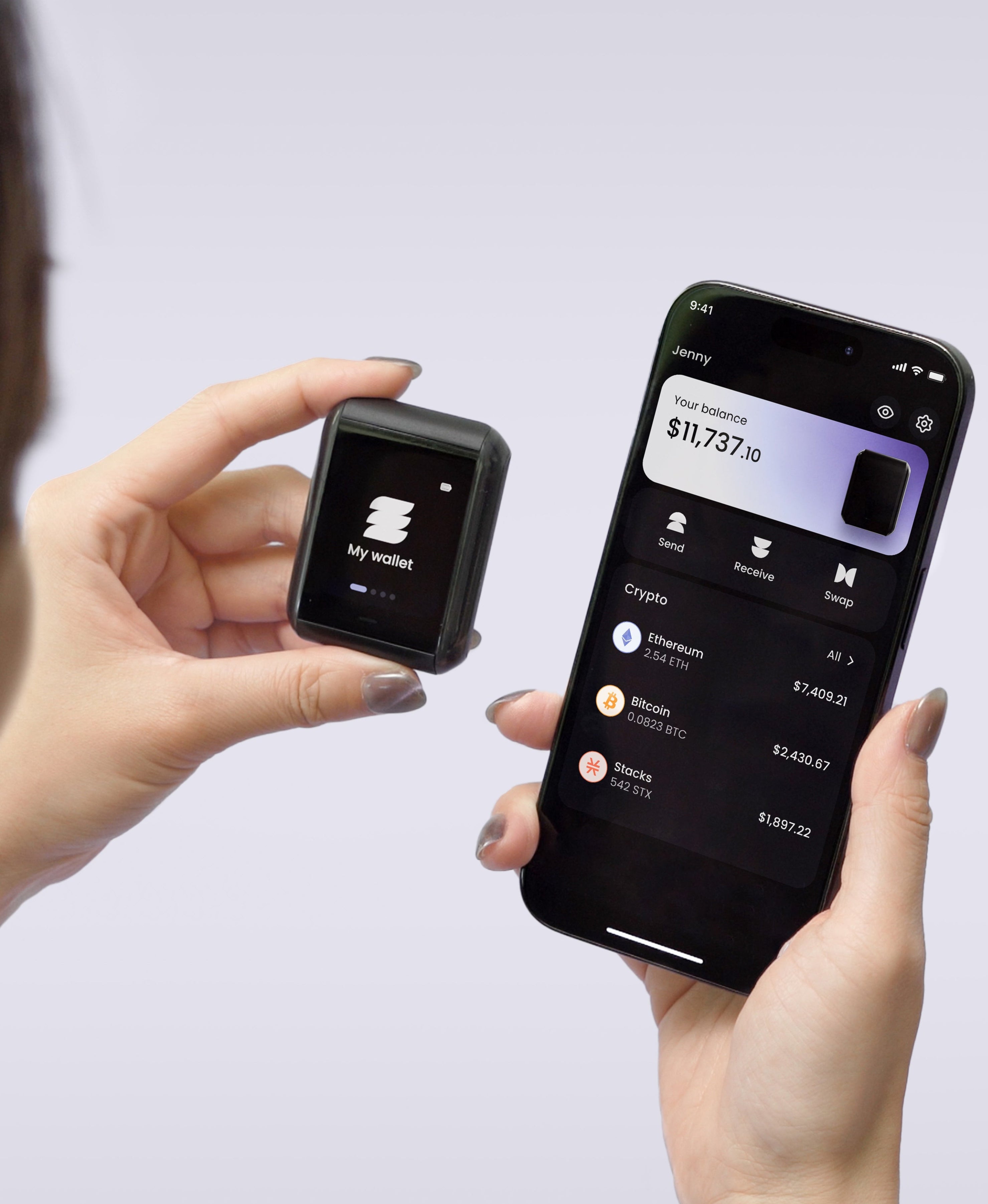
The self-custody side of the hybrid setup is where Ryder One lives. The EAL6+ Infineon SLC38 secure element holds your Bitcoin offline, with every transaction verified on the 1.6-inch AMOLED touchscreen and signed with a physical button press. TapSafe Recovery splits the backup across hardware and people you trust. For users with a Bitcoin IRA, Ryder One handles the part of the position that doesn't fit inside the retirement wrapper: amounts you want to be able to move, spend, or recover without going through a custodian.
The bottom line
You can hold Bitcoin in your IRA in 2026, with three main paths and one common trade-off: the IRA structure requires a custodian, so the holder doesn't hold the keys. The tax benefit is substantial, the custodian setup matches what institutional holders use, and the wrapper restrictions (no spending, age-based withdrawal rules, custodial counterparty) come with the package. Most holders who want both tax efficiency and self-custody flexibility run a hybrid: the IRA for the long-term tax-advantaged position, a hardware wallet for everything else.
The hybrid setup: an IRA for tax-advantaged holding, a hardware wallet for everything you want to move yourself. Ryder One handles the self-custody side: EAL6+ secure element, on-device verification, TapSafe Recovery as the backup. See how it works.


Share: