


# Bitcoin Runes in 2026: Two Years After the Halving Launch, Where the Protocol Stands
Bitcoin Runes went live on April 20, 2024 at block 840,000, the same block that triggered the fourth Bitcoin halving. The debut set records on both sides of the ledger. Miners took home about $107 million in fees that day, the largest single-day payout in Bitcoin's history, and the average transaction fee spiked to roughly $128 as thousands of new tokens raced to mint into the halving block. Two years on, the mania is gone. Runes now accounts for less than 2% of Bitcoin's network fees, and the market is finding its actual level.
In this piece we look at what Runes is, why Casey Rodarmor designed it the way he did, what happened after the launch bubble popped, and what holding a Rune in self-custody looks like in practice. We also cover where a hardware wallet fits when the token you are signing is nothing more than a number attached to a specific unspent Bitcoin output.
What Runes is, in plain terms
Runes is a fungible token standard for Bitcoin. It lets anyone etch a new token into existence and transfer amounts of it between addresses, using nothing but ordinary Bitcoin transactions. There is no sidechain, no bridge, no separate ledger. Balances live inside Bitcoin's own unspent transaction outputs (UTXOs), and every mint or transfer settles as a standard Bitcoin transaction confirmed by miners.
The trick is where the token data lives. When you send a Rune, the transaction carries a small piece of encoded data inside an OP_RETURN output, a script opcode designed for embedding arbitrary bytes that never get treated as spendable. That OP_RETURN acts as a receipt: it tells any Runes-aware indexer how many units of which token now belong to which of the transaction's UTXO outputs. Nodes that don't care about Runes ignore the OP_RETURN entirely. Nodes that do care replay the same math against the chain and arrive at the same balances.
Casey Rodarmor, who also created the Ordinals protocol in early 2023, released the Runes specification in September 2023 and shipped the reference implementation in time for the halving. His stated goal was to give Bitcoin a fungible token layer without the mess of BRC-20, and he tied the launch to block 840,000 partly as a Schelling point and partly as a way to keep pre-halving speculation clean.
Why Runes is different from BRC-20
BRC-20 arrived in early 2023 as the first widely used token standard on Bitcoin. It works by piggybacking on Ordinals: token operations are inscribed into individual satoshis as JSON blobs stored in the witness data of a transaction. That approach works, and BRC-20 briefly held tens of billions in nominal market cap, but the mechanics leave a mess. Every mint and every transfer is its own inscription, which means every action produces new UTXOs and bloats the mempool with data-heavy transactions. At peak BRC-20 activity in mid-2023, most of the largest Bitcoin blocks were 90%+ inscription data.
Runes takes a cleaner approach. Instead of inscribing token state into sats, it treats a UTXO as the container. If a Rune balance sits on a UTXO with 10,000 satoshis of value, you can send that Rune by spending that UTXO in a transaction whose OP_RETURN redistributes the balance across the outputs. One input, a few outputs, one OP_RETURN. No inscription, no witness bloat, no per-transaction JSON parsing. Rodarmor specifically chose OP_RETURN over the witness segment because it makes partially signed Bitcoin transactions (PSBTs) and multi-party swaps easier to build. Wallets can compose a Runes transfer the same way they compose any other Bitcoin spend.
The efficiency shows up in block composition. A high-volume Runes day sits comfortably alongside ordinary Bitcoin traffic; a high-volume BRC-20 day used to crowd it out. That was one of the strongest arguments for the design.
What happened after the mania
The first 48 hours were a fee event. Runes transactions ate roughly 90% of all Bitcoin network fees during the launch window, and daily miner revenue that Saturday landed near the $107 million mark as bidders raced to be included in the first few blocks after 840,000. The halving block itself cost more than 37 BTC in fees, then worth over $2.4 million, the most anyone had ever paid to be etched into a single block.
The correction was fast. Within a week average fees dropped from over $100 back to the mid-teens. Within a month Runes' share of Bitcoin fees had fallen from 90% to under 20%. By early 2026, BlockEden's one-year retrospective put the share at under 2% and the total tracked Runes market cap at roughly $130 million, with about two-thirds of individual tokens trading below their mint price. Magic Eden, the marketplace that had briefly ranked first globally on the back of Bitcoin token volume, wound down its Bitcoin and EVM markets in March 2026 to focus on Solana. OKX and UniSat picked up most of what remained.
That arc reads as a failure only if you thought Runes was going to displace Ethereum. Judged on its own terms, the protocol did what it was built to do. It ships fungible tokens on Bitcoin with a light on-chain footprint, it settles to Bitcoin's finality, and it survives without a foundation, a token, or a marketing budget. The volume that dropped away was the mint-and-flip volume that was never going to persist. What remains is a smaller, quieter ecosystem where a few tokens hold liquidity and the rest sit as digital collectibles with a fixed supply and a spec that anyone can read.
Holding Runes in self-custody
Here is the part that matters if you own some. A Rune balance is not a separate asset the way an ERC-20 lives inside a smart contract. It is a bookkeeping entry that says "this specific UTXO carries this many units of this Rune." Spend that UTXO and the balance moves with the OP_RETURN instructions. Spend it without paying attention to the Runes data and the balance can be destroyed, sent as sats to a miner, or scattered across change outputs in ways you did not intend.
That is the reason wallet support matters more for Runes than for a typical Bitcoin balance. A Bitcoin-only wallet that ignores the OP_RETURN encoding will happily let you burn a valuable Rune by spending its UTXO as if it were ordinary bitcoin. A Runes-aware wallet reads the encoded state, shows you which UTXO holds which balance, and constructs the transaction so the token lands where you meant it to.
This is where self-custody becomes a technical exercise rather than a slogan. Owning your keys is the starting condition. Owning the transaction, verifying on your own screen what the OP_RETURN payload says before you sign, is the part that stops you from burning the position by accident or approving a swap that quietly rewrites the output structure. Every Runes transfer is a small demonstration of why anti-blind-signing on a hardware wallet is worth the trouble.
Where Ryder One fits
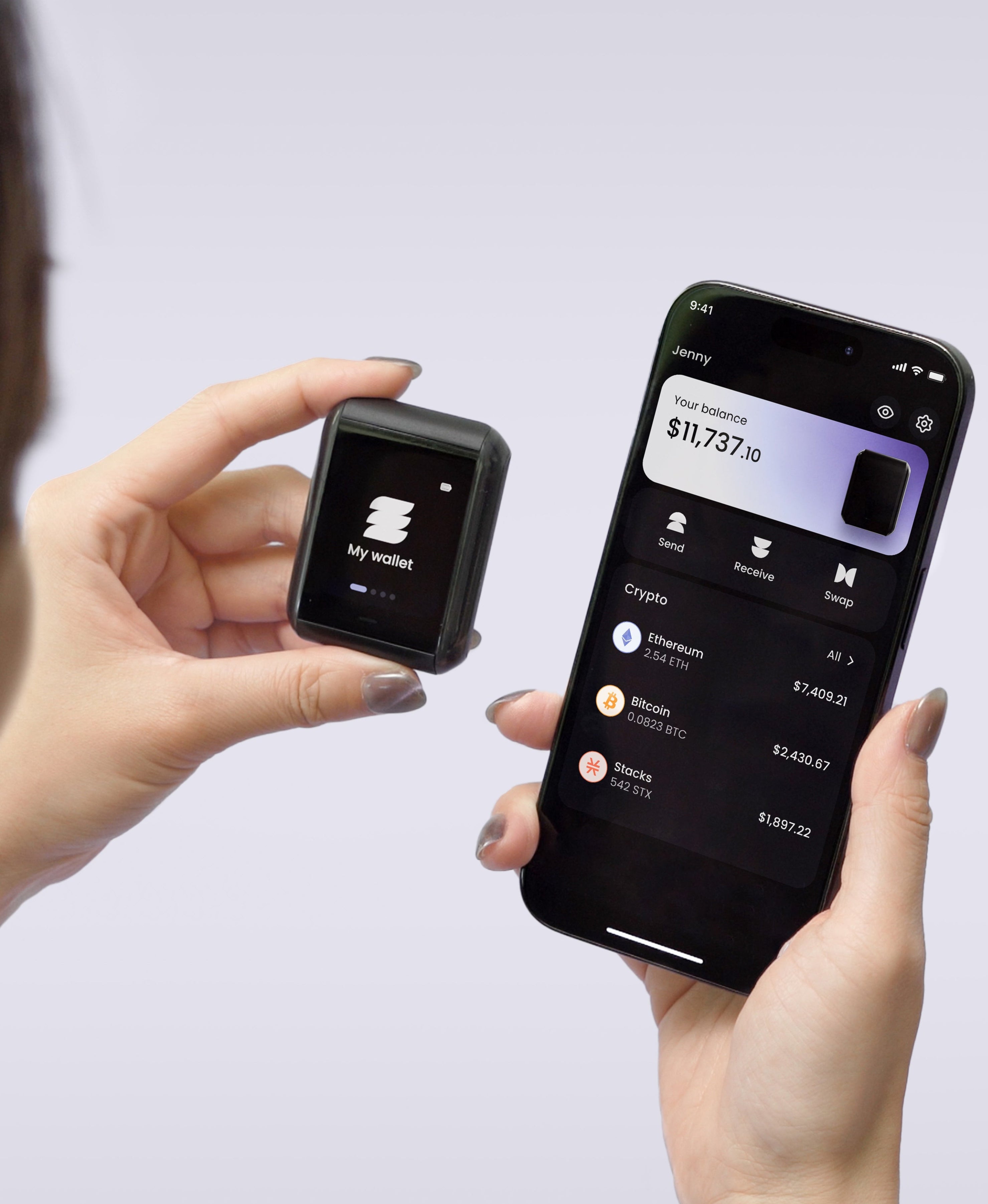
If you are minting or trading Runes, you want the signing device to show you the full transaction, not a hash. The Ryder One is a compact hardware wallet with a 1.6-inch AMOLED touchscreen, an EAL6+ Infineon SLC38 secure element, and NFC-only communication. There is no USB, no Bluetooth, no Wi-Fi. Every transaction the device signs shows on the screen with the destination address, the amount, and the fee, and the physical button that authorizes the signature is wired directly into the secure element so no software path can produce a signature without your press.
For Bitcoin transactions carrying Runes payloads, that on-device readout is the safety net. You see the UTXO structure the transaction is about to build and can catch the case where a listing site or a swap contract has rewritten the outputs in a way that would strand or destroy the balance. Address verification runs on-device too, which defends against the clipboard-swap phishing that has followed every token boom since 2017.
Recovery is handled by TapSafe rather than a paper backup. The Recovery Tag holds 50% of the wallet share and is IP69K rated against high-pressure water, dust, and temperature extremes. A phone backup, stored encrypted in your iCloud or Google Drive rather than on the phone itself, holds the other 50%. Together they form a 2-of-2: either half alone is useless to a thief, and either half alone is useless to you, which is the point. Optional Recovery Contacts add 25% shares apiece, paired in person over NFC, and contacts can never see your balance or your keys. The BIP-39 seed phrase remains accessible on-device as a last resort, so nothing about the recovery model locks you to Ryder hardware. Ryder One ships at $229 with the Recovery Tag, a Qi wireless charger, and a pouch in the box.
The bottom line
Runes did what its spec promised. It brought a UTXO-native token standard to Bitcoin without a bridge or a sidechain, it ran cleaner than BRC-20 on-chain, and it survived the collapse of its own launch bubble. What it did not do was become the next Solana. Two years in, the ecosystem is smaller than the halving-day fee charts suggested it would be, and the tokens that traded on hype are trading below cost.
For the holders who are still there, the question shifts from "will this moon" to "can I move this safely." A Rune position is a Bitcoin UTXO with a specific encoding attached. Treating it like any other Bitcoin balance is how positions get burned. Verifying the transaction on a device you own, before you sign, is how they don't. The Ryder One was built for exactly that kind of custody.
SEO
Target keyword: bitcoin runes
SEO title: Bitcoin Runes in 2026: Where the Protocol Stands Two Years On
Meta description: Runes launched on Bitcoin's 2024 halving block with record fees. Two years on, its share is under 2%. Here's what holding a Rune in self-custody looks like.



Share: