

Binance bitcoin reserves reached roughly 693,000 BTC in September 2026, about 30% of all bitcoin sitting on major exchanges and the highest level in two years, after the platform added around 77,000 BTC since late April. The Market Periodical reported the figures on 11 September, drawing on CryptoQuant and Glassnode data.
Rising exchange balances usually get read as sell pressure. That reading is incomplete here, and the incomplete part is the interesting one.
Where the coins came from
Some of that inflow is ordinary trading behaviour. Some of it is people who used to hold their own keys deciding they would rather someone else did. After the Coldcard exploit drained roughly 1,816 BTC from more than 5,200 addresses starting on 30 July 2026, a number of self-custody holders moved bitcoin onto exchanges, which inflates reserve figures without anyone intending to sell.
You can follow the logic. A firmware bug from 2021 sat undetected for five years and then emptied thousands of wallets belonging to people who had done everything the guides told them to do. If that is what careful looks like, handing the problem to a company with a security team starts to sound like the adult choice.
The trade in that decision deserves to be stated plainly rather than argued away. You are not removing risk. You are swapping a technical risk you can read about for a counterparty risk decided somewhere you have no standing.
The second choke point
The exchange number is only half the concentration story. On the institutional side, funds naming Coinbase as custodian accounted for roughly 77.10 billion USD of the 91.71 billion USD US spot bitcoin ETF market as of 8 April 2026, or about 84.1% of it, which CryptoSlate covered as a single point of failure at the centre of the ETF complex. A stricter count puts it near 80.8%, and either number tells the same story.
So the two largest pools of bitcoin that people don't hold themselves, exchange balances and ETF assets, each funnel into one dominant keeper. Roughly 30% of exchange-held coins sit with one venue. More than four fifths of US spot ETF assets sit with one custodian. Neither concentration was designed; both came from first-mover advantage becoming self-reinforcing as each new entrant copied the template the last one used.
Concentration isn't evidence that either firm is badly run. Coinbase and Binance both operate at a scale that most self-custody holders could not match on their worst day. The problem with a choke point is structural: when a large share of an asset class depends on one operator staying solvent, staying uncompromised, and staying legally free to act, the failure that matters is no longer about any individual's security habits.
What you own in each arrangement
The distinction that survives all of this is legal, and it shows up only under stress. Holding your own keys means you hold the asset. A balance on an exchange or with a custodian means you hold a claim against a company, and a claim behaves differently when the company is paused, frozen, subpoenaed, or insolvent.
FTX made the point at scale: about 8 billion USD of customer funds went missing in 2022, and account holders spent years as unsecured creditors in a bankruptcy proceeding rather than as owners of coins. Binance's own 4.3 billion USD settlement with the US Department of Justice in 2023 came without customer losses, and it still demonstrated that the largest venue operates inside a regulatory system with the power to compel it.
Compare the failure shapes. A wallet bug is technical, dated, and usually published within days of discovery, which means it has an end. An insolvency is decided by a court over years, and your position in it is set by documents you didn't write.
The honest version of the self-custody argument
Self-custody relocates risk. It doesn't delete it, and anyone selling it as risk-free is selling something. Coldcard is the proof: owners controlled their keys and still lost coins, because the device generating those keys had a defect they had no way to inspect.
What self-custody gives you is a risk surface you can see and bound. Firmware that has been independently audited, with the report published rather than summarized. Transactions displayed in readable detail on a screen you approve. A recovery design that doesn't collapse when one object goes missing. None of that is free of danger, and all of it is legible in a way a counterparty's balance sheet is not.
Recovery is where most people give up on holding their own keys
Ask someone why their coins live on an exchange and the answer is rarely about trusting Binance. It's about the twelve words in a drawer and the quiet fear of being the single reason the money is gone. That fear is rational, because the standard playbook does hang everything on one item surviving every scenario. Paper burns. A steel plate survives fire and still leaves you depending on one object nobody can reissue.
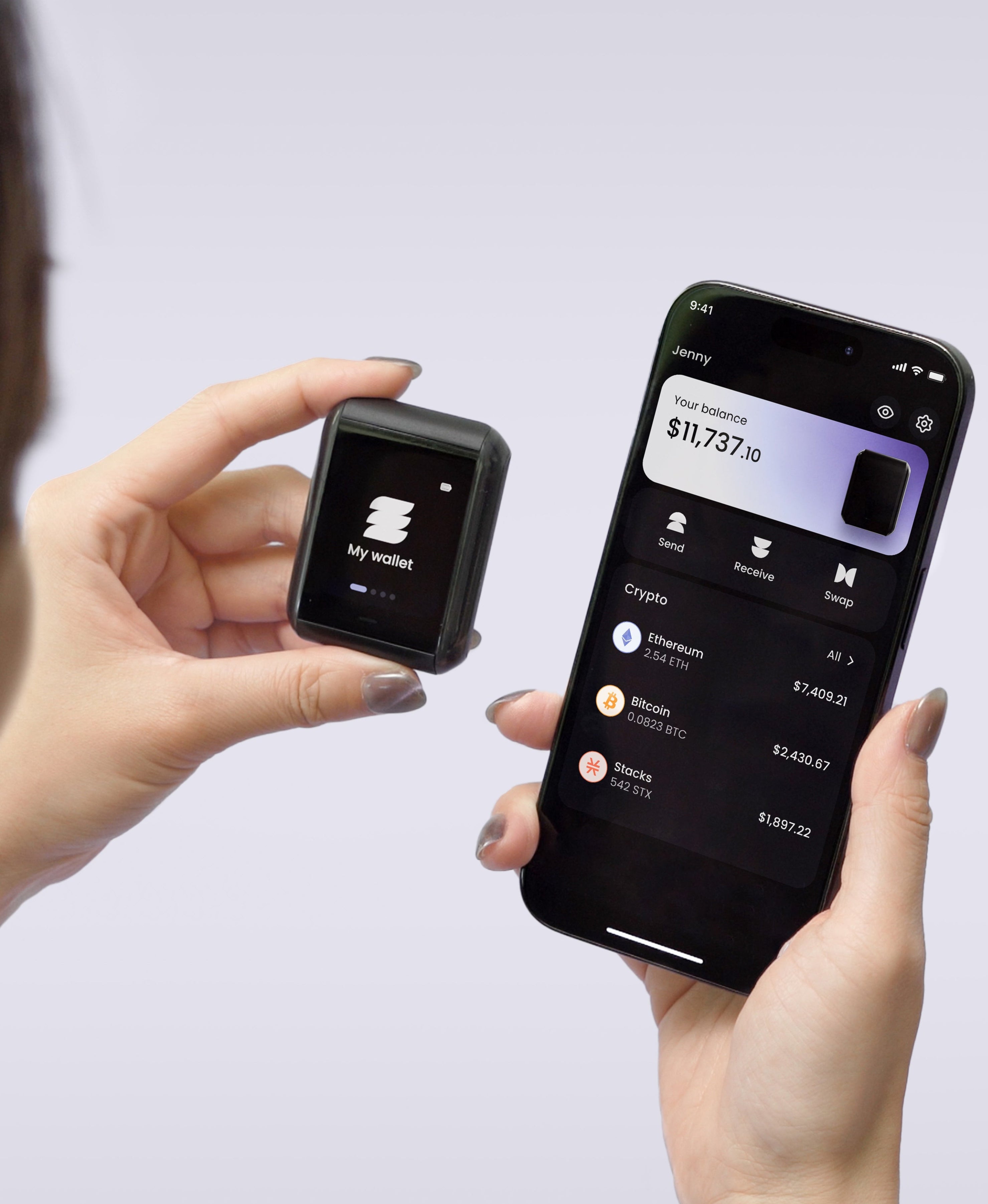
TapSafe Recovery is our answer to that shape of problem. Backup is split: a Recovery Tag holds 50%, and your paired phone holds the other 50%, kept encrypted in your iCloud or Google Drive rather than on the handset, so a lost phone doesn't cost you the share. Optional Recovery Contacts hold 25% each and can see nothing about your wallet. It runs on a custom implementation of Shamir's Secret Sharing, and the seed phrase remains available on the device as a last resort on the BIP-39 standard, so you keep the option to leave.
The Ryder One generates keys inside an EAL6+ certified Infineon SLC38 secure element, where they stay, and its firmware audit by Halborn is public in full. Setup runs about 60 seconds across three NFC taps.
What to take from the number
693,000 BTC at one venue is a market fact, and on its own it predicts very little about price. What it describes is where responsibility has pooled. Every coin in that figure belongs to someone who decided, reasonably, that a company would look after it better than they would.
That decision is worth revisiting once the recovery problem has an answer you trust, because the reason most people outsource custody is not that they want a counterparty. It's that they were handed twelve words and no plan.
Ready to hold your own keys without a single backup object deciding everything? Get your Ryder One for 149 USD.
Meta description: Binance bitcoin reserves hit 693,000 BTC, a two-year high, while one custodian holds 84% of US spot ETF assets. What that concentration means for holders.
Target keyword: binance bitcoin reserves


Share: