

Most advice about holding crypto is written for the next few months, and it answers a question about convenience: where can I keep this and still trade it on a Tuesday. Looking for the best way to store crypto long term means asking something different, because the enemy stops being a bad market and starts being time. Over ten years, the things that take your coins are forgetfulness, a house move, a drawer nobody opened, a company that folded, and a death in the family.
What time does to crypto that hacks don't
The scale of quiet loss is larger than most people expect. Chainalysis studied the age and movement of the bitcoin supply and estimated that between 2.78 and 3.79 million coins were already gone for good, a range the firm later revised to roughly 2.3 to 3.7 million as its wallet-level methodology improved. Either figure puts more bitcoin beyond reach than any exchange collapse has ever touched.
Very little of that was stolen. It sits in addresses whose owners lost a hard drive, wrote twelve words on something that did not survive a decade, or died without telling anyone where to look. Long-term storage is a durability problem before it is a security problem, and the two need separate answers.
Why an exchange is the worst long-term answer
Leaving coins on a crypto exchange means you hold a claim against a company rather than the asset itself, and a claim is only as good as the decade the company survives. FTX made that concrete when roughly 8 billion USD of customer funds went missing in 2022, and the customers who eventually recovered value did so through a bankruptcy process measured in years, at dollar values fixed on the date the doors closed.
Even solvent venues change. They get acquired, exit jurisdictions, freeze withdrawals during incidents, and impose account requirements nobody agreed to at signup. None of that is theft, and all of it stands between you and money you thought was yours to move.
Is a hardware wallet the best way to store crypto long term?
For anything you intend to hold for years, yes, with one condition attached. A hardware wallet keeps your private key inside a chip that never exposes it to a computer, which removes the entire class of loss that comes from malware, browser extensions, and a signature approved on a compromised screen. Ten years of not being drained is worth a great deal.
The condition is that the device is the easy part to replace. Hardware fails, gets lost, and eventually stops being manufactured, so what you are storing for the long run is the ability to recover, and any wallet worth buying uses the BIP-39 standard so that ability outlives the vendor. Check that before you buy, because a recovery method that only works with one company's hardware is a bet on that company still existing when you need it.
Paper, metal, and the one-object problem
The standard advice runs: write the words down, keep them off any computer, store them somewhere safe. It is sound as far as it goes, and paper is where nearly everyone starts.
Paper is also fragile in ways that matter over a decade, since ink fades, damp gets into drawers, house fires happen, and a slip of paper is indistinguishable from rubbish to anyone clearing a room. Stamping the words into a steel plate is the sensible upgrade, and a good plate will survive a fire that takes the building down with it.
Durability is not the whole problem, though. A metal plate is still one object, in one place, that one person needs to find, and it holds a complete secret: whoever picks it up owns everything you have. You have traded a copy that burns for a copy that lasts forever in a stranger's hand, and the single point of failure has moved rather than disappeared.
TapSafe Recovery is our answer to that, and it works by making sure no single item restores your wallet at all. Recovery splits into shares: the Recovery Tag carries 50% and is IP69K rated to survive water jets, dust and temperature extremes, your paired phone carries 50% encrypted into your own iCloud or Google Drive rather than sitting on the handset, and optional Recovery Contacts hold 25% each while learning nothing about your holdings. It is built on our own implementation of Shamir's Secret Sharing, and your seed phrase stays available on the device as a last resort, so nothing about this locks you to us.
Making your storage outlive you
Ask a plain question of whatever setup you land on: if you were hit by a bus tomorrow, would anyone be able to recover this, and could they do it without being able to steal it from you today. Most long-term arrangements fail one half or the other. A steel plate in a safe your partner can open is inheritance without security; a plate nobody knows about is security without inheritance.
Splitting recovery across shares is what lets you answer both at once, because a Recovery Contact holding 25% can help your family rebuild access later while having no route to your coins now. Whatever you choose, write down where the pieces are and tell one person you trust, since an arrangement nobody can reconstruct is the most common way coins join the missing millions. The TapSafe shares make this a conversation about locations rather than about handing someone your keys.
A setup you can finish this week
Move long-term holdings off exchanges first, in a small test transaction before the rest, and verify the receiving address on the device screen rather than in the app that generated it. Keep a separate wallet for the coins you trade, because mixing the two is how long-term money ends up approving a contract it never needed to touch.
Then check the recovery side properly, which is the step nearly everyone skips: confirm you can restore, confirm someone else could, and note where each piece lives.
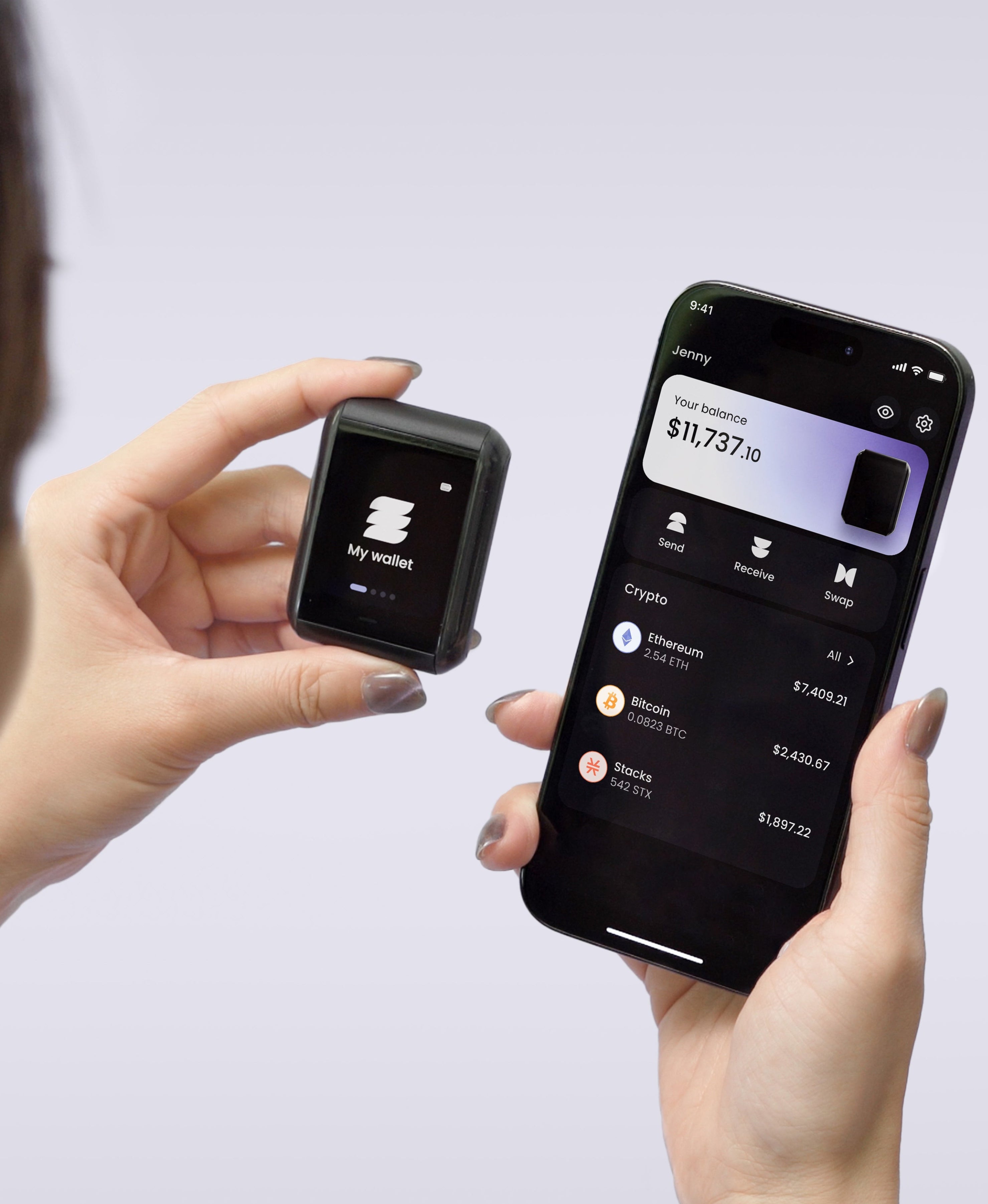
Ryder One was built for exactly this holding pattern. Keys are generated inside an EAL6+ certified Infineon SLC38 secure element and never leave it, every transaction is shown in readable detail on a 1.6-inch AMOLED touchscreen before you approve it, and the firmware was independently audited by Halborn with the report published in full. Communication runs over NFC alone, with no wired data path and no Bluetooth radio. Setup takes about 60 seconds, and the Starter Combo is 149 USD. Get your Ryder One.
Meta description: The best way to store crypto long term isn't about hacks. Over ten years coins go to fires, house moves and deaths. What survives, and what quietly does not.


Share: