


# Base Network in 2026: Coinbase's L2 and What Self-Custody Users Should Know
When Coinbase quietly opened Base to the public in August 2023, the pitch was modest: a low-fee Ethereum layer-2 built on the OP Stack, tuned for consumer apps, with no promise of a token and no attempt to reinvent DeFi. Three years later, Base holds roughly $13.5 billion in TVL according to L2BEAT, sits at the top of the L2 leaderboard by DEX volume, and hosts most of the social apps people mean when they talk about "onchain consumer." It is the closest thing crypto has to a mainstream on-ramp that is not an exchange.
In this piece we look at where Base sits in 2026, why the network grew so fast, and what its architecture means if you hold assets on it. We cover the Farcaster flywheel, the memecoin summer of 2024, the sequencer question, and the bridge assumptions that a self-custody user should read carefully before parking meaningful funds there.
What Base is, in plain terms
Base is an optimistic rollup that settles to Ethereum. It uses the OP Stack, the open-source codebase maintained by the Optimism collective, and it is a member of the Superchain. Transactions execute on Base at fractions of a cent, then batches of those transactions are posted back to Ethereum for finality. If Base's sequencer ever produces an invalid state, anyone can challenge it with a fraud proof during the seven-day withdrawal window.
There is no BASE token. Gas is paid in ETH, which was a deliberate choice by Coinbase to avoid the appearance of an ICO and to keep the chain aligned with Ethereum's economics. USDC is deployed natively (not the bridged USDbC that filled the gap at launch), so stablecoin flows land on Base without a wrapper. In April 2025 Base reached Stage 1 decentralization, meaning a permissionless fault proof system went live and a Security Council was seated to backstop it.
That is the technical shell. The interesting part is what people built inside it.
Why the traction happened
Two things pulled users onto Base in a way that other L2s could not match. The first was the Coinbase distribution funnel: onboarding, KYC, and fiat rails were all one tap from an existing Coinbase account. The second was Farcaster.
Farcaster is a decentralized social protocol. In January 2024 it shipped Frames, a spec that turned any Farcaster post into an interactive mini-app. You could mint an NFT, swap a token, or vote in a poll without leaving the feed. Base was the default settlement layer, and the feedback loop was quick: more Frames drove more Base transactions, more Base activity drew more Farcaster builders, and the two products effectively bootstrapped one another. Cast volume on Farcaster jumped from 200,000 per day to 2 million in the week Frames launched, and Farcaster grew past 200,000 users on that surge.
Then came the memecoin wave. Through spring and summer 2024, tokens like BRETT, DEGEN, and later CLANKER pushed Base's daily transaction count to record highs. BRETT crossed a $1 billion market cap in its first months. DEGEN became a de-facto tipping token inside Farcaster. Aerodrome, the native DEX modeled on Velodrome, absorbed most of the flow and turned into one of the highest-fee-generating protocols on any L2. By late 2025 Base was capturing close to half of all DEX volume across Ethereum L2s according to DefiLlama's chain rankings, a share it has held into 2026.
The mix now is more diverse than memecoins. Morpho anchors the lending side, Aerodrome remains the volume leader, and consumer apps like Zora and Warpcast layer on top. Coinbase itself has started moving portions of its own USDC reserves onto Base, which is worth noting: the operator is also becoming a large customer.
The custody question
Assets on Base are still self-custody assets if you hold them in a hardware wallet. The private keys that control a Base address are the same secp256k1 keys that control the equivalent Ethereum address, and any wallet that supports EVM chains can sign Base transactions. Nothing about the L2 relationship changes who owns the key.
What does change is where the assets settle and who runs the machinery in between. When you deposit ETH or USDC into Base through the canonical bridge, Coinbase's sequencer credits your balance on the L2 and locks the corresponding amount in a smart contract on Ethereum mainnet. To get back to mainnet through that same canonical route, you initiate a withdrawal on Base, wait out the seven-day challenge window (an inherent property of optimistic rollups, giving fraud provers time to contest bad state), then claim the funds on Ethereum. Third-party bridges will front you the liquidity for a fee if you don't want to wait, but that adds its own trust assumptions to the trip.
Self-custody on Base therefore has two layers. Your keys are yours, always. The rails your assets move on, however, are operated by a company. If you plan to keep significant value on Base, treat that as a live consideration rather than a footnote.
Where the sequencer sits
Here is the part that gets skipped in most Base explainers. As of mid-2026 there is one sequencer, and Coinbase runs it. Every transaction on Base is ordered by a single operator before it is posted to Ethereum for finality. That gives Base its speed and low fees; it also means a Coinbase outage is a Base outage. The network has already had at least one multi-hour block-production stall attributable to sequencer bugs, and users could not transact during that window.
The mitigation is the fraud proof system that shipped with Stage 1. If the sequencer ever posted an invalid state, an independent challenger could contest it and roll it back. The seven-day withdrawal delay is the price for that guarantee. The Security Council can also override the sequencer in defined emergency cases. What has not happened yet is a permissionless sequencer set, which is the Stage 2 milestone and the point at which any qualified operator could produce blocks alongside Coinbase. The Superchain roadmap points that direction, and Base has publicly committed to it, but there is no live target date as of writing.
If you are the kind of user who reads L2BEAT risk cards before bridging, this is where you spend your attention. Base scores well on data availability (batches go to Ethereum) and on proof systems (fault proofs are live). It scores as expected on operator centralization: single sequencer, one entity, defined upgrade paths held by a small multisig plus the Security Council. That profile is common across today's top L2s. It is also the specific reason a hardware wallet earns its keep here.
Where Ryder One fits
If your Base activity is casual (a few dollars into Farcaster mini-apps, a memecoin bet, some Aerodrome LP positions) a hot wallet is fine. When the position grows past what you would carry as cash, the calculus changes.
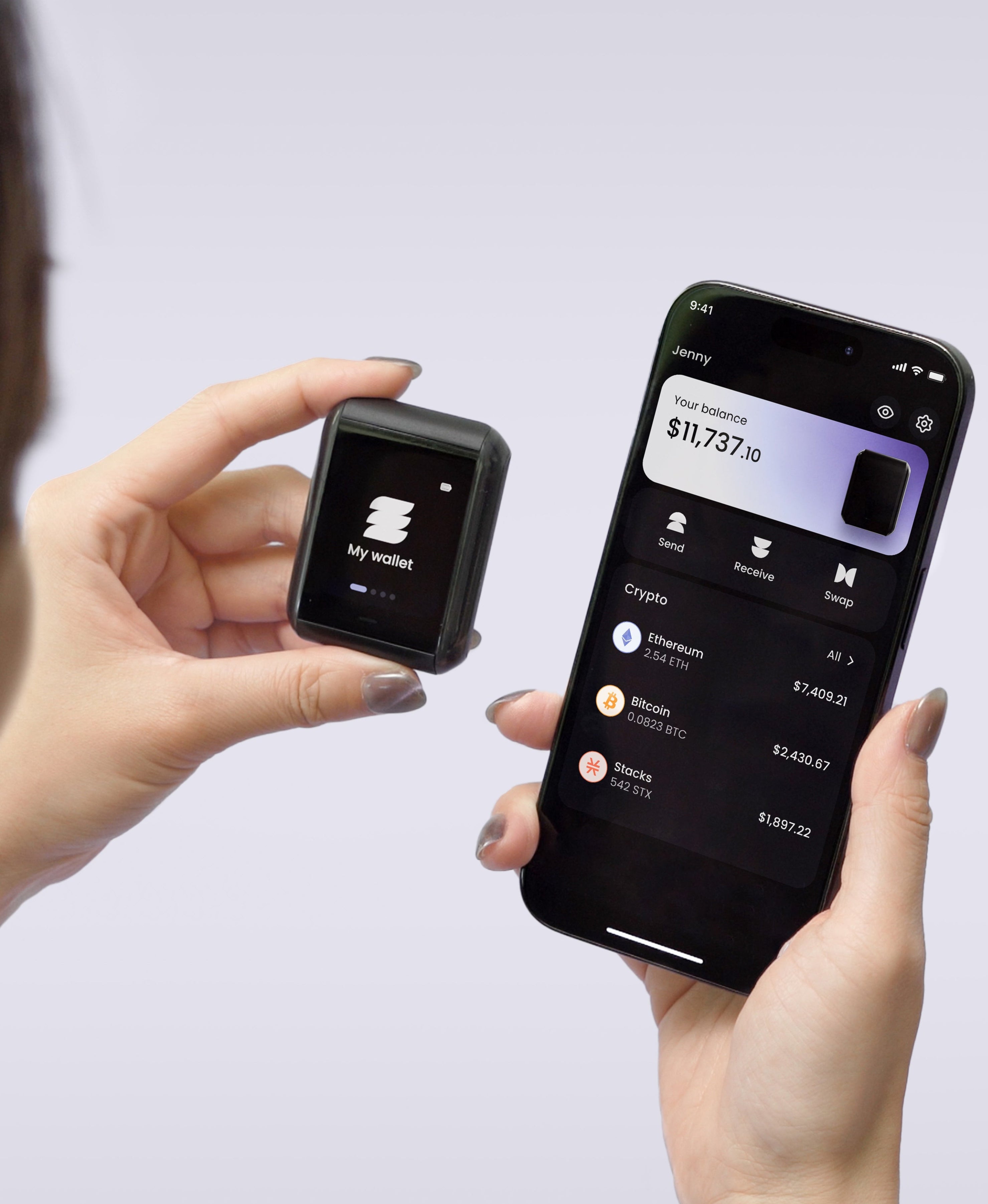
The Ryder One is a compact hardware wallet with a 1.6-inch AMOLED touchscreen, an EAL6+ Infineon SLC38 secure element, and NFC-only communication. There is no USB, no Bluetooth, no Wi-Fi. Every Base transaction (a swap on Aerodrome, a bridge withdrawal, an approval to a new contract) shows on the device screen with full readable detail before you press the button to sign. That button is wired directly to the secure element, so no software path can produce a signature without your tap. Address verification runs on the device too, which defends against clipboard-swap attacks that have shown up on L2s where fees are low enough to make small-value phishing profitable.
Recovery is handled by TapSafe rather than a paper seed. The Recovery Tag holds 50% of the wallet share and is IP69K rated. A phone backup, stored encrypted in your iCloud or Google Drive (not on the phone itself), holds the other 50%. Together they form a 2-of-2: either half alone is useless to an attacker, and either half alone is useless to you, which is the point. Optional Recovery Contacts add 25% shares apiece, up to four, paired in person over NFC. Contacts cannot see your balance or your keys. The BIP-39 seed phrase is available on-device as a last resort, so you are never locked to Ryder hardware. Ryder One ships at $229 with the Recovery Tag, a Qi wireless charger, and a pouch in the box.
This is what self-custody looks like when the underlying chain is operated by a third party. You do not need to trust Coinbase to hold your coins. You do need to accept that the rails those coins ride on are, for now, one company's rails.
The bottom line
Base is the most-used consumer L2 in 2026 by a wide margin. Fees are cheap, apps are plentiful, USDC lands natively, and the Farcaster flywheel has kept new builders arriving even as some other L2s have thinned out. Stage 1 decentralization is a credit to the team; Stage 2 is still ahead. The sequencer remains Coinbase's, and the bridge back to mainnet still runs on a seven-day timer.
None of that makes Base a bad place to be. It does make the case for keeping the key in your pocket and the confirmation on your own screen. If you hold assets on Base worth more than you would leave in a checking account, put them behind a hardware wallet. The Ryder One was built for exactly that job.
SEO
Target keyword: base network
SEO title: Base Network in 2026: Coinbase's L2 Explained
Meta description: Base is Coinbase's L2 with $13B TVL, native USDC, and a single sequencer. Here's what self-custody users should know before parking assets there.


Share: