


# XRP in 2026: What the CLARITY Act Changed for Ripple Holders
For years, XRP powered live payment corridors with a multi-billion-dollar market cap while shadowed by a federal securities lawsuit that kept exchanges cautious and institutions hesitant. That shadow lifted in stages between 2023 and 2025, and 2026 added the regulatory clarity that had always been missing. What changed came through three overlapping developments: a court settlement, agency guidance, and legislation designed to write the outcome into federal statute.
XRP and the XRP Ledger Are Not the Same as Ripple Labs
XRP is the native digital asset of the XRP Ledger (XRPL), an open-source blockchain that has been running since 2012. Three developers, David Schwartz, Jed McCaleb, and Arthur Britto, built the ledger and gifted 80 billion of the 100 billion XRP supply to Ripple Labs, the company. The ledger itself runs independently of any single organization: validators are distributed across institutions worldwide, and XRP can be held, transferred, and traded by anyone without Ripple's involvement or permission.
The XRPL settles transactions through a Federated Byzantine Agreement mechanism called the Ripple Protocol Consensus Algorithm (RPCA): each participant selects a set of trusted validators, and transactions clear when a sufficient percentage of those validators agree. There is no mining, and ledger versions close roughly every three to five seconds. Accounts support both secp256k1 and ed25519 cryptographic signing, with ed25519 increasingly recommended for new wallets.
Every active XRPL account must hold a minimum reserve of 10 XRP, locked at the protocol level as an anti-spam measure. Additional account objects, such as Trust Lines for holding non-native XRPL tokens, each require a further 2 XRP reserve. Addresses come in two formats: classic addresses starting with "r" (Base58 encoded) and X-addresses that bundle the address and a destination tag into a single string. These reserve mechanics and address structures are specific to XRPL and differ from what you encounter on Bitcoin or Ethereum.
The SEC Case: What Happened and When It Ended
The SEC filed suit against Ripple Labs in December 2020, alleging that Ripple had conducted approximately $1.38 billion in unregistered securities offerings by selling XRP to institutional and retail buyers over several years.
In July 2023, Judge Analisa Torres issued a summary judgment that drew a significant line between Ripple's direct institutional XRP sales, which qualified as investment contracts under the Howey test, and the programmatic exchange sales to retail buyers on public platforms, which did not. Retail buyers lacked a direct contractual relationship with Ripple and had no specific expectation of profit tied to the company's efforts. The SEC dropped charges against CEO Brad Garlinghouse and co-founder Chris Larsen in October 2023, and a 2024 remedies order set Ripple's civil penalty at $125 million alongside a permanent injunction against future direct institutional XRP sales in the United States.
In August 2025, both Ripple and the SEC withdrew their cross-appeals, locking in the 2023 summary judgment as the final legal word. The final settlement reduced the penalty to $50 million, with the remainder returned to Ripple, and the case was closed. For secondary-market holders, the relevant conclusion had been established years earlier: buying XRP on an exchange is not buying a security. The August 2025 withdrawal confirmed that conclusion would stand.
What the CLARITY Act Changes for XRP Holders
Two developments in 2026 moved XRP's status from courtroom outcomes into regulatory architecture.
On March 17, 2026, the SEC and CFTC issued a joint interpretive release classifying 16 digital assets, including Bitcoin, Ethereum, Solana, and XRP, as digital commodities. That guidance placed XRP under CFTC jurisdiction, putting it in the same regulatory category as oil, wheat, and gold futures. Agency guidance, however, carries a built-in fragility: a future administration could revise or reverse it without congressional action.
The CLARITY Act (H.R. 3633) is designed to fix that problem by writing commodity classification into federal statute. The bill passed the US House 294-134 in 2025 and cleared the Senate Banking Committee 15-9 on May 14, 2026. As of late July 2026, it remains pending on the Senate floor, requiring 60 votes for cloture and facing a tight timeline before the August recess. Prediction markets priced passage odds at roughly 43% at the time of writing.
If enacted, the CLARITY Act would write the commodity classification into federal statute, requiring congressional action to undo rather than an agency leadership change. Exchanges listing XRP would face fewer registration burdens, the pathway for exchange-traded products would become more defined, and the bill's formal distinction between sufficiently decentralized digital commodities and those that are not would move XRP's oversight permanently to the CFTC rather than the SEC. For XRP, whose decentralization had been disputed since the Ripple lawsuit began, codifying that status would close the most significant remaining regulatory question.
How XRP Works as a Payment Rail
XRP was designed for currency interoperability, not as a store-of-value asset. Ripple's On-Demand Liquidity service (ODL), now operating under the Ripple Payments umbrella, uses XRP as a bridge currency in cross-border payment corridors.
The process: a sender converts funds into XRP, which travels the XRPL in seconds, then converts into the destination currency. No bank needs to pre-fund a local account at the other end. By eliminating pre-funded nostro accounts, ODL corridors can reduce liquidity costs by 60 to 70 percent compared to conventional wire transfers, removing the capital requirement that has kept cross-border banking slow for decades.
Ripple's Q1 2026 update reported that ODL processed over $35 billion in cross-border value, a 41 percent increase year-over-year, with the strongest growth in Latin America through corridors including USD-MXN via Bitso and USD-PHP via Coins.ph. Cumulative Ripple Payments volume surpassed $95 billion as of early 2026. XRP's price sits around $1.06 with a circulating market cap of approximately $66 billion, ranking sixth among all digital assets; the total supply is capped at 100 billion XRP with no mechanism for creating new coins.
Self-Custody on XRP: What Controlling Your Keys Means on XRPL
Moving XRP off an exchange and into self-custody involves a few XRPL-specific considerations that do not apply to Bitcoin or Ethereum wallets.
A freshly derived XRPL address exists as a cryptographic key pair but remains inactive until it receives the 10 XRP base reserve. That reserve is locked by the protocol and cannot be spent; it functions as a security deposit that stays for as long as the account is open. When you hold XRP on an exchange, this reserve is absorbed into the platform's pooled ledger accounts. When you take custody yourself, that 10 XRP becomes your entry cost for a live XRPL account.
Trust Lines add to this. Each non-native token you choose to hold on XRPL requires a Trust Line, and each Trust Line locks an additional 2 XRP in reserve. Managing these objects has direct implications for your spendable balance, which is worth planning before you open the account.
At the signing layer, your private key controls the XRPL account, and your seed phrase recovers that key. An exchange holding your balance controls the actual on-ledger accounts; your position is a ledger entry in their database rather than a direct XRPL account you control. Moving to a hardware wallet changes that arrangement by keeping private key generation and transaction signing offline inside a dedicated secure element.
Where Ryder One Fits
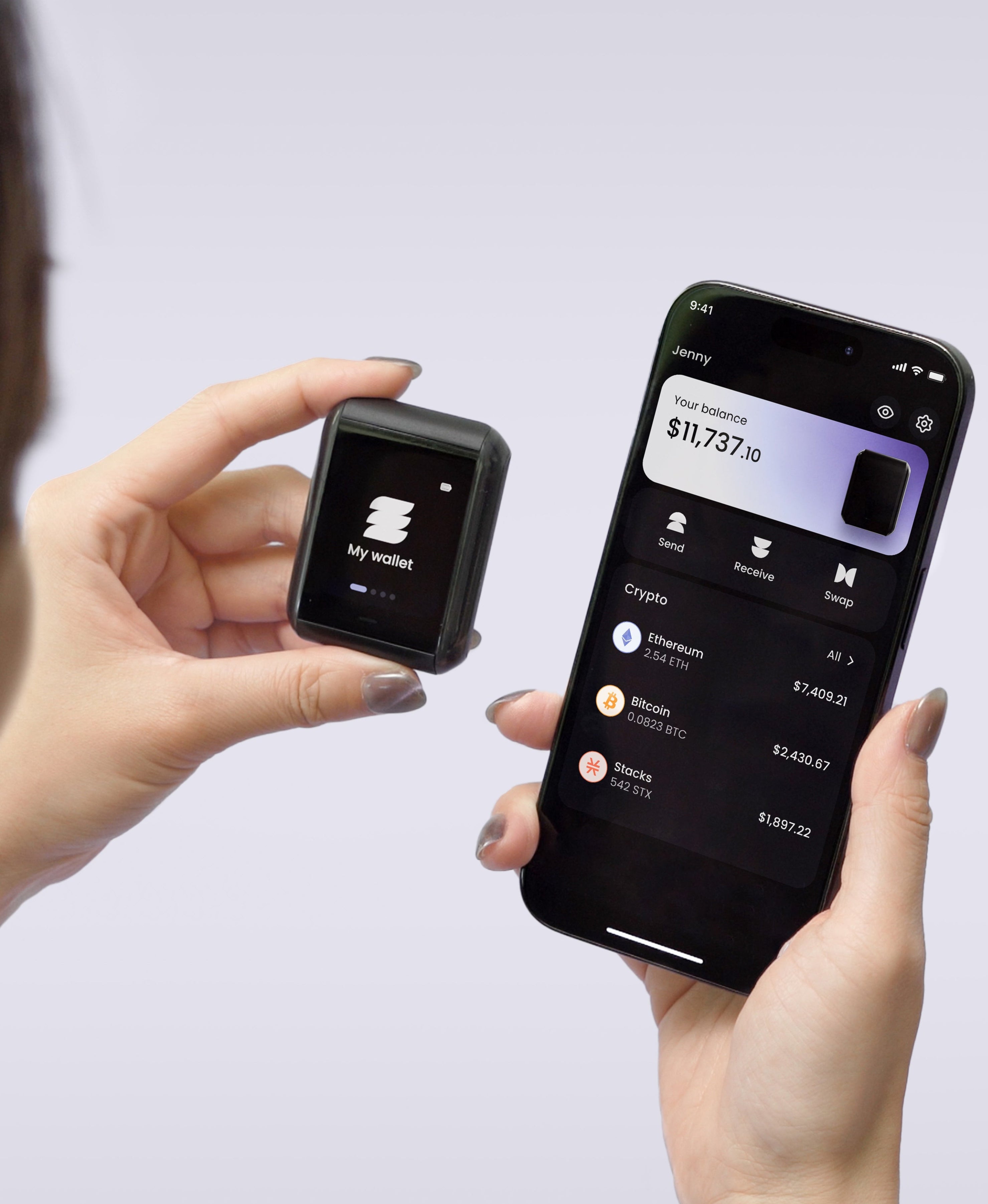
Ryder One currently supports Bitcoin, Ethereum, Solana, and a growing range of ERC-20 and SPL tokens. Native XRP on the XRP Ledger is not on the current supported chain list, and we are not going to pretend otherwise.
That does not make the self-custody principles discussed here less relevant. The logic holds across every blockchain: your keys give you direct control over your assets; a custodian's keys mean a contractual claim against an intermediary rather than the asset itself. When XRP support arrives on Ryder One, the same hardware-isolation model will apply: a secure element that generates and signs keys offline, a screen that shows full transaction details before confirmation, and a recovery model that does not reduce to a single piece of paper. For current chain support and pricing, check the Ryder One product page.
The Custody Question Does Not Wait for Legislation
The CLARITY Act passing or stalling does not change who controls XRP sitting on an exchange. Regulatory status shapes how an asset is treated by law; it does not affect who holds the private keys or what a platform's solvency has to do with your balance.
Ripple winning its court case was welcome news for the ecosystem. What protects your holdings is the custody layer beneath the asset rather than the classification layer above it. If XRP is part of your portfolio, the questions worth asking are the same ones worth asking about any digital asset: who controls the keys, what happens if that party encounters trouble, and what your recovery path looks like.
Those questions have answers. Ryder One is where to start finding them for the chains it supports today.
SEO
- Target keyword: xrp clarity act
- SEO title: XRP in 2026: What the CLARITY Act Changed
- Meta description: The CLARITY Act reshuffled XRP's regulatory status in 2026. Here's what changed, what Ripple won, and the self-custody read for XRP holders. (153 chars)
- Hero alt text: XRP CLARITY Act Ripple 2026 — Ryder self-custody hardware wallet


Share: