

When Ledger announced its Recover service in May 2023, the crypto community reacted faster than the marketing team had planned for. Within days the company had paused public messaging, walked back parts of its rollout, and started clarifying what the feature actually did. The controversy never fully died down. Three years later, Ledger Recover is still a reference point for self-custody holders trying to decide what they want their hardware wallet vendor to be capable of. This piece walks through what Ledger Recover actually is, why the reaction was as strong as it was, and how a structurally different approach to the same problem (split-share recovery) handles the trust question.
What Ledger Recover does
Ledger Recover is an optional subscription service. Users who opt in have their seed phrase encrypted on-device, split into three shares, and each share sent to a separate custodian partner. The original three custodians at launch were Coincover, Onfido (later renamed Entrust), and EscrowTech. To recover the seed phrase, the user submits an ID verification through Ledger's recovery flow. If the verification succeeds, the three custodians release their shares, the device reconstructs the seed phrase, and the user regains access. The legitimate use case is a holder who can't or won't manage a seed phrase the traditional way: an elderly relative, an heir without crypto experience, or a holder paranoid about losing a paper backup. For those use cases, Ledger Recover is a reasonable answer.
Why the reaction was strong
Three threads tangled together at launch. The firmware update came to everyone. The capability to extract an encrypted seed-phrase backup and send it off-device shipped as part of a firmware update that all Ledger devices received, not just devices belonging to users who'd subscribed to the service. The feature was opt-in (you had to subscribe to Recover to actually use it), but the mechanism existed in firmware on every device. For users who had bought a Ledger specifically because they'd been told the seed phrase never left the secure element, that was a reframing. The previous marketing said something different. For years, Ledger's marketing had emphasized that private keys stay on the secure element and can't be extracted. Recover required a code path that could extract an encrypted version of the seed phrase from the secure element under specific conditions. Defenders argued this had always been technically possible given the device's design; critics argued the marketing had implied otherwise. The trust model changed. Before Recover, a Ledger user's trust set was: Ledger (firmware integrity), themselves (key custody), and the people they personally chose to share recovery with (if anyone). With Recover, the trust set added: three custodian companies that hold encrypted shares, the ID-verification provider that gates recovery, and the legal jurisdictions those companies operate in. For users who'd chosen self-custody specifically to avoid that kind of multi-party trust, the feature represented the thing they'd opted out of. Ledger's response was reasonable. The feature is optional. The encryption is end-to-end. The custodians can't reconstruct the seed phrase on their own. None of those points were wrong, but they also didn't address the underlying objection, which wasn't about Recover specifically but about the existence of a firmware path that could do what Recover does.
What the criticism gets right
The structural concern isn't paranoid. Once a firmware path exists that can extract encrypted backups from a secure element, the question of "under what conditions can the backup be extracted" becomes one the user has to trust the vendor on, rather than one the hardware can answer mechanically. The ID-verification dependency is also a real consideration. Identity verification is a service performed by a company subject to jurisdictional law. If that company is compelled to release a recovery, or if it changes its policies, the recovery path changes with it. A self-custody recovery flow that depends on an ID-verification step is, by definition, not purely self-custodial.
What the criticism gets wrong
No recovery system is purely magical. Every recovery flow either depends on something the user wrote down (the seed phrase) or distributes trust across other parties (shares, guardians, custodians). The alternative to a system like Recover isn't "no trust"; it's "trust spread across different parties." For users who genuinely can't manage a seed phrase, the realistic options are: - A custodial exchange (single point of failure plus full custody, not recommended) - A vendor-managed recovery like Ledger Recover (split trust across custodians and ID-verification) - A user-managed split-share recovery (trust spread across people the user chose personally) The first is worse than Recover for almost every threat model. The third is better, but it requires the user to have people they can split trust across. For users who don't, Recover is a defensible third option.
A different structural answer
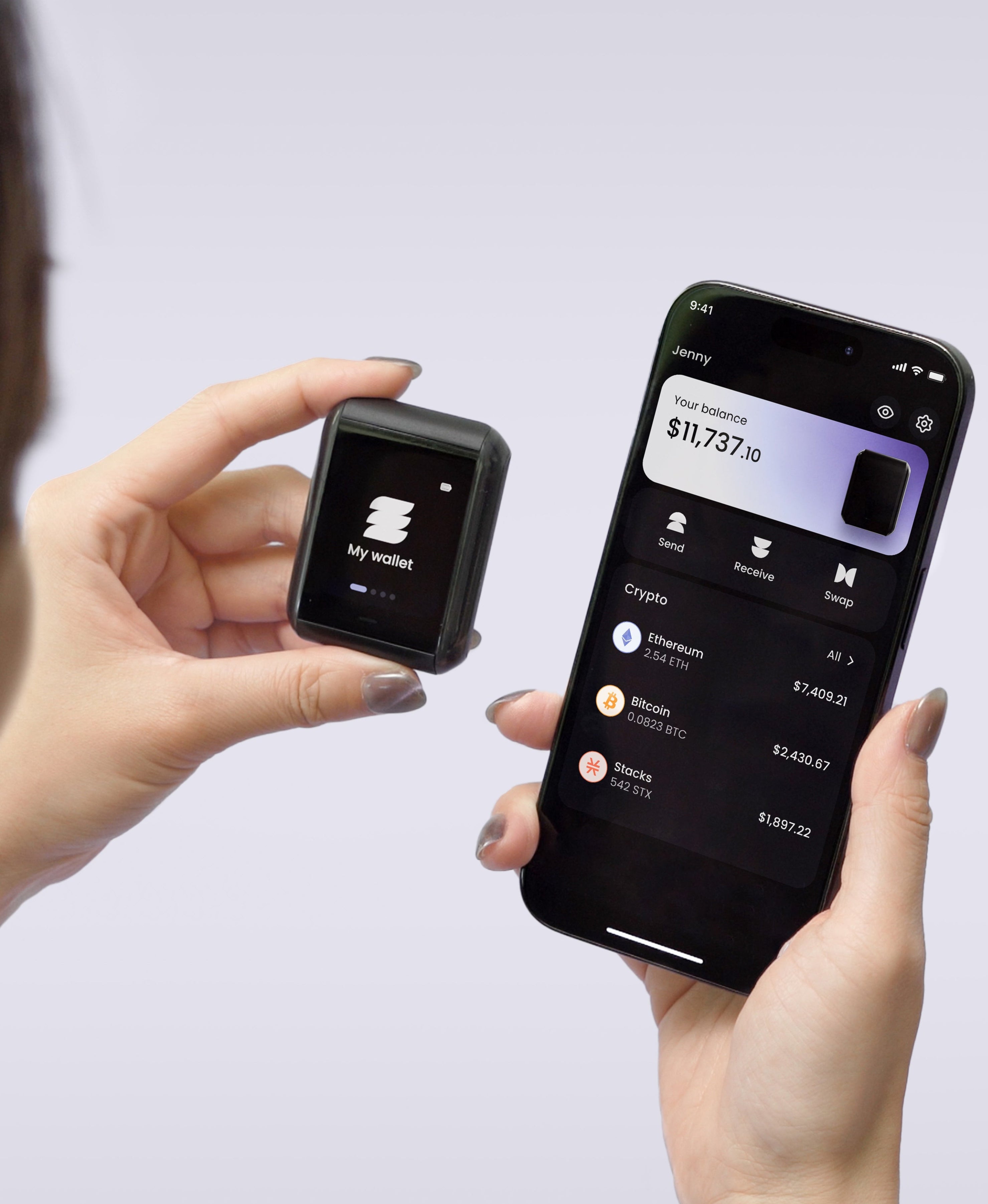
The specific objection to Recover wasn't about the goal (recovery without a seed phrase). It was about the trust model (companies and ID-verification). A recovery system that achieves the goal without the trust model is what self-custody holders had been asking for. Ryder One ships with TapSafe Recovery as the default backup model. The split is structural: some of the backup lives on the Recovery Tag (battery-free, NFC, IP69K rated), the other lives encrypted in your phone's iCloud or Google Drive backup, and you can split it even further per Recovery Contact, which can be distributed to people you personally trust. The Recovery Contacts pair in-person via NFC and have no visibility into your wallet during your lifetime. The trust set is what the user chose. There are no custodian partners holding shares. There is no ID-verification gate. The recovery process runs through hardware the user owns and people the user already trusts. And of course, the seed phrase remains accessible on-device as a last resort, so the user is never locked into Ryder hardware. The firmware that runs all of this is independently audited by Halborn, with the audit report public.
What this means for the average holder
If you're a Ledger user weighing Recover, the question isn't whether the service is well-built. It's whether the trust model fits what you wanted from self-custody in the first place. If you don't have people you'd split recovery shares with, Recover is reasonable for the use case it solves. If you do, a recovery system that distributes trust to those people rather than to companies is closer to what self-custody was supposed to be. If you're considering a new hardware wallet, the structural question is the same one Ledger Recover surfaced: where does the trust go? A recovery flow that depends on a small group of custodians or an ID-verification provider is a different trust model from one that depends on people you know and hardware you hold. Both can be reasonable.
The bottom line
Ledger Recover is an answer to a real problem (users who can't manage a seed phrase) that uses a trust model some users specifically chose self-custody to avoid. The reaction wasn't about whether the feature works, it was about what trust set the user is asked to accept. A recovery system that asks the user to trust people they already trust, on hardware they already own, is a structurally different answer to the same question. Both exist. The choice between them is the choice between two definitions of what self-custody is supposed to mean.
Recover on your own terms. Ryder One splits wallet recovery across a Recovery Tag, your phone backup, and optional Recovery Contacts of your choosing, with no third-party custodians and no ID-verification gate. See how it works.


Share: