

A satoshi is the smallest unit of Bitcoin. One Bitcoin equals 100 million satoshis (often abbreviated "sats"), and the unit is named after Satoshi Nakamoto, Bitcoin's pseudonymous creator. The name first appeared in the Bitcoin community around 2010-2011, and the convention has stuck across every Bitcoin wallet, exchange, and tool ever since. Understanding satoshis matters more than it sounds. As Bitcoin's price has climbed, the cents-and-dollars framing has stopped working for ordinary holders. A single Bitcoin priced at 100,000 USD isn't a unit anyone buys whole, which is where sats come in. This piece walks through what a satoshi is, why the unit matters in 2026, and how to think about Bitcoin in terms of sats rather than whole coins.
The math
1 BTC = 100,000,000 satoshis. The relationship is fixed and built into the protocol. A satoshi is the smallest amount of Bitcoin that can be transferred or held; you cannot send a fraction of a satoshi. Some quick conversions: - 1 BTC = 100,000,000 sats - 0.01 BTC = 1,000,000 sats - 0.001 BTC = 100,000 sats - 0.0001 BTC = 10,000 sats - 0.00000001 BTC = 1 sat At a Bitcoin price of 100,000 USD per BTC, one satoshi is worth 0.001 USD (one tenth of a cent). At higher Bitcoin prices, the satoshi-to-cent ratio shifts: at 200,000 USD per BTC, one satoshi is worth 0.002 USD.
Why the unit matters in 2026
Three reasons to think in satoshis. Bitcoin has scaled out of whole-coin amounts. When Bitcoin was 1 USD, holders bought and sold in whole BTC. At 100,000 USD per BTC, most holders are dealing with fractions of a coin. "Half a Bitcoin" is awkward; "50 million sats" is easier to reason about for the amounts most retail holders move. Wallet UIs are switching to sat-denominated displays. Bitcoin-native wallets like Sparrow, Strike, and Phoenix display balances in sats by default, with whole-BTC as a secondary toggle. The shift makes sats the operational unit for any holder using these tools. Lightning Network sends are sat-denominated. Most Lightning transactions are micropayments, with values in the hundreds or thousands of sats range. The whole-BTC unit doesn't fit Lightning at all; everyone in the Lightning ecosystem talks in sats.
What you can do with sats
Sats are still Bitcoin. The protocol doesn't distinguish between "buying half a BTC" and "buying 50 million sats." Every wallet, exchange, and DApp that supports Bitcoin supports sat-denominated amounts. Some specific use cases where sats matter more than whole BTC: Stacking sats. Recurring small purchases ("dollar cost averaging") let holders accumulate Bitcoin in sat-denominated amounts over time. Buying 5 USD of Bitcoin every Monday is a sat-stacking strategy that accumulates a significant position over years. Lightning payments. Sending 1,000 sats over Lightning to pay for a coffee, a tip, or a digital service is the use case Lightning was built for. Whole-BTC denomination doesn't fit. Ordinals and inscriptions. Bitcoin Ordinals (NFTs on Bitcoin) are inscribed onto specific individual satoshis. The unit is the asset. Salaries paid in Bitcoin. Companies paying employees in Bitcoin typically denominate the salary in sats (for example, "100,000 sats per hour") to insulate the pay structure from Bitcoin's price volatility.
The Lightning Network and sub-sat units
The Lightning Network operates with even smaller units than satoshis. A millisatoshi (msat) is one one-thousandth of a satoshi: 1 sat = 1,000 msats. Millisatoshis exist because Lightning's payment routing math requires sub-sat precision for accurate fee calculations across multi-hop payments. The unit isn't user-facing in most contexts; you'll see sats in your wallet, not msats. Lightning channels and routing internally use msat denomination. For ordinary holders, the takeaway is that the smallest practical unit you'll interact with is a satoshi, with the sub-sat msat unit existing as a routing primitive rather than a holding denomination.
Why "satoshi"
The unit is named after Satoshi Nakamoto, Bitcoin's pseudonymous creator, who published the Bitcoin whitepaper in October 2008 and mined the first Bitcoin block in January 2009. Nakamoto remained active in the Bitcoin community until late 2010, then disappeared without publicly identifying themselves. Nakamoto's identity remains unknown to this day. The "satoshi" unit name first appeared in informal Bitcoin community discussions around 2010-2011, was adopted by Bitcoin wallets shortly after, and has been the standard unit name ever since.
How to display sats in your wallet
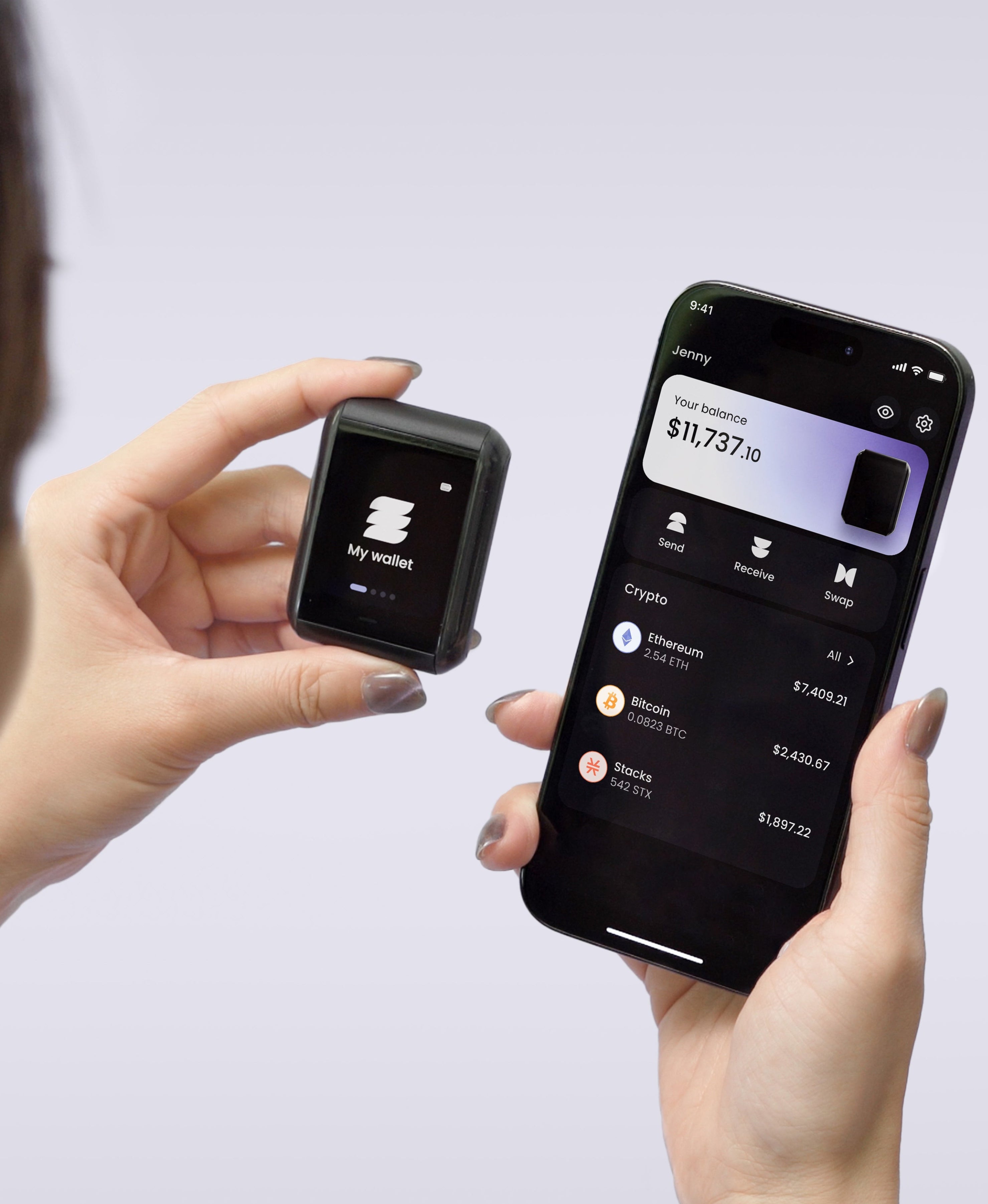
Most modern Bitcoin wallets support sat-denominated display as an option. The setting is usually under "Display Units" or "Currency" in the wallet's preferences. Hardware wallets like Ryder One display Bitcoin amounts in both BTC and sats during transaction verification, so you can see the value in whichever unit makes sense for the amount. For amounts under 0.01 BTC (1 million sats), the sat denomination usually reads more naturally.
Where Ryder One fits
Ryder One handles sat-denominated Bitcoin natively. Transaction verification on the 1.6-inch AMOLED touchscreen shows amounts in your chosen unit (BTC or sats), with the full address and the fee displayed for confirmation. The EAL6+ Infineon SLC38 secure element signs the transaction with a physical button press. For holders stacking sats over years, the device handles the full range from tiny daily DCA purchases to large position consolidations on the same chip. TapSafe Recovery secures the backup independently: 50% on a Recovery Tag, 50% in your phone's iCloud or Google Drive backup, optional 25% per Recovery Contact.
The bottom line
A satoshi is one one-hundred-millionth of a Bitcoin, the smallest unit the protocol supports. As Bitcoin's price has climbed, sats have become the natural unit for ordinary holders to think in. Lightning payments, sat-stacking strategies, Ordinals, and most modern Bitcoin wallets all default to sat denomination. Understanding the conversion (1 BTC = 100 million sats) and switching your wallet display to sats makes the amounts you actually move easier to reason about.
Stack sats, hold them safely. Ryder One displays Bitcoin in both BTC and sats during transaction verification, with the EAL6+ secure element holding your keys offline and TapSafe Recovery handling the backup. See how it works.


Share: