

Most people don't think about what happens to their crypto when they're gone. It's understandable. It's not a comfortable topic. But if you hold crypto in self-custody, this is one of the most important questions you'll ever face. Without a plan, your crypto inheritance doesn't go to your family. It disappears.
This guide walks through the real challenge of crypto inheritance, what the ideal solution actually looks like, every option that exists today evaluated against that standard, and how to build a plan that works for the people you love.
Why crypto inheritance is harder than anything else you own
When you pass on a house, a bank account, or an investment portfolio, there are systems built to handle it. Lawyers, courts, and financial institutions know how to transfer ownership. Crypto has none of that.
Your crypto lives behind a seed phrase, a string of 12 or 24 words that only you know. No bank can recover it for your family, and no court can make a blockchain hand it over. If your family can't access those words, they can't access your crypto. It's not frozen. It's gone.
This creates a painful paradox: the thing that makes self-custody so powerful, the fact that only you control your assets, is the same thing that makes inheritance so hard.
What the ideal solution actually looks like
Before comparing your options, it helps to define what you're actually trying to achieve. A proper crypto inheritance solution needs to do all of the following at once:
Your assets need to be completely secure while you're alive. The right people need to be able to access them after you're gone. The wrong people need to find it impossible at any point. Your family shouldn't need to be technically sophisticated to execute the plan. And ideally, it shouldn't depend on an ongoing subscription to a company that might not exist in ten years.
Every option below falls short of this in at least one way. Some fall short in several. Keep this standard in mind as you read.
Your options for crypto inheritance today
Option 1: Leave your seed phrase in a will or with a lawyer
The most common approach, and one of the most dangerous.
Pros: Simple to set up. Legally recognized. Your family knows where to look.
Cons: Your seed phrase is now a document that passes through hands: lawyers, executors, potentially courts. Probate is a public process in many jurisdictions, which means your phrase could become accessible to anyone. Anyone who sees it before your family does can drain your wallet immediately.
Verdict: Fine for low-value holdings. A serious risk for anything significant.
Option 2: Tell a trusted person directly
Simple, human, and widely used.
Pros: No technical setup. Your chosen person can act immediately without third-party involvement.
Cons: One person holds everything. If they're compromised, your wallet is gone. If the relationship changes, you have a problem. If they die before you, you're back to square one. This is a single point of failure with no redundancy.
Verdict: Better than nothing, but not a plan. A person is not a system.
Option 3: Split your seed phrase manually
A DIY version of distributed recovery. You split your 12 or 24-word phrase across multiple people or locations.
Pros: No third-party services. Distributed across multiple people so no single point of failure. Free.
Cons: This is not how BIP-39 was designed to work. A partial seed phrase can sometimes be brute-forced, which means splitting it doesn't give you the security you think it does. There's also no coordination mechanism. Your family still needs to know how to put it together under stress, with no guidance.
Verdict: Better than a single point of failure, but technically flawed. Not recommended as a primary strategy.
Option 4: External Key Management Services (e.g. Casa)
Casa is a Bitcoin and Ethereum key management service built around multisig, with a dedicated inheritance product.
Pros: Purpose-built for exactly this problem. Uses multisig so no single key gives full access. Actively supports the inheritance process with real human guidance at higher tiers. Has a strong security model.
Cons: Ongoing subscription cost: Standard is $250/year with self-guided onboarding, Premium is $2,100/year with 1-on-1 support [VERIFY BEFORE PUBLISHING: confirm current Casa pricing]. You're in an ongoing relationship with Casa as a company. If Casa changes their service or shuts down, your inheritance plan needs to change too.
Verdict: One of the most serious options available. Strong for someone who wants professional support and is comfortable with the annual cost. But the ongoing dependency is a real consideration.
Option 5: Wallet Recovery Subscriptions (e.g. Ledger Recover)
Ledger's subscription service backs up your seed phrase by splitting it across three custodians: Ledger, Coincover, and EscrowTech.
Pros: Integrated directly into the Ledger hardware wallet. Accessible for existing Ledger users.
Cons: Caused significant controversy when launched because it requires your seed phrase to leave the device, which contradicts the foundational promise of a hardware wallet. You're trusting three companies to hold pieces of your phrase. If any of them are compromised, your seed phrase is at risk.
Verdict: Convenient, but it involves a fundamental tradeoff on the core promise of self-custody.
Option 6: Multisig via Safe (formerly Gnosis Safe)
Safe is a smart contract wallet that requires multiple signers to authorize transactions. You can configure it so a set number of chosen signers must approve any transaction, for example 2 out of 3.
Pros: Fully decentralized. No company holds your keys. Open source and battle-tested. Highly flexible.
Cons: Primarily designed for teams and DAOs, not individuals planning personal inheritance. Setup is technical and not beginner-friendly. Your heirs need to understand how to interact with a smart contract wallet. [VERIFY BEFORE PUBLISHING: confirm current Safe inheritance handling in practice before recommending]
Verdict: Powerful for technically sophisticated users. Likely too complex for the average person planning family inheritance.
Option 7: Dead Man's Switch via Codegreen
Codegreen automatically sends a predefined message, including wallet access instructions, to your designated recipients if you fail to check in after a set period.
Pros: Automated trigger that doesn't rely on your family initiating anything. Can be layered on top of other strategies. Doesn't require your family to know anything in advance.
Cons: False triggers are a real risk. Travel, illness, or simply forgetting to check in could fire the switch early. The security of your entire inheritance plan depends on the security of Codegreen's platform.
Verdict: A useful layer in a broader plan, not a standalone solution. Best used in combination with a hardware-level recovery system.
Option 8: TapSafe Recovery via Ryder One
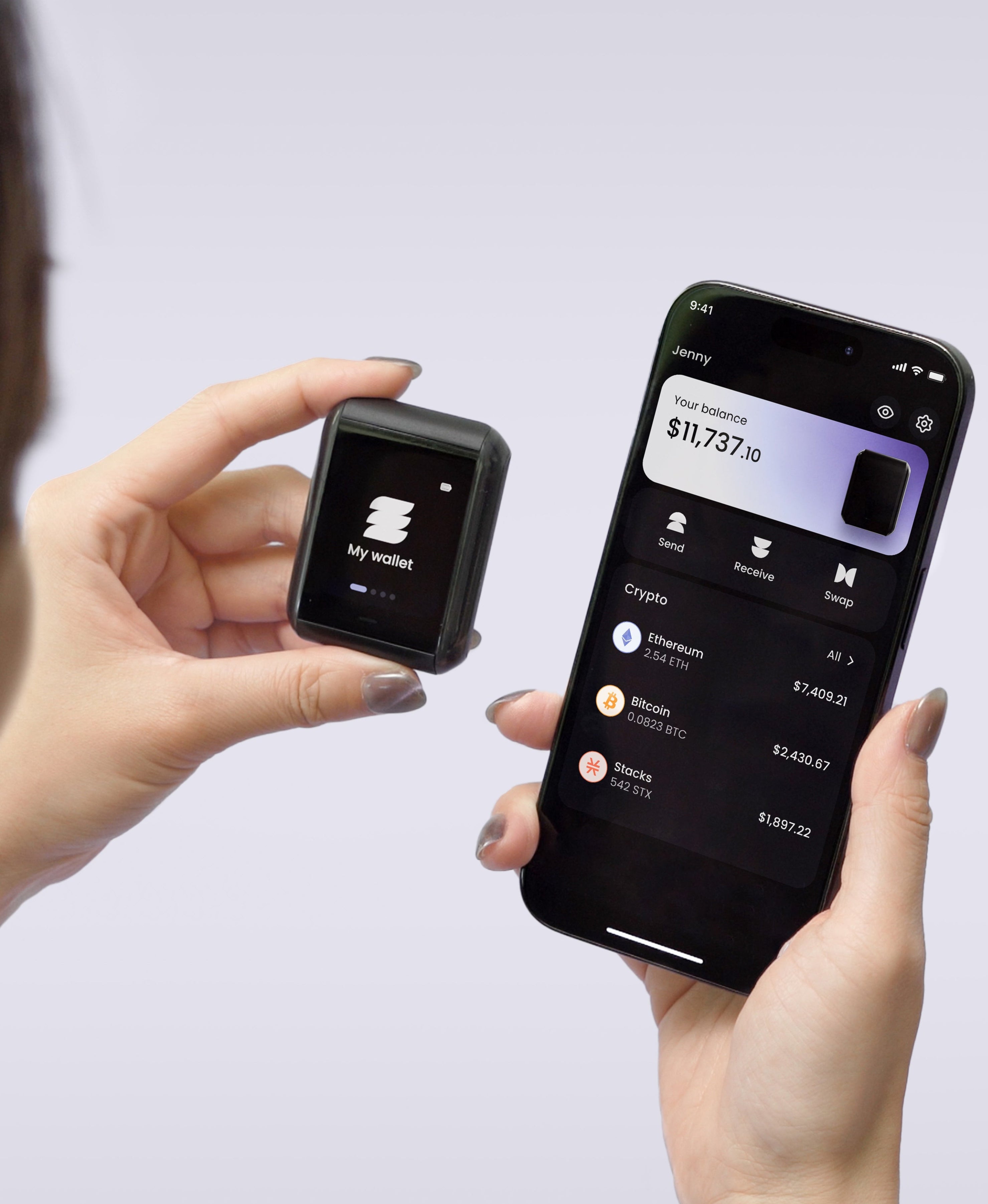
TapSafe is Ryder's built-in recovery system. Instead of a single seed phrase your family needs to find, protect, and use correctly under stress, TapSafe distributes recovery across three layers using cryptographic key splitting.
Recovery Tags are physical NFC tags, each storing an encrypted fragment of your backup. You can store them in different locations: a home safe, a safety deposit box, a trusted family member's house. Your family doesn't need to find a piece of paper. They tap a Recovery Tag, and the process begins.
Recovery Contacts let you assign trusted people to hold additional recovery fragments. Four contacts are required to restore access, so no single person holds enough to act alone. This isn't just security. It's exactly how a good inheritance plan should work: coordination required, single points of failure eliminated.
Phone Backup provides a local encrypted backup as a final fallback layer.
Your seed phrase remains available on the device as a last resort and meets the BIP-39 standard, so your crypto is never locked to Ryder hardware. TapSafe is also expandable, so you can add Recovery Tags and Recovery Contacts as your family and situation change.
Pros: No seed phrase exposure to third parties. No ongoing subscription. No single point of failure. Family doesn't need to be technically sophisticated. Ships in the box. Works alongside a dead man's switch or legal documentation for a layered plan.
Cons: Requires a Ryder One. [VERIFY BEFORE PUBLISHING: confirm current supported blockchains]
Verdict: The closest thing to the ideal solution described above. Secure while you're alive, accessible to the right people after you're gone, no third-party seed phrase custody, no annual fee, and no technical expertise required from your family.
What none of these fully solve on their own
Every option involves tradeoffs. The options that are simplest introduce the most risk. The options with the strongest security models require the most technical sophistication or ongoing cost. A dead man's switch adds automation but depends entirely on a platform you don't control.
The closest thing to a complete solution is a layered plan: hardware-level distributed recovery as the foundation, with optional legal documentation and a dead man's switch as supporting layers. TapSafe is built to be that foundation.
How to actually build your crypto inheritance plan
Decide who your trusted contacts are. These should be people who are responsible, unlikely to be in the same place at the same time, and who understand the basic concept of what you're asking them to hold. Think geographically spread, emotionally trustworthy, and unlikely to be affected by the same event simultaneously.
Have an honest conversation with them. You don't need to explain cryptography. You need to explain that you're leaving them a responsibility, what they'll receive, and roughly how it works. A recovery system is only as strong as the people in it. Don't skip this conversation.
Store your documentation separately from your recovery pieces. Instructions go in one place. Recovery Tags go in another. Your Recovery Contacts hold their fragments independently. Think of it as a puzzle where no single piece reveals the answer, and the instructions for assembling it are stored separately.
Test the process while you're alive. Run through recovery with your contacts at least once so nobody is figuring it out for the first time under stress. This is the step most people skip. It's also the most important one.
Update your plan when life changes. New family members, changes in relationships, moving house, adding Recovery Tags. All of these need to be reflected in your setup. Treat your inheritance plan like a will: something you review and update, not something you set once and forget.
Self-custody doesn't have to end with you
The beauty of owning your crypto outright is that it belongs to you completely. No institution controls it. No one can freeze it or confiscate it. That same property means you're also the only one responsible for making sure it passes to the right hands.
This isn't morbid planning. It's the same thinking that goes into writing a will, naming a beneficiary on a life insurance policy, or putting a trusted person on a bank account. You built something. Now make sure it survives you.


Share: