

In November 2022, FTX, then the second-largest cryptocurrency exchange in the world, collapsed in eleven days. About 8 billion USD of customer funds were missing. The founder, Sam Bankman-Fried, was later convicted of seven federal counts of fraud and conspiracy and sentenced to 25 years in prison. The wreckage stretched across hundreds of thousands of customers, dozens of investment funds, and an entire industry that had spent two years convincing itself that something this big couldn't fail.
A lot has been written about what FTX did wrong and how it ended. Less has been written about what FTX taught the rest of us about how to hold crypto. This piece is the second version.
What happened, in one paragraph
FTX accepted customer deposits, lent them to a sister hedge fund (Alameda Research) at zero or near-zero collateral, and treated the result as one big balance sheet for the firm rather than two separate ones for the customers. When a market downturn made Alameda's positions worthless, the customer deposits that had been lent against them were also worthless. Withdrawals on FTX paused, then stopped. Within two weeks the company filed for bankruptcy. The number that didn't add up was the gap between the customer assets FTX claimed to be holding and the customer assets that were left.
"Not your keys, not your coins" stopped being a meme
For most of crypto's history, the phrase "not your keys, not your coins" had been a saying shared by old-timers who thought exchanges were a phase. After FTX, the phrase showed up everywhere. Customers who'd parked their crypto on FTX learned what the phrase meant in the most expensive way possible: that custody isn't a technicality, it's the thing.
The lesson is structural, not moral. FTX wasn't a small shady operator. It had a US registration, a Super Bowl ad, an entire stadium named after it, an Anthony Hopkins voiceover commercial, and the public endorsement of Tom Brady, Stephen Curry, and most of the financial press. People with a habit of being right about most things were comfortable parking real money there. The lesson isn't "be more careful about which exchange to trust." The lesson is "the trust step itself is the problem."
Four things FTX taught us
1. "Reserves" without an audited liability side proves nothing
In hindsight, FTX could have published a beautiful Merkle-tree proof of reserves and it wouldn't have changed anything. The problem wasn't that the reserves didn't exist. The problem was that the liabilities (the customer balances FTX owed, plus the loans to Alameda, plus everything else) were uncountable from the outside. An asset snapshot without a liability audit is half a balance sheet. The half that flatters the issuer.
This is the practical limit of "Proof of Reserves" pages that exchanges started publishing after FTX. They're better than nothing. They're not a guarantee.
2. Distance from regulators is a feature, until it isn't
FTX was based in the Bahamas, with a US-facing entity (FTX US) that was supposed to be insulated from the offshore arm. The insulation didn't hold. By the time US regulators arrived, the assets had already moved across borders, jurisdictions, and sub-entities in ways that took years to untangle.
The lesson for holders is simpler than the legal arc. The exchange you use is only as recoverable as the jurisdiction it lives in. Pick that jurisdiction with care, or remove it from the equation by holding your own keys.
3. Customer funds and operating capital should never share a wallet
FTX's deepest sin was mixing customer money with the company’s own money, because this meant the company could lend customer funds to whatever it wanted and the customer would never know. There was no on-chain segregation. There was no off-chain segregation. There were just numbers on a database screen, and the database could say whatever the company wanted it to say.
This is the failure mode every centralized exchange has to engineer against. The ones that survive long-term will be the ones that prove segregation cryptographically and submit to live audits. As of 2026, most haven't.
4. The simplest answer was the right one
The crypto holders who came out of November 2022 unscathed were the ones holding their own keys. Not because they were smarter than everyone else. Because the failure mode they were exposed to (their own loss of access) was a failure mode they could control. The failure mode FTX customers were exposed to (their custodian's solvency) wasn't.
Self-custody isn't a moral position. It's an accounting one. You move from a system where you trust someone else's balance sheet to a system where the balance sheet is the public ledger and your name on it is your own private key.
What changed after FTX, and what didn't
The industry changed in obvious ways. Every major exchange now publishes some form of proof-of-reserves snapshot. The CFTC and DOJ have built dedicated crypto-fraud teams. Coinbase publicly separated customer assets from operational assets in its disclosures. Hardware wallet sales spiked the week of the bankruptcy and stayed elevated for months.
What didn't change is the underlying retail behavior. Most people still hold most of their crypto on exchanges, because exchanges are convenient and the path of least resistance is exchange first, custody later. The lesson got delivered, and most people filed it under "things to do eventually." Eventually doesn't help when the next exchange fails.
The simplest thing FTX teaches
You can spend a long time studying the corporate structure, the risk management failures, the regulatory arbitrage, and the personality of Sam Bankman-Fried. You can also skip all of that and arrive at the same conclusion in a sentence: don't leave more crypto on an exchange than you can afford to lose to its bankruptcy.
The mechanism of getting there is self-custody. The standard tool is a hardware wallet that holds your keys offline. The standard backup is a 24-word seed phrase you write on paper, then graduate to a stamped metal plate. Metal lasts longer than paper, but your security still hinges on one piece of metal surviving every fire, flood, and move that happens between now and the day you need it.
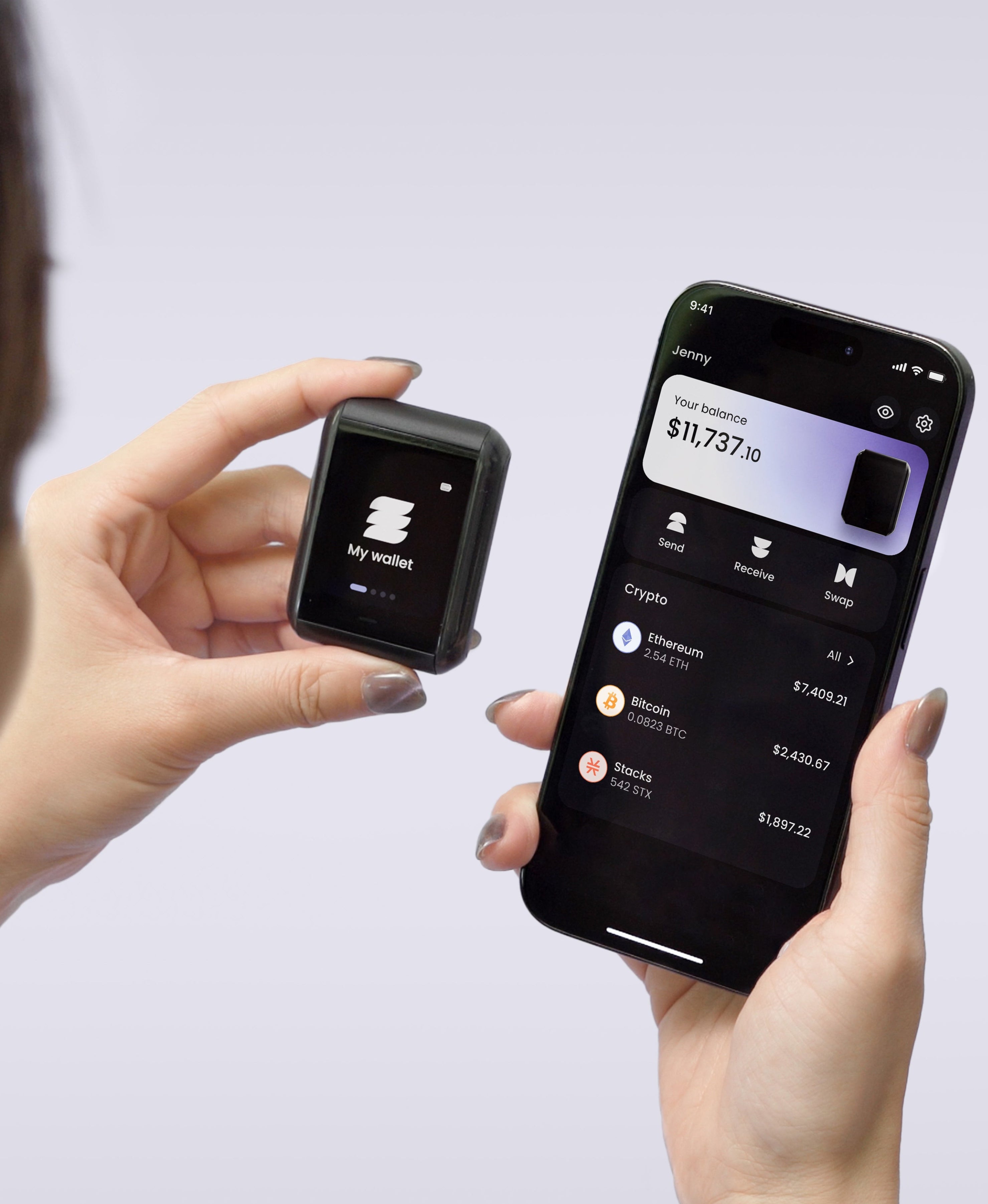
We built Ryder One to remove that last single point of failure. TapSafe Recovery splits the wallet backup across a battery-free Recovery Tag, your phone, and an optional circle of Recovery Contacts. No single component on its own gives anyone access. The seed phrase is still on-device as a last resort, so you're never locked into our hardware. You just don't have to hand your savings to one piece of metal and hope the next forty years are gentle.
The bottom line
FTX wasn't an isolated failure. It was the largest custodial collapse in crypto history, and it happened to a company that everybody from Tom Brady to the New York Times had told you was safe. The lesson it taught isn't about which exchange to use next. It's about whether to give one custody of your savings at all.
Skip the next FTX. Ryder One puts the keys in your hands and your backup across three independent layers, so no single failure takes everything down. See how it works.


Share: