

If you've been searching for "crypto scam recovery," you're already in the second-worst position in crypto. The first is being scammed. The second is the moment after, when the air goes out of your stomach and you start Googling whether the money can come back. This is the moment scammers love most. Any "recovery service" promising to claw back lost crypto for an upfront fee is, with very few exceptions, a second scam targeting victims of the first.
This piece is the version a friend would give you. It tells you what's possible, what isn't, what to do in the next 48 hours, and how to spot the second scam dressed up as your savior.
The hard truth
Crypto transactions are non-reversible. Once a signed transaction is included in a block, the network treats it as final. There is no chargeback, no fraud department, and no central party that can rewind the chain. The technical foundation of the system is the thing that makes recovery hard, and no amount of clever lawyering can change that.
Recovery, when it happens, comes from one of two places. Either the funds touched a centralized choke point (an exchange, a stablecoin issuer, a sanctioned address pool), or law enforcement traces and seizes them through the same legal process that seizes any criminal asset. Both routes are slow, neither is guaranteed, and both depend on factors outside your control.
What you can really do in the first 48 hours
Speed matters. The longer the funds sit on a public address, the more times they've been mixed, swapped, and sent through bridges that obscure the trail.
Document everything: transaction hashes, wallet addresses involved, the platform you were using, screenshots of every message and page from the scam. This becomes your case file.
If the funds touched a centralized exchange (most pig-butchering and many phishing scams eventually move funds through one), file an alert with that exchange's compliance team. Some exchanges will freeze funds on a verified law-enforcement request. This window is narrow.
File a formal report as soon as you can. In the US, start with the FBI’s Internet Crime Complaint Center (IC3) and the FTC. In the UK, report to Action Fraud. In the EU, contact your country’s cybercrime unit. If you are not sure where to start, Europol’s reporting hub can point you in the right direction. Local police may not have crypto specialists, but having an official report creates a paper trail that helps if a larger investigation happens later.
Notify any platforms named in the scam: the exchange that sent the funds, any wallet provider, the social platform where you were contacted. They can sometimes identify and ban the account network behind the scam, even if they can't recover the funds.
Don't pay anyone who promises recovery for an upfront fee. We'll come back to this.
The "recovery service" scam ecosystem
When you Google "crypto scam recovery" you'll see ads, blog posts, and aggressive testimonial sites all promising to recover stolen funds for a fee. Almost none of them work. Many of them are operated by the same networks that ran the original scam, or by adjacent ones who buy victim lists.
The pattern is consistent. They promise a high recovery probability. They charge an upfront retainer, often in crypto. They string victims along with fake "progress" updates and a request for a second fee to cover bribes, court costs, or "blockchain release fees." When the victim stops paying, the service vanishes.
The legitimate version of this work is done by licensed forensic firms (Chainalysis, TRM Labs, Elliptic) on contract to law enforcement and victims. They charge market rates, work case by case, and never guarantee results. If a service is promising recovery via Telegram or Instagram DMs, it's the second scam.
What law enforcement can do
US federal agencies have gotten much better at tracking crypto. The US Department of Justice (DOJ) has taken back ("seized") a lot of stolen crypto in recent years, including well-known cases like the Bitfinex hack and the Colonial Pipeline ransomware attack. Learn more from the DOJ’s page on the National Cryptocurrency Enforcement Team (NCET).
What this means for you depends on the size of your loss and the route the funds took. Six-figure and seven-figure losses from large coordinated scams sometimes trigger federal investigations that recover years later. Smaller losses rarely do. Even when funds are recovered by a federal action, distribution to individual victims can take years and recover cents on the dollar.
Hire a lawyer who works in crypto recovery if the loss justifies it. Many file civil suits against the on-chain address itself (technically against "John Doe controllers of address X"). This sometimes leads to seizure orders that exchanges will honor. It's slow and expensive and not appropriate for every case.
What you can't do
You can't reverse the transaction. You can't compel the receiving wallet to give the funds back. You can't ban the address from the network. You can't force a privacy mixer to disgorge funds. You can't sue an anonymous attacker effectively without first identifying them.
The honest list of what's not possible matters because the scams targeting recovery seekers exploit the gap between hope and reality. Knowing the wall is there protects you from running into it twice.
The only recovery that always works: prevention
The best position to be in is the one before the scam. That's the corner of the problem where you have leverage, and it's the only corner where the math is in your favor.
Most crypto thefts trace back to one of three failure modes: handing the seed phrase to a phishing site, signing a malicious transaction in a hot wallet, or trusting a custodian (an exchange, a yield platform, a "friend") who didn't deserve it.
A hardware wallet blocks the first two modes by construction. The keys never leave the device, the on-device screen verifies every transaction before signing, and even a fully compromised computer can't trick a user who reads the device screen before tapping confirm. Self-custody blocks the third mode by removing the custodian.
The remaining failure mode is loss of access through a lost or stole seed phrase. Burned paper backups, phones getting hacked, or no back up at all. Standard hardware-wallet recovery still relies on a 24-word seed phrase you write down once and pray you can find decades later. A stamped steel plate is more durable than paper, but your security still hinges on one object surviving every fire, flood, and house move between now and the day you need it.
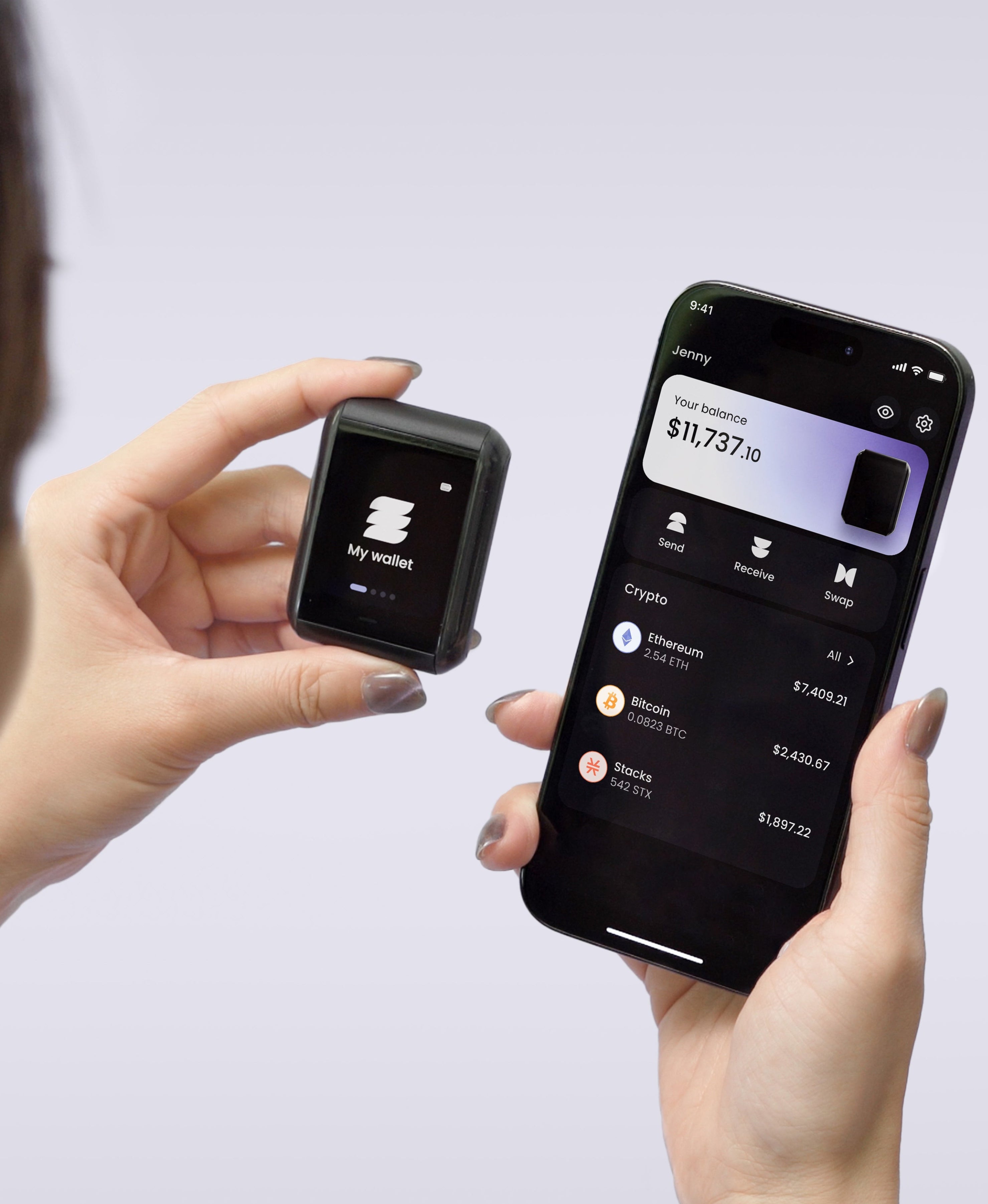
We built Ryder One to remove that single-object dependency. TapSafe Recovery splits the wallet backup across a battery-free Recovery Tag, your phone, and an optional circle of Recovery Contacts. No single layer on its own gives anyone access. The seed phrase is still available on-device as a last resort, so you're never locked into our hardware. You just don't have to bet your savings on one piece of paper or metal.
The short version
If you've been scammed: document, report, and notify the platforms involved within 48 hours. Don't pay any service that promises recovery for an upfront fee. The odds of seeing the money again are low and depend on factors you don't control.
If you haven't: the strongest move you can make is the one that makes the scam impossible in the first place. Hold your own keys, in cold storage, with a backup that doesn't depend on a single piece of paper or metal.
Skip the recovery scams. Skip the original one too. Ryder One keeps your keys offline and your backup distributed. See how it works.


Share: