


A 24-word seed phrase looks like a random list of common English words. Underneath the list is a precise piece of cryptographic engineering: a 256-bit secret converted into a sequence chosen from a fixed dictionary, with a checksum baked into the final word to catch typos. Once you understand what's underneath, the seed phrase becomes less mysterious and more obviously durable.
This piece walks through what each word in a seed phrase represents, how BIP-39 (the standard most wallets use) puts the words together, and what changes for the holder once the mechanics are clear.
The BIP-39 dictionary
Every word in a seed phrase comes from a fixed list of 2,048 English words. The list is called BIP-39 (Bitcoin Improvement Proposal 39), and it was standardized in 2013. Almost every hardware wallet, software wallet, and exchange-issued recovery phrase uses this dictionary.
The dictionary was chosen carefully. Each word is between four and eight letters long. No two words share the first four letters, so a wallet can recognize the word from the first four characters even if you misspell the ending. No word is a plural of another, no word is a verb conjugation of another, and no two words sound alike enough to be confused over a phone.
The list isn't arbitrary. The 2,048 number isn't decorative either: 2,048 is 2^11, which means each word represents exactly 11 bits of information.
How entropy becomes words
A 12-word seed phrase encodes 128 bits of entropy. A 24-word seed phrase encodes 256 bits. The conversion from a random number to a word list follows a fixed procedure.
For a 24-word phrase, the wallet starts with 256 random bits, generated by the device's secure element (in a hardware wallet) or by the operating system's cryptographic random number generator (in a software wallet). The wallet then computes a SHA-256 hash of those 256 bits and takes the first 8 bits of the hash as a checksum. The 256 bits plus the 8-bit checksum makes 264 bits total.
264 bits divided into groups of 11 gives you 24 chunks of 11 bits each. Each chunk maps to a single word in the BIP-39 list: the 11-bit number is the index into the 2,048-word dictionary. Run through the 24 chunks, look up each one in the dictionary, and you have your seed phrase.
For 12 words, the math runs the same way with smaller numbers: 128 bits of entropy plus a 4-bit checksum gives 132 bits, which divides into 12 chunks of 11 bits.
The checksum (the last word isn't random)
The final word in a BIP-39 seed phrase isn't fully random. It's mostly random, with the last few bits dedicated to the checksum.
For a 12-word phrase, the last 4 bits of the final word's 11-bit chunk are the SHA-256 checksum. For a 24-word phrase, the last 8 bits of the final word's 11-bit chunk are the checksum.
The checksum's job is to catch typos. If you write down "house" instead of "horse," the wallet computes the SHA-256 hash of the first 23 words plus what the checksum should be, compares it to the checksum encoded in the 24th word, and rejects the phrase if they don't match. The error gets caught at import time rather than after funds have been sent.
The catch rate isn't 100%. The checksum is 8 bits for 24-word phrases, which means roughly 1 in 256 typo'd phrases will still pass the checksum check by random chance. Most won't.
Why the words aren't random in the way you'd think
When people see "ladder mountain orange voice galaxy thunder ...," the instinct is to assume the words came out of a hat. The truth is two-layered.
The first layer is mechanical. The words are deterministic outputs of the entropy. Given the same 256 random bits, every BIP-39-compliant wallet would produce the same 24-word phrase.
The second layer is structural. The dictionary was filtered for clarity, distinguishability, and ease of writing down. A truly random word list would include "the," "a," "of," words that are too short to disambiguate. BIP-39 filters those out.
What is random is the entropy that drives the conversion. The 256 bits at the top of the process are produced by a cryptographically secure random number generator, and the quality of that generator is the security property of the seed phrase. A weak random number generator produces predictable entropy, which produces predictable seed phrases, which can be brute-forced.
Languages and alternative word lists
BIP-39 supports word lists in multiple languages, including English, Japanese, Korean, Spanish, Chinese (Simplified and Traditional), French, Italian, Czech, and Portuguese. Each language has its own 2,048-word dictionary, with the same selection criteria.
For interoperability, almost every wallet defaults to the English list. Mixing word lists across wallets is technically possible but operationally fragile; the recovery flow depends on the wallet knowing which dictionary to look up the words in.
Some wallet projects have proposed custom or extended word lists, including the Electrum word list (different from BIP-39) and Monero's 25-word mnemonic (which uses a different cryptographic structure). These work within their own ecosystems but aren't portable to BIP-39-compliant wallets.
What happens when one word is wrong
A single wrong word usually triggers the checksum check at import time. The wallet rejects the phrase and asks you to try again. The error path leads to either finding the right word in your written backup or trying to reconstruct the phrase through educated guessing if the backup is corrupted.
If you know which word is wrong and you have 23 or 11 correct words, the wallet can sometimes help. Some recovery tools let you brute-force the missing word by trying all 2,048 options and looking for the one that produces a valid checksum. The math is fast: 2,048 possibilities is trivial computationally, and a valid checksum almost always identifies the right word.
If you don't know which word is wrong (you have all 24 written, but one or two might be incorrect), recovery gets harder. Tools exist for this case too, with the search space expanding quickly. A single wrong word in a 24-word phrase means 24 * 2,048 = ~49,000 possibilities. Two wrong words is ~1.2 million. Three wrong words is millions more.
One seed, many keys
A single seed phrase doesn't generate one key. It generates a tree of keys through a process called hierarchical deterministic (HD) derivation, defined in BIP-32. The seed phrase becomes the master entropy, and the wallet derives child keys for each address using a path like m/44'/0'/0'/0/0.
The practical implication is that a single 24-word phrase can hold Bitcoin, Ethereum, Solana, and any other chain a wallet supports, all from the same master entropy. The seed phrase is the wallet, in a structural sense. Loss of the phrase is loss of every chain the wallet had access to.
This is why a hardware wallet can show you balances across multiple chains without storing 47 different keys: it stores one seed and derives the keys it needs on demand.
Where TapSafe Recovery sits
The standard BIP-39 model puts the entire wallet on a single piece of paper (or metal). That works if the paper survives every fire, flood, divorce, move, and family event between now and the day you need it. For most holders, single-object backups eventually fail.
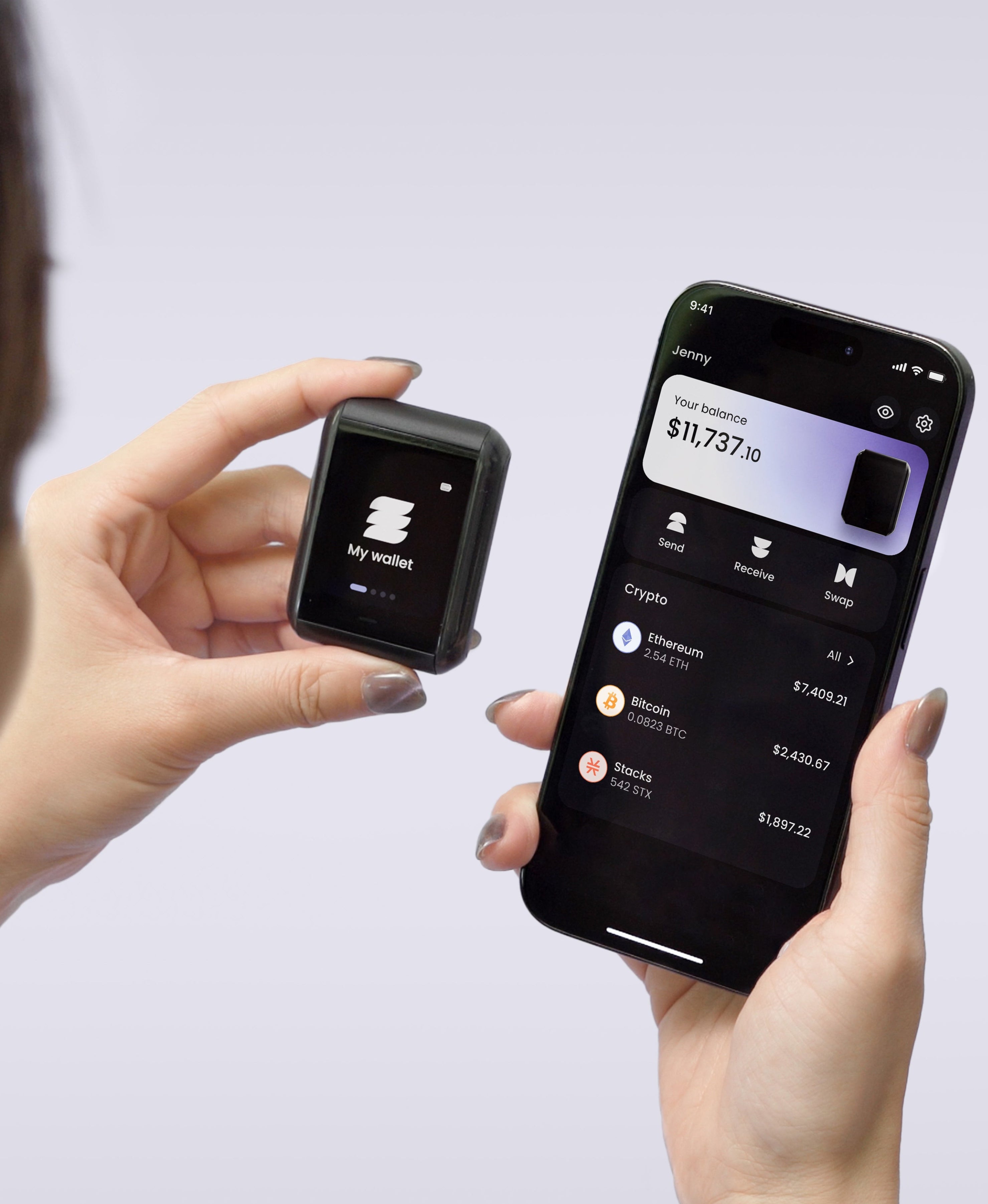
TapSafe Recovery on Ryder One keeps the BIP-39 seed phrase accessible on the device as a last resort and adds a structural layer on top: 50% of the wallet backup lives on a Recovery Tag (battery-free, NFC, IP69K rated), 50% lives encrypted in your phone's iCloud or Google Drive backup, and you can optionally split a further 25% per Recovery Contact for the people you trust. Standard interoperability is preserved, with structural durability layered on so single-object failures don't take the wallet down.
The bottom line
A BIP-39 seed phrase is 256 random bits encoded as words through a fixed dictionary, with a checksum baked into the final word to catch typos. Each of the 24 words represents 11 bits of information drawn from a list designed to be easy to write down and easy to verify. Understanding the structure makes the backup less mysterious: it's a piece of cryptography pretending to be a piece of paper, with the security properties of the former and the failure modes of the latter.
Hold the phrase, plus the structural backup. Ryder One supports BIP-39 seed phrases as a last-resort recovery option, with TapSafe Recovery handling the day-to-day backup so a single piece of paper isn't what stands between you and your wallet. See how it works.


Share: