


On August 7, 2025, President Trump signed an executive order directing the Department of Labor to revise guidance allowing crypto and alternative assets in employer-sponsored 401(k) plans. The order rescinded the Biden-era 2022 guidance that had warned fiduciaries to exercise "extreme care" before adding crypto options. In June 2026, the first major 401(k) providers began rolling out Bitcoin allocation options to participants.
For self-custody holders, the 401(k) crypto question is structurally different from the holdings-on-a-hardware-wallet question. Both can coexist. The trade-offs are about which path serves which purpose.
This piece walks through what the executive order actually changed, how 401(k) crypto allocations work in practice, the trade-offs versus direct self-custody, and how holders should think about splitting positions between the two.
What the executive order actually changed
Three concrete shifts in policy.
Fiduciary guidance. The 2022 Biden-era guidance had told 401(k) plan fiduciaries that adding crypto investment options carried significant legal risk. Plan administrators interpreted this as a soft prohibition. The Trump executive order rescinded that guidance, replacing it with neutral language that treats crypto like any other alternative asset.
Plan administrator discretion. Without the warning guidance, plan administrators can now add crypto options without taking on disproportionate legal exposure. Fidelity, Schwab, and others had already designed Bitcoin allocation products that sat dormant under the previous regime; these products are now being rolled out to plan participants.
Allocation caps. Most plans cap crypto allocation at 5-15% of a participant's portfolio. The cap is structural risk management, not regulatory. Plan administrators retain discretion on how much exposure they're willing to facilitate.
How 401(k) crypto allocations work in practice
A participant who wants Bitcoin exposure through their 401(k) follows the standard plan flow.
Step 1: Plan must offer it. Not all 401(k) plans have added crypto options yet. By mid-2026, approximately 15% of Fortune 500 plans had added at least Bitcoin allocation. The number is growing month-over-month.
Step 2: Allocation through the plan's available products. Participants don't directly buy Bitcoin. They allocate to a fund (typically the spot Bitcoin ETF held by the plan, or a Bitcoin-specific mutual fund). The custody arrangement is institutional — the plan's custodian holds the Bitcoin on behalf of all participants.
Step 3: Tax treatment. Bitcoin held in a traditional 401(k) is tax-deferred. No capital gains tax on appreciation until withdrawal. Bitcoin held in a Roth 401(k) grows tax-free if held to retirement age. This is the largest structural advantage of the 401(k) path over direct self-custody.
Step 4: Limited liquidity. 401(k) funds carry early-withdrawal penalties (10% plus income tax) for withdrawals before age 59½. The Bitcoin can't be moved on-chain. It can't be used for payments. It exists as a balance line on a plan statement.
What this changes versus self-custody
The trade-offs are structural, not ideological.
Tax advantages favor 401(k). A 1% allocation to Bitcoin in a Roth 401(k) over a 30-year horizon could generate hundreds of thousands of dollars in tax-free appreciation. The tax benefit is real and substantial.
Liquidity and control favor self-custody. A Bitcoin position on a Ryder One can be moved on-chain at any time, used for Lightning payments, multi-sig arrangements, or any other on-chain activity. The 401(k) position is locked behind the plan structure until retirement.
Counterparty risk favors self-custody. A 401(k) Bitcoin position depends on the plan custodian. If the custodian fails (rare but possible), the participant's exposure runs through ERISA protections and plan-specific recovery processes. A hardware wallet position has no counterparty.
Cost favors self-custody for long horizons. Plan custodial fees typically run 0.25-0.75% annually. Over 30 years that compounds significantly. A Ryder One purchase is one-time ($119).
The clean answer: hold both. A 401(k) Bitcoin allocation for the tax-deferred growth and the discipline of long-horizon holding. A self-custody Bitcoin position for control, liquidity, and the counterparty-free property of direct ownership.
What hardware wallet holders should do
For holders who don't currently have 401(k) Bitcoin exposure but qualify for one, the executive order opens up a real opportunity.
Check if your plan offers a Bitcoin option. Many haven't added it yet. Pressure on plan administrators to add the option is growing.
Consider a small allocation alongside direct custody. A 5% 401(k) Bitcoin allocation alongside the existing self-custody position takes the tax advantage without making the 401(k) the primary holding.
Maintain self-custody as the long-term core. The 401(k) is a wrapper. The hardware wallet position is the asset. The two complement each other rather than competing.
For holders who already maxed self-custody and want incremental Bitcoin exposure, the 401(k) path is the most tax-efficient incremental position available in 2026.
Where Ryder One fits
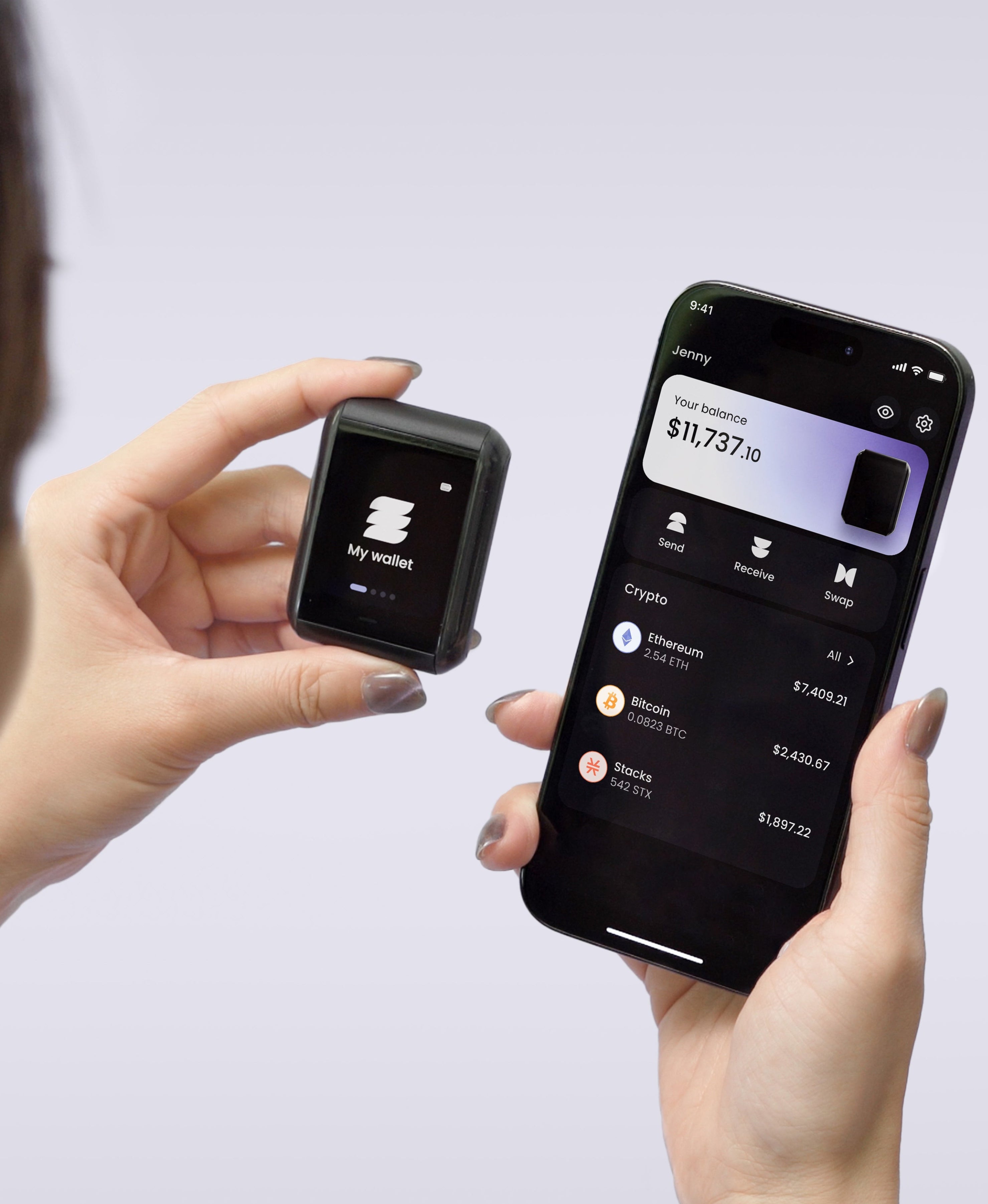
Ryder One is the direct-custody half of the dual-track approach. The EAL6+ Infineon SLC38 secure element holds the private key offline. Every transaction is verified on the device's 1.6-inch AMOLED touchscreen with a physical button press. TapSafe Recovery handles the backup so the long-term position is durable.
For holders running a 401(k) allocation alongside direct custody, Ryder One handles the part of the position that needs to remain liquid, programmable, and counterparty-free. The 401(k) handles the tax-advantaged growth half. Both can compound over decades.
The bottom line
The August 2025 executive order on 401(k) crypto allocations reversed the previous fiduciary guidance and opened the door to retirement-account Bitcoin exposure for tens of millions of American workers. By mid-2026, major plan providers are rolling out the option to participants. For self-custody holders, the executive order doesn't change the direct-custody case — it adds a complementary path that captures tax advantages the hardware wallet position can't. The cleanest structural position is to run both: 401(k) for tax-deferred growth, hardware wallet for control and liquidity.
Run the tax wrapper. And the direct position. Both compound. Ryder One holds your liquid Bitcoin offline on an EAL6+ secure element, with TapSafe Recovery as the backup. The 401(k) handles the tax angle. The wallet handles the keys. See how it works.
SEO
- Target keyword: trump 401k crypto
- SEO title: Trump's 401(k) Crypto Order: What It Changes for Holders (54 chars)
- Meta description: Trump's executive order opened 401(k)s to crypto allocations. Here's how it works in practice, the trade-offs vs self-custody, and how holders should split positions. (162 chars)



Share: