

The Nano X has been Ledger's mid-range device for years, and it is still the wallet most people are shown first when they go looking for cold storage. This Ledger Nano X review covers what the hardware does well, where the trade-offs sit, and which of them you will notice in year three rather than week one. We make a competing device, so we have been specific about sources throughout and have left Ledger's advantages where they are.
At 149 USD it lands at exactly the price we charge for a Ryder One Starter Combo, which makes the comparison unusually clean. You are choosing between two approaches at the same number rather than paying for a tier.
Ledger Nano X review: the specifications that matter
Ledger lists the hardware as a 1.1-inch monochrome OLED running at 128 by 64 pixels, Bluetooth 5.2 for phones alongside a wired USB port for desktop, around five hours of battery autonomy, and an ST33J2M0 secure element certified to CC EAL5+. The body measures 72 by 18.6 by 11.7 mm and weighs 34 g, with a metal swivel cover over the connector.
Asset coverage is the headline number. Coin Bureau's teardown puts it at more than 5,500 coins across over 100 chains, with room for roughly 100 apps installed at once. For anyone holding a long tail of altcoins, that breadth is the strongest argument in the device's favour, and nothing we sell competes with it.
| Ledger Nano X | Ryder One | |
|---|---|---|
| Price | 149 USD | 149 USD (Starter Combo) |
| Screen | 1.1 inch monochrome OLED, 128 x 64 | 1.6 inch AMOLED touch, 320 x 360 |
| Connectivity | Bluetooth 5.2 and wired USB | NFC only |
| Secure element | ST33J2M0, CC EAL5+ | Infineon SLC38, EAL6+ |
| Battery | About 5 hours, not user-replaceable | 200 mAh, Qi wireless charging |
| Size and weight | 72 x 18.6 x 11.7 mm, 34 g | 41 x 55 x 14.5 mm, 38 g |
| Asset support | 5,500+ coins, 100+ chains | Bitcoin, Ethereum, Solana, top ERC-20 and SPL tokens |
| Backup | 24-word seed phrase | Split shares with seed phrase as last resort |
What the Nano X is good at
Best for: someone holding a wide spread of assets who wants one device to cover all of them, and who values signing from a phone without a cable.
Bluetooth is the feature that distinguishes this device from Ledger's cheaper models, and it works. Pairing to a phone and approving a transaction without hunting for an adapter is a small convenience that compounds if you transact often. The secure element is a certified chip from a reputable vendor, and the chip itself has no public record of being broken.
Ledger Live is also mature software. Years of iteration show in the staking flows, the portfolio view, and the breadth of integrations, and new users tend to find their footing in it quickly.
Worth knowing before you buy
The screen is the real constraint. A 128 by 64 monochrome display shows you a few short lines at a time, which is enough for an amount and a truncated address and not enough to read a contract interaction in full. When a device cannot render what you are approving, you are trusting the software that composed the request. The industry calls this blind signing, and it is how careful people with good equipment still lose money.
The battery is a consumable in a device you want to keep for a decade. Ledger rates it at about five hours of use, and reviewers who have run the device over several years report noticeable degradation after two to three years of regular wireless sessions, with no user-replaceable cell. The device still functions over its cable when the battery is flat, so this is an inconvenience rather than a loss of funds.
The firmware is closed source. Ledger's 2023 announcement of an opt-in key-recovery service made clear that firmware code paths existed which could export key material in encrypted form under specific conditions. No breach followed, and the episode changed how a lot of buyers read the phrase "never leaves the chip", because the question stopped being whether a company is trustworthy and became which code paths exist at all.
The customer data has leaked more than once. The 2020 incident remains the most consequential in the category: an abused third-party API key pulled over a million email addresses and roughly 292,000 records with names, phone numbers, and postal addresses, and the dataset was dumped publicly that December. People who bought a hardware wallet in private found their home address attached to proof they held crypto, and the extortion letters that followed were credible precisely because the address was correct. Ledger has had further breaches since, and none of them touched a private key. That distinction matters and it does not make the leak harmless.
The backup question both devices have to answer
Buy a Nano X and your recovery rests on 24 words you write down during setup. That model has been the category standard for a decade, and its weakness is structural: one object reconstructs the entire wallet, so it has to survive fire, flood, and every house move while staying unseen by everyone who passes through your home. Paper tears and fades. Stamping the words into steel is a sensible upgrade, and it leaves the underlying shape of the problem alone, because a single item that opens everything is still a single item that opens everything.
TapSafe Recovery is our answer to that shape. Recovery is split using our own implementation of Shamir's Secret Sharing: the Recovery Tag carries half, your paired phone carries the other half encrypted into your own iCloud or Google Drive rather than sitting on the handset, and optional Recovery Contacts hold a quarter each without learning anything about your holdings. Because no single share opens the wallet, losing one becomes a repair job instead of a disaster. The seed phrase stays readable on the device as a last resort and follows BIP-39, so you can leave for other hardware whenever you want.
Where Ryder One lands against it
Best for: someone holding Bitcoin, Ethereum, Solana, and major tokens who wants to read every transaction before approving it and wants backup that does not hinge on one piece of paper.
Worth knowing: our asset list is a fraction of Ledger's. Check your holdings against it before you buy anything, ours included.
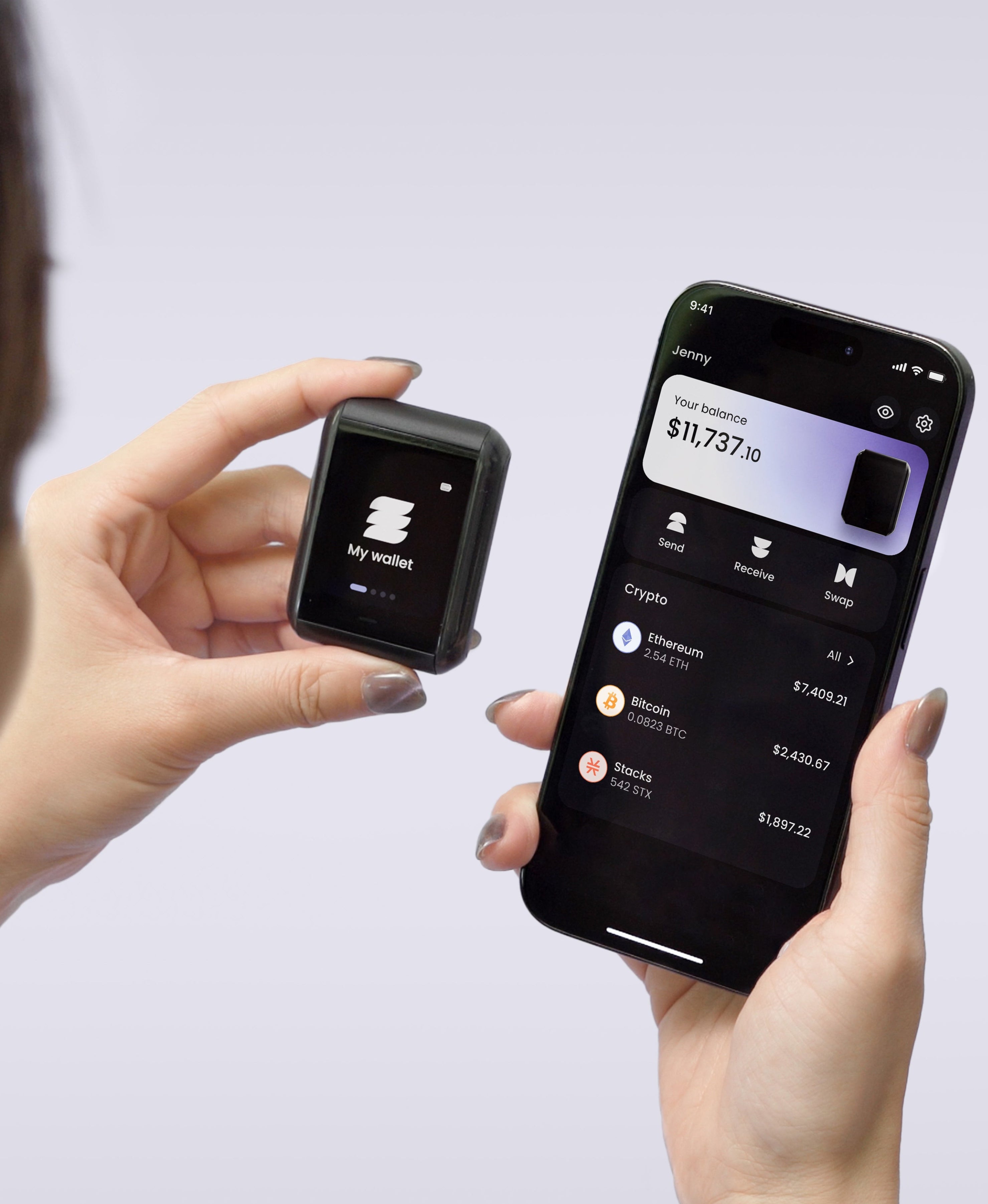
The Ryder One renders every transaction in full on a 1.6-inch AMOLED touchscreen, which is the difference between approving a description and approving a hash. Keys are generated inside an EAL6+ Infineon SLC38 secure element and stay there, the confirmation button is wired directly to that chip so no software path can sign without a deliberate press, and Halborn published a full independent audit of the firmware rather than describing one. Communication is NFC only, with no Bluetooth radio, no Wi-Fi, and no data over a cable, so the device is reachable while you hold it against your phone and at no other moment. It charges over Qi, carries an IP67 rating, and won a Red Dot Product Design Award in 2026.
The verdict
If your portfolio spans dozens of chains, the Nano X earns its place and the breadth is worth the compromises. If you hold a handful of major assets and expect to still be holding them in ten years, the questions that decide the outcome are narrower: can you read what you are signing, and how many objects have to survive for you to recover?
The Ryder One is 149 USD for the Starter Combo and 179 USD for the Super Safe Combo, each including the Recovery Tag, a wireless charger, and a pouch, with setup taking about 60 seconds across three taps. Get your Ryder One.


Share: