


The "tornado cash storm" ruling is shorthand for two rulings that landed a year apart. A New York jury convicted Tornado Cash co-founder Roman Storm on August 6, 2025 on one count of conspiracy to operate an unlicensed money-transmitting business, and hung on the two heavier counts of money laundering conspiracy and sanctions-violation conspiracy. That partial verdict lands on top of the Fifth Circuit's November 2024 decision in Van Loon v. Treasury, which stripped OFAC's sanctions off Tornado Cash's immutable smart contracts. Together, those two rulings redraw the perimeter around what code you can write and publish in the United States without becoming a defendant.
This piece walks through what Tornado Cash is, the OFAC sanctions timeline, the Storm criminal case and August 2025 verdict, the Fifth Circuit's ruling on smart-contract sanctions, and where a hardware wallet like Ryder One sits in the legal frame that emerged.
What Tornado Cash is
Tornado Cash is an Ethereum-based mixer: a set of smart contracts that pool deposits from many users and let each user withdraw an equivalent amount to a different address, breaking the on-chain link between sender and receiver. The mixer was launched in 2019 by Alexey Pertsev, Roman Storm, and Roman Semenov. Its most important design choice came later: in May 2020 the founders removed their admin keys, making the mixer's core smart contracts immutable. Once that upgrade shipped, no developer or company could pause the pools, change fees, freeze balances, or withdraw user funds.
Privacy tools attract mixed users. Ethereum wallets from ordinary users worried about counterparty surveillance ran through the pools alongside stolen funds from major exchange hacks. By mid-2022, US enforcement had counted Tornado Cash deposits linked to the Lazarus Group, the state-sponsored North Korean crew behind the Ronin bridge exploit. That mix sets up every downstream legal question.
The OFAC sanctions and the 2022 timeline
On August 8, 2022, the Treasury's Office of Foreign Assets Control added Tornado Cash to the Specially Designated Nationals list, sanctioning 45 Ethereum addresses tied to the mixer. In November 2022, OFAC added another 53 addresses, including at least 20 immutable smart contracts with no admin key holder to negotiate with. Any US person interacting with those addresses risked a sanctions violation.
The immediate fallout hit developers. Alexey Pertsev was arrested in the Netherlands within days of the OFAC action; a Dutch court convicted him of money laundering in May 2024 and sentenced him to 64 months. GitHub removed the Tornado Cash repositories. Circle froze USDC held by the sanctioned addresses. Roman Semenov, a Russian citizen, was later added to the SDN list in August 2023 for alleged support of North Korean cyber operations. On the same day OFAC named Semenov, the DOJ unsealed an indictment against Storm in the Southern District of New York.
The Roman Storm trial and August 2025 verdict
Storm's trial ran for four weeks in July 2025 before Judge Katherine Polk Failla in the SDNY. Prosecutors argued that Storm and his co-founders knew Tornado Cash was moving criminal proceeds, kept operating the front-end and relayers around the immutable contracts, and shared in fees paid by the users the group had been warned about. The defense argued that publishing open-source code isn't a money-transmitting business, and that a US developer can't be held criminally responsible for how anonymous third parties use software once it ships.
On August 6, 2025, the jury returned a mixed verdict. Storm was convicted on one count: conspiracy to operate an unlicensed money-transmitting business under 18 U.S.C. § 1960, which carries a five-year statutory maximum. The jury deadlocked on the two heavier counts, conspiracy to commit money laundering and conspiracy to violate US sanctions, each of which carries a twenty-year maximum. Storm remains free on bail and has filed a motion for judgment of acquittal on the convicted count.
In March 2026, prosecutors filed for a retrial on the deadlocked charges, proposing an October 2026 start date. That retrial, if it goes ahead, will be the case that settles whether writing and publishing immutable open-source code amounts to a money-laundering conspiracy under existing US law.
The Fifth Circuit ruling on smart-contract sanctions
While the criminal case was moving through the SDNY, a parallel civil case reshaped the sanctions half of the story. Six Tornado Cash users, backed by Coin Center and Coinbase, sued Treasury in the Eastern District of Texas, arguing that OFAC had exceeded its statutory authority when it sanctioned immutable smart contracts under the International Emergency Economic Powers Act. The district court sided with Treasury. On appeal, the Fifth Circuit reversed.
The three-judge panel's November 26, 2024 opinion in Van Loon v. Department of the Treasury held that Tornado Cash's immutable smart contracts don't qualify as "property" under IEEPA. Property under the statute has to have an owner and be capable of ownership or control. Immutable code sitting on the Ethereum network has neither: no one can revoke it, no one can pause it, and no one can enter into a contract about it because there's no counterparty on the other side. The panel called the contracts "just software code" and held them outside OFAC's designation authority.
Treasury didn't appeal. On March 21, 2025, OFAC officially delisted Tornado Cash, removing the mixer's addresses from the SDN list. Roman Semenov's individual sanction was moved off the cyber-related program and kept alive under the North Korea program, so he remains on the list. Interacting with the Tornado Cash pools is no longer a sanctions violation for US persons. Interacting with Semenov's own addresses still is.
What the Tornado Cash Storm ruling means for self-custody and wallet developers
The two rulings answer different pieces of the same underlying question: when does writing crypto code cross the line into regulated financial activity?
Van Loon gave a clean answer for OFAC's sanctions authority. Immutable smart contracts without an owner are outside the sanctions perimeter. That precedent shields developers who ship open-source code and then walk away from any admin keys. It also puts a check on the executive branch's ability to designate protocols by fiat.
The Storm conviction went the other way on the money-transmitting question. Jurors found that Storm and his co-founders were doing enough beyond just deploying code, running relayers, taking fee revenue, marketing the mixer, and refusing to reject high-risk deposits, to fall inside the definition of an unlicensed money-transmitting conspiracy. Deadlock on the money-laundering and sanctions-violation counts suggests the panel didn't buy the government's most aggressive theories, but it left them open for a retrial.
For self-custody users, none of this changes what's legal to do with your own wallet. Holding, sending, and receiving crypto from an address you control isn't in scope. The Storm ruling is a case about developers and operators, not holders. What it does affect is the environment in which the next wave of self-custody tools gets built inside the United States. Coin Center and the Electronic Frontier Foundation have both argued in filings that treating immutable code as a money-transmitting business is a First Amendment problem waiting for its own appellate ruling.
Where things get uncertain is the hybrid case. A "decentralized" mixer with an identifiable front-end team taking fees looks a lot more like Tornado Cash's post-2020 operation than it does like a pure protocol. A hardware wallet that ships firmware and lets the user hold their own keys sits on the opposite end of the spectrum.
Where Ryder One fits
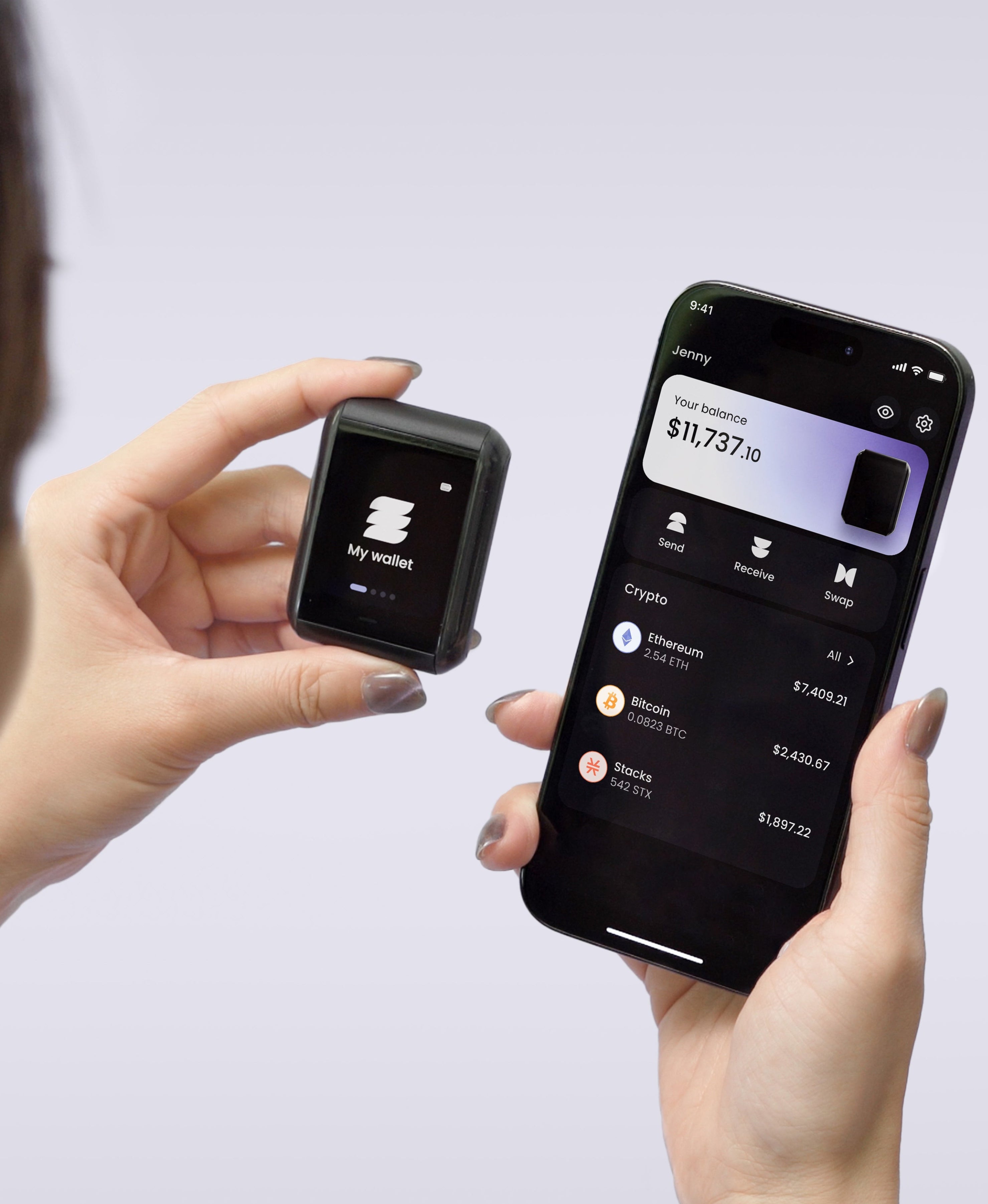
A hardware wallet isn't a mixer, and its legal profile is different by design. Ryder One holds your private keys on an EAL6+ Infineon SLC38 secure element that generates them inside the chip and never lets them off. Every transaction is verified on the 1.6-inch AMOLED touchscreen, with a mechanical button wired into the secure element so nothing gets signed without your finger on the device. NFC-only communication means no USB port and no Bluetooth radio for a remote attacker to work through.
The self-custody read on the Storm case is that owning the tool matters more than ever. A hardware wallet that stays firmly on the consumer side of the line, one that doesn't operate relayers, doesn't take transaction fees, and doesn't route funds, is a cleaner story to build when developers of adjacent tooling face criminal exposure.
We built TapSafe Recovery so a self-custody wallet doesn't collapse into one weak backup. The Recovery Tag holds 50% of the recovery secret and is IP69K rated for water and dust. Your paired phone holds the other 50%, encrypted into iCloud or Google Drive rather than on the phone itself. Optional Recovery Contacts can hold 25% each, with no visibility into your wallet contents. The BIP-39 seed phrase stays on-device as a last resort. Ryder One ships at $229 with the Recovery Tag, Qi wireless charger, and travel pouch in the box.
The tornado cash storm bottom line
The tornado cash storm ruling isn't over. August 2025 saw Storm convicted on one count with two heavier counts hanging for a possible October 2026 retrial. The Fifth Circuit's Van Loon decision stripped OFAC's sanctions off Tornado Cash's immutable smart contracts and forced Treasury to delist the protocol in March 2025. Roman Semenov remains sanctioned as an individual. What US law now says, with a partial answer, is that immutable code isn't "property" for sanctions purposes and that operating a mixer with a live front-end can still be an unlicensed money-transmitting business.
For anyone holding their own keys, the direct rules haven't shifted. Self-custody is legal, and interacting with the chain from a wallet you control remains outside the money-transmitting perimeter. What shifted is the legal ground under the developers and operators who build the tools you use, and that ground will keep moving through the Storm retrial and any appeal on the acquittal motion. The safest read for a holder is the one that was safe before the case started: the further your assets sit from an intermediary, the fewer regulatory or enforcement events can reach them.
Keep your keys off the intermediary map. Ryder One holds your crypto offline on an EAL6+ secure element, with TapSafe Recovery as the backup and no operator sitting between you and the chain.
SEO
- Target keyword: tornado cash storm
- SEO title: Tornado Cash Storm Ruling: What It Means for Crypto Code (56 chars)
- Meta description: The tornado cash storm ruling: Roman Storm's August 2025 conviction plus the Fifth Circuit reversal on OFAC sanctions. What it means for self-custody. (152 chars)
- Hero alt text: Tornado Cash Storm ruling self-custody code — Ryder self-custody hardware wallet


Share: