


# Stellar (XLM) in 2026: The Old Payments Chain Explained
Stellar is one of the oldest L1s still writing new headlines. Bitcoin came first, Ethereum reshaped the space, and a wave of newer chains have chased throughput in the years since. Stellar has stayed in a lane most of them ignore: moving fiat between people and institutions at low cost, with as little consumer-facing crypto vocabulary as it can get away with. The chain is nearly twelve years old in mid-2026 and has spent the last two years adding a full smart-contract platform on top of the payments core it never gave up.
Below we cover what Stellar and XLM are, how the Stellar Consensus Protocol works, how anchors turn a public blockchain into a remittance network, what Soroban brings to the ecosystem, and where a hardware wallet fits for XLM holders.
What Stellar and XLM are in plain terms
Stellar is a public, open-source ledger that went live in July 2014. Jed McCaleb (co-founder of Mt. Gox and Ripple) started the project after leaving Ripple over strategy disagreements, and he set up the Stellar Development Foundation as a non-profit to steward the protocol. XLM (also called the lumen) is the native asset used to pay fees and to satisfy the small reserve each account holds on the ledger.
The supply story is worth knowing before you look at any market data. Stellar launched with an inflationary schedule, and in October 2019 the SDF board voted to cap the total at 50 billion by burning 55 billion of the previously issued 105 billion tokens. Roughly 30 billion XLM circulate today per CoinGecko, and the rest sits in an SDF endowment used for network grants and enterprise integrations. There is no ongoing issuance and no staking-driven inflation, so the supply picture looks closer to Bitcoin's than to a proof-of-stake L1.
How the Stellar Consensus Protocol differs from Bitcoin and Ethereum
Bitcoin secures its ledger with proof of work, and Ethereum switched to proof of stake in 2022. Stellar uses the Stellar Consensus Protocol, an implementation of federated Byzantine agreement described in a 2015 whitepaper by David Mazières. The design skips both mining and staking. Each node picks a set of other nodes it trusts (its quorum slice), and consensus emerges when enough overlapping slices agree on the same transaction set. There is no leader election, no block reward, and no on-chain penalty for bad behavior; what holds the network together is the social layer of who trusts whom.
The practical outcome shows up in the numbers. Ledger close time sits at roughly five seconds, transactions cost a fraction of a cent, and finality lands the moment a ledger closes with no probabilistic waiting on confirmations. The consensus paper is public at stellar.org, and the design tolerates arbitrary node failures inside a quorum as long as trust dependencies overlap in the right places. Critics point out that FBA leans on human governance where proof of work leans on hash rate and proof of stake leans on capital at risk.
Stellar's other design choice worth naming is native asset issuance. Anyone can create an asset on the ledger with a single transaction that names the asset code and the issuing account, and trustlines let a receiving account opt in before any balance can arrive. USDC, PYUSD, BENJI, and thousands of anchor-issued fiat tokens live inside this model, with no ERC-20 equivalent because the asset primitive sits at the protocol layer.
Anchors and the remittance angle
An anchor is a regulated entity that holds fiat currency in a bank account and issues a matching asset on Stellar backed one-to-one by that reserve. If you deposit 100 USD with an anchor, it credits your Stellar address with 100 USD of its stablecoin, and when you withdraw, the anchor burns the token and wires you the fiat. Between deposit and withdrawal, the token behaves like any other Stellar asset you can send, swap on the built-in orderbook, or hand to a counterparty for another currency.
That model is what makes Stellar attractive to remittance operators. The MoneyGram Access service, live since 2021, lets a sender fund a wallet with USDC and have a family member walk into a MoneyGram location abroad to pick up local fiat, with the settlement flowing over Stellar. PayPal launched PYUSD on Stellar in September 2024 as its second issuance chain, citing anchor connectivity and low-cost cross-border rails, and Franklin Templeton's BENJI tokenized money-market fund uses Stellar for share tokenization alongside its other chains. The reason to care as a holder is that the on and off ramps closest to cash flow already exist on the network.
Soroban and the 2025-2026 ecosystem
For most of its life, Stellar had no smart contract layer. That gap closed in early 2024 with the mainnet launch of Soroban, a WebAssembly-based execution environment written in Rust. Soroban runs alongside the payments core rather than replacing it, so an application can call payment operations and contract logic inside the same transaction envelope. The Soroban documentation covers a growing set of features around fees, contract storage, and cross-contract calls.
What Soroban unlocked in practice is a set of DeFi primitives Stellar had been missing. Blend runs money markets on Soroban, Aquarius handles AMMs and liquidity mining, Allbridge shipped a Soroban integration for cross-chain transfers, and newer teams are building orderbook trading into the contract model. Total value locked across Soroban DeFi crossed the 100 million USD line in 2025 after starting near zero the year before, and the ecosystem now has more shape than the payments-only story of the previous decade.
The self-custody read on XLM
Stellar uses ed25519 signatures for its native accounts, the same curve Solana and Cardano use and a different family from the secp256k1 keys behind Bitcoin and Ethereum. A Stellar address is the public key of the account encoded as a 56-character string starting with G, so what you paste into a wallet is a direct public-key representation rather than a hashed derivative. Nothing is hidden in an address; what you see is the account.
The custody consequence is the memo field. Many exchanges use one shared Stellar deposit address for every customer and route incoming funds to individual accounts based on a memo attached to the transaction. If you send XLM or a Stellar-issued asset to an exchange address without the correct memo, the funds land in the shared wallet without any attribution to your account, and recovering them requires a support ticket, ID verification, and sometimes a manual fee. Some exchanges do not recover them at all, so read the deposit instructions carefully before you send.
Beyond the memo issue, the standard L1 custody discipline applies. Keys sitting on a phone or a browser extension are exposed to phishing pages, browser malware, clipboard swaps that replace a destination address at the point of paste, and social engineering that walks a user into revealing recovery words. Moving the signing key onto a hardware wallet cuts most of that surface off because the private key sits inside a secure element that will never release it to the host computer.
Where Ryder One fits
Ryder One signs Bitcoin, Ethereum, Solana, and a growing list of top ERC-20 and SPL tokens today, and Stellar sits outside that current supported set. If your portfolio includes XLM alongside those chains, keep each asset on a wallet that supports it and hold the security posture level across all of them.
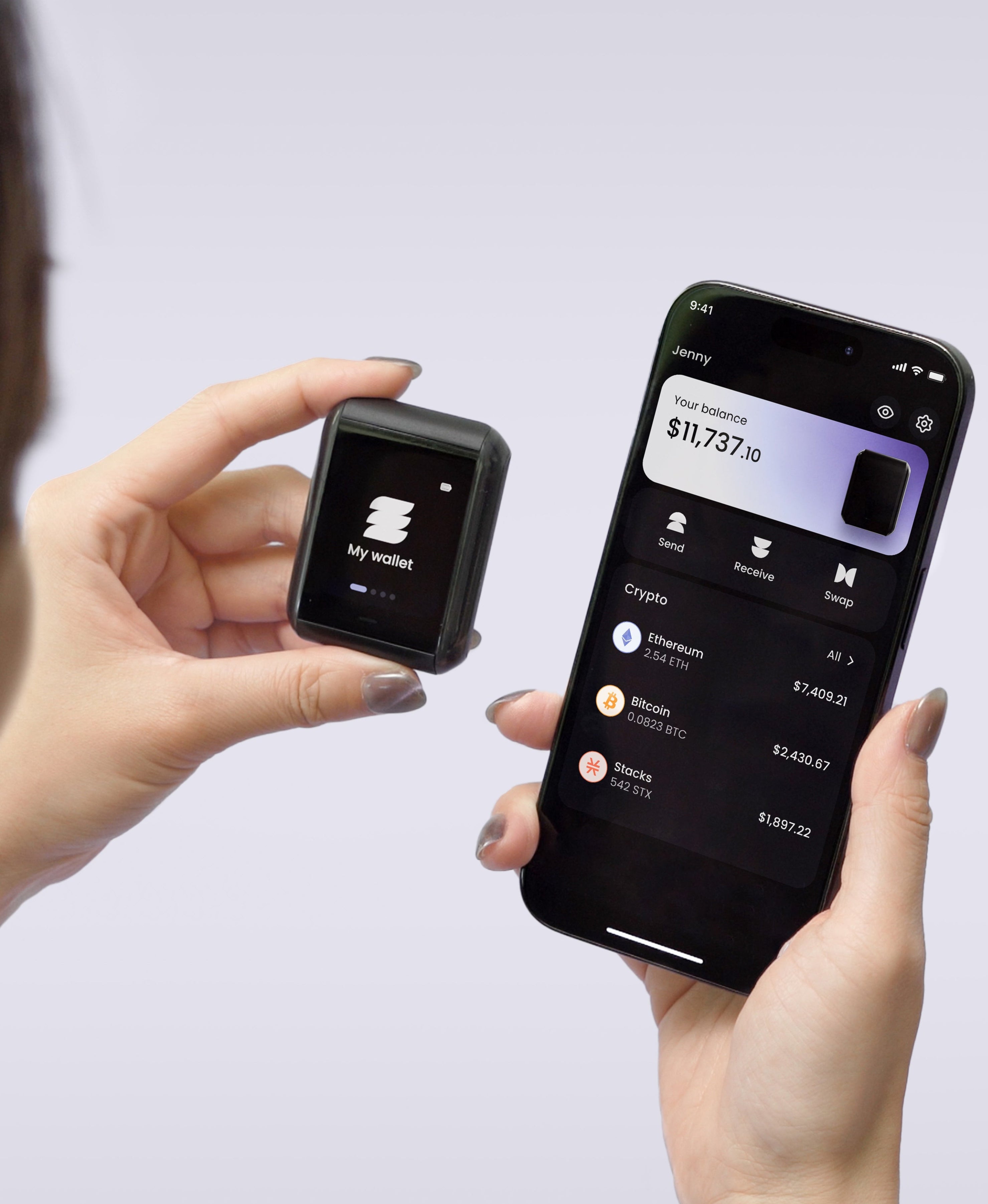
For the chains Ryder One does support, the device is built around the same self-custody discipline any XLM holder needs. A 1.6-inch AMOLED touchscreen renders every transaction in full readable detail before you approve it, and the EAL6+ certified Infineon SLC38 secure element generates and holds the keys with a button wired directly into the chip so no software path can produce a signature without your press. Communication is NFC-only, with no USB port, no Bluetooth radio, and no Wi-Fi surface a remote attacker can poke at.
Recovery uses TapSafe instead of a paper seed phrase sitting in a drawer. The Recovery Tag holds 50 percent of the wallet share and carries an IP69K rating that survives water jets and dust, while the paired phone holds the other 50 percent stored encrypted in your iCloud or Google Drive so losing the phone does not lose the backup. Ryder One ships at $229 with the Recovery Tag, a Qi wireless charger, and a pouch in the box, and the device itself carries an IP67 rating.
The bottom line
Stellar is an old-guard L1 that stayed in its payments lane through nearly twelve years of market cycles. XLM is the native asset behind a network with sub-five-second finality, sub-cent fees, and a supply cap of 50 billion after the 2019 burn. Anchors, PayPal PYUSD, MoneyGram cash rails, and Franklin Templeton fund shares live on the chain because the design was built for the quieter work of moving fiat between institutions, and Soroban has closed the smart-contract gap since 2024.
For a self-custody holder, the read on XLM comes down to ed25519 keys, memo fields on exchange deposits, and the same signing discipline every L1 asks for. Wherever your keys live, put them behind a device that shows every transaction on screen before you tap the button and back them up so no single accident can take everything out. That is the model Ryder One was designed for on the chains it supports today.
SEO
Target keyword: xlm crypto
SEO title: Stellar (XLM) in 2026: The Old Payments Chain Explained
Meta description: XLM crypto sits behind Stellar, a twelve-year-old payments L1 with sub-5s finality. Here is how it works, key partnerships, and the self-custody read.
Hero alt text: Stellar XLM payments blockchain 2026 — Ryder self-custody hardware wallet


Share: