

Most crypto holders who stake do it the easy way: send funds to a centralized exchange, click stake, collect yield. The exchange does the technical work. You get a percentage. You also hand over your keys. Cold storage staking is the alternative. You can earn yield on coins that support proof-of-stake while your keys stay on a hardware wallet that never connects to the internet directly. You delegate your stake without delegating your custody. Here's how it works, when it makes sense, and where the trade-offs are.
How staking from cold storage works
Staking is the proof-of-stake equivalent of mining. Validators on the network stake coins as collateral, validate transactions, and earn rewards. Anyone holding the underlying coin can delegate their stake to a validator without transferring the coins themselves. The delegation is on-chain. Your keys still sign anything that touches the funds. When you stake from a hardware wallet, the wallet holds the keys, an interface (usually a wallet app or browser extension) builds the delegation transaction, and the hardware wallet signs it. The signed transaction goes on-chain. The validator handles validation duties. Rewards accrue to your address. The keys never leave the hardware wallet. The internet-connected interface only sees the signed transactions, not your private keys. That's the model.
Which chains let you stake from cold storage
The list is bigger than most holders realise, but the experience varies a lot. Solid hardware wallet staking support: Cardano (ADA), Cosmos (ATOM and the broader Cosmos ecosystem), Polkadot (DOT), Tezos (XTZ), Solana (SOL), Polygon (MATIC), Near (NEAR), Algorand (ALGO). For these, the hardware wallet signs delegation transactions natively. Yields range roughly from 4 to 18 percent annually depending on the chain and fluctuate constantly with network condition. Ethereum: The trickiest case. Solo staking requires 32 ETH and running a validator node, which is far beyond what hardware wallets handle alone. Most holders use liquid staking tokens (Lido stETH, Rocket Pool rETH) instead. You exchange ETH for the liquid staking token, and the token earns yield. Your hardware wallet still custodies the token, so you keep self-custody, but you've taken on smart-contract risk from the staking protocol. Bitcoin: Doesn't have native staking. Period. If you see "Bitcoin staking" advertised, it's either a wrapped-BTC product on another chain or an outright scam. Layer 2 options offer great staking alternatives, like Fastpool.
The yield math, in plain English
Staking rewards are paid in the underlying coin. If you stake 100 SOL at 7 percent APY, you earn approximately 7 SOL over a year, paid in periodic increments depending on the chain. Two important caveats holders forget. Yield is denominated in the staked coin. A 7 percent ATOM yield doesn't mean 7 percent USD return. If ATOM drops 40 percent in price over the year, your USD position is down even though your ATOM count is up. Staking yield is a hedge against dilution from validator rewards, not a guarantee of dollar returns. Compounding requires action. Most chains don't auto-compound. Rewards land in your address as separate balance, and you have to manually delegate the rewards back to keep them earning. If you don't, your principal earns; your rewards sit idle.
What can go wrong
Staking from cold storage isn't risk-free. The main hazards. Slashing. Validators that misbehave (double-signing, prolonged downtime) can have their stake (and yours, by proxy) reduced by the network. Pick validators with strong uptime histories and audit their slashing records before delegating. Lockup periods. Most chains require a waiting period to unstake. Cosmos: 21 days. Polkadot: 28 days. Solana: 2 to 3 days. During the unbonding window, your funds are non-transferable and earn nothing. Plan around this. Validator centralisation. If you delegate to the largest validator on a chain, you contribute to centralisation, which weakens the network long-term. Spread delegations across smaller, well-run validators. Smart-contract risk on Ethereum. Liquid staking tokens add a contract layer between you and the underlying ETH. Lido and Rocket Pool have strong audit histories, but the contract layer is a non-zero risk.
Why doing it from a hardware wallet matters
The exchange version of staking is a custody arrangement dressed up as a yield product. Coinbase and Kraken hold your keys. They earn the yield. They give you a cut. If the exchange fails (FTX, Voyager, and Celsius all collapsed with staked customer funds frozen), your stake goes with it. Cold-storage staking removes that counterparty. You delegate validation duties to a validator on the network, but you never delegate custody. The validator can't move your funds. The exchange can't go bankrupt with your stake. Your keys, your coins, your stake. This is the whole point of self-custody for staking: yield without trust.
Where Ryder fits
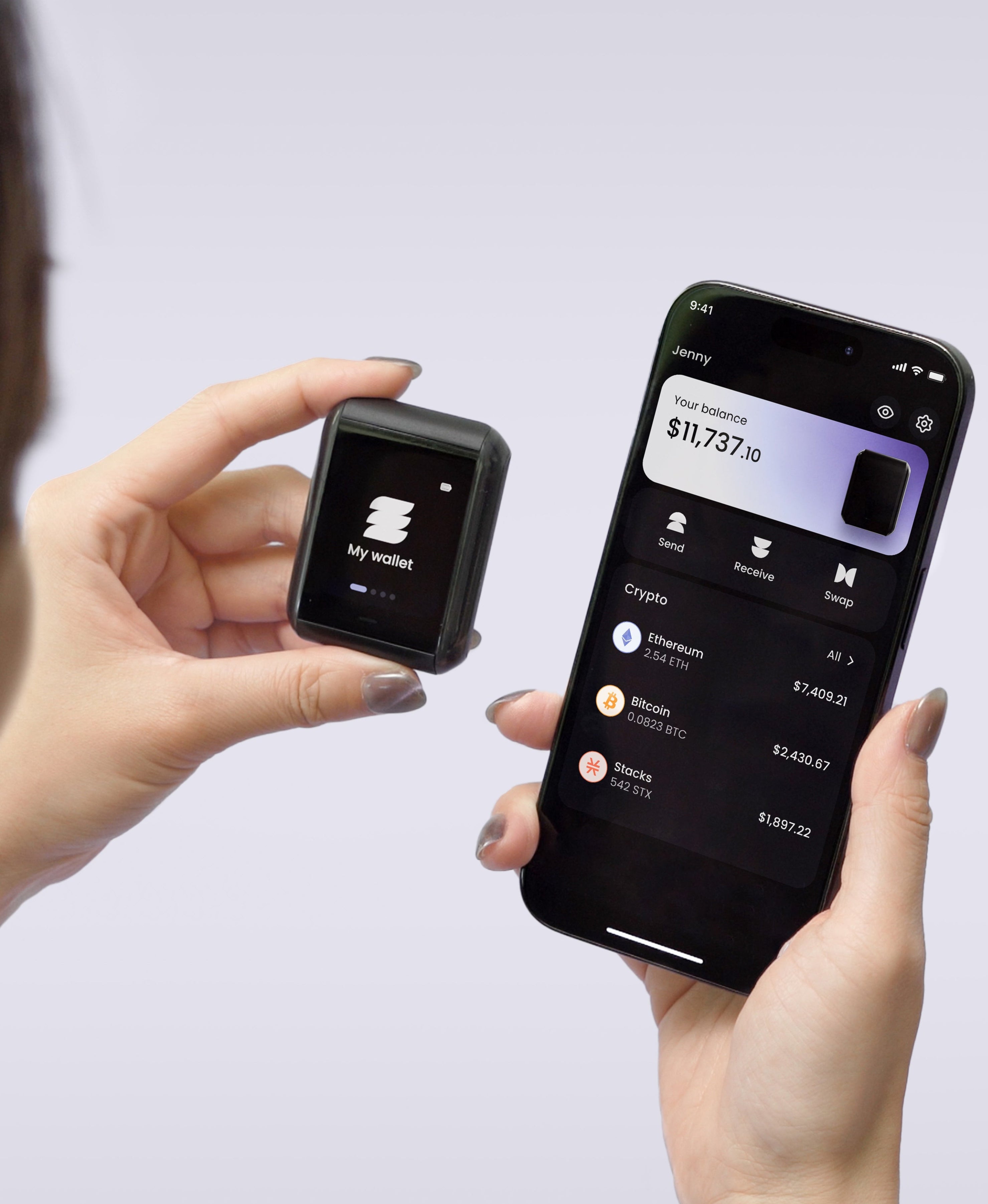
Ryder One supports hardware-wallet staking flows on the major proof-of-stake chains. The model is the same as any cold-storage staking setup: your keys stay on the device, the seed phrase never touches the internet, every transaction is verified on the 1.6-inch screen before you sign, and TapSafe Recovery handles backup so you're not betting your stake on a single piece of paper surviving the next decade. Staking on the Ryder One hardware wallet is launching soon in May 2026. Staking only works long-term if your custody works long-term. We built TapSafe so the recovery side stops being the weak link. The seed phrase is always available on-device as a last resort, which means you meet the BIP-39 standard and you can move your funds (staked or otherwise) to any compatible wallet if you ever want to.
The takeaway
Cold-storage staking lets you earn yield on proof-of-stake coins without giving up custody. Most major chains (Cosmos, Cardano, Solana, Polkadot, Tezos, Polygon, Near, Algorand) support it natively. Ethereum is more complicated because of liquid staking tokens. Bitcoin doesn't support staking at all. If you're going to stake long-term, the hardware wallet is non-negotiable. Pick one with a recovery model that survives life events as well as it survives technical attacks. That's where Ryder One is built to fit.


Share: