


The SEC has multiple Solana spot ETF applications pending review, with the first approval window opening in mid-2026. VanEck, 21Shares, Bitwise, Canary Capital, and Grayscale all have S-1 filings under active review. The decision timeline runs through Q3 2026, with most analysts expecting at least one approval by year-end.
For holders, the question isn't whether a Solana ETF will eventually exist (the regulatory path is clear) but what changes when one does. The Bitcoin ETF analogy from January 2024 gives a partial roadmap, but Solana's structural differences make the story different.
This piece walks through what's in the pending applications, what changes for Solana's market structure if and when an ETF is approved, what changes for self-custody Solana holders, and what the analogous Bitcoin ETF experience suggests is coming.
What's in the pending ETF applications
Five spot Solana ETF S-1s are under active SEC review as of mid-2026:
VanEck Solana Trust — first filed in June 2024. Currently in its second round of S-1 amendments. Custodian: Coinbase Custody.
21Shares Solana ETF — filed July 2024. Lower fee structure (0.21% expense ratio) designed to undercut competitors. Custodian: Coinbase Custody.
Bitwise Solana ETF — filed September 2024. Includes provisions for in-kind creation/redemption that weren't initially permitted under the Bitcoin ETF structure.
Canary Capital Solana Trust — filed October 2024. Smallest issuer in the group, banking on early approval to capture market share.
Grayscale Solana Trust (GSOL) — has existed as an OTC product since 2021. Filing aims to convert GSOL to a spot ETF, mirroring the GBTC-to-spot-ETF conversion path.
The approval criteria the SEC is evaluating: surveillance-sharing agreements between Solana spot exchanges and futures markets, custody arrangements, redemption mechanics, and basic disclosure requirements. The first four are essentially solved (Coinbase Custody is the dominant institutional custodian, and surveillance-sharing arrangements are now standard). The decision is closer to a timing question than a fundamental approval question.
What changes if a Solana ETF is approved
The Bitcoin ETF experience from January 2024 is the closest analog.
Inflows. BlackRock's IBIT and the broader Bitcoin ETF complex pulled in roughly $50 billion in their first year. Solana ETFs will be smaller in absolute terms (Solana's market cap is a fraction of Bitcoin's), but proportionally similar inflows would put $5-15 billion into Solana ETFs over 12 months.
Price impact. Bitcoin rose roughly 60% in the six months following ETF approval. Some of that was the inflows themselves; some was the regulatory legitimacy signal. Solana could see a similar pattern, though the macro context matters more than the analogy suggests.
Custody concentration. Coinbase Custody would likely hold most of the Solana spot ETF assets. The existing 1.4M BTC held in Coinbase Custody for Bitcoin ETFs would be joined by potentially 5-10% of all SOL in circulation. The custodian concentration risk that exists for Bitcoin transfers to Solana.
Staking question. Solana validators earn ~5-7% annual yield through staking. ETF holders don't capture this directly. Some applications include provisions for "staking-passthrough" yield, but the SEC has historically not approved staking-yield ETFs. The compromise that emerges (or doesn't) will shape whether ETF Solana exposure is meaningfully different from spot Solana.
What this means for self-custody Solana holders
Three things change. None of them require action.
Demand floor strengthens. ETF inflows put a continuous bid under Solana that didn't exist before. For long-term holders, this is structural support for price.
Custodial competition intensifies. Coinbase Custody growing further entrenches the existing concentration. For self-custody holders, this reinforces the structural argument for direct custody — the ETF route depends on a small number of institutional custodians.
Staking yield becomes more visible. As ETF holders ask "why don't I get staking yield?", the gap between custodial Solana exposure and self-custody Solana exposure becomes more visible to retail buyers. This works in favor of holders who want yield, run a validator (or delegate), and hold the assets directly.
How a self-custody holder benefits versus ETF exposure
Three structural advantages of direct custody over Solana ETF exposure.
Staking yield. Direct self-custody Solana holders can stake their SOL through any wallet, earning 5-7% annual yield. ETF holders don't capture this. Over a 5-year horizon, the staking yield difference compounds significantly.
On-chain activity. Direct Solana holders can interact with DeFi protocols, NFT marketplaces, and other on-chain activity. ETF holders are limited to the financial exposure only. For users who want to actually use Solana for what it does, the ETF wrapper doesn't help.
No expense ratio. ETF holders pay 0.21-0.50% annually depending on the issuer. Direct custody has zero ongoing fees (after a one-time hardware wallet purchase).
For users who want pure financial exposure, the ETF is fine. For users who want to use Solana, hold the keys, capture staking yield, or run any on-chain activity, the ETF is structurally inferior.
Where Ryder One fits
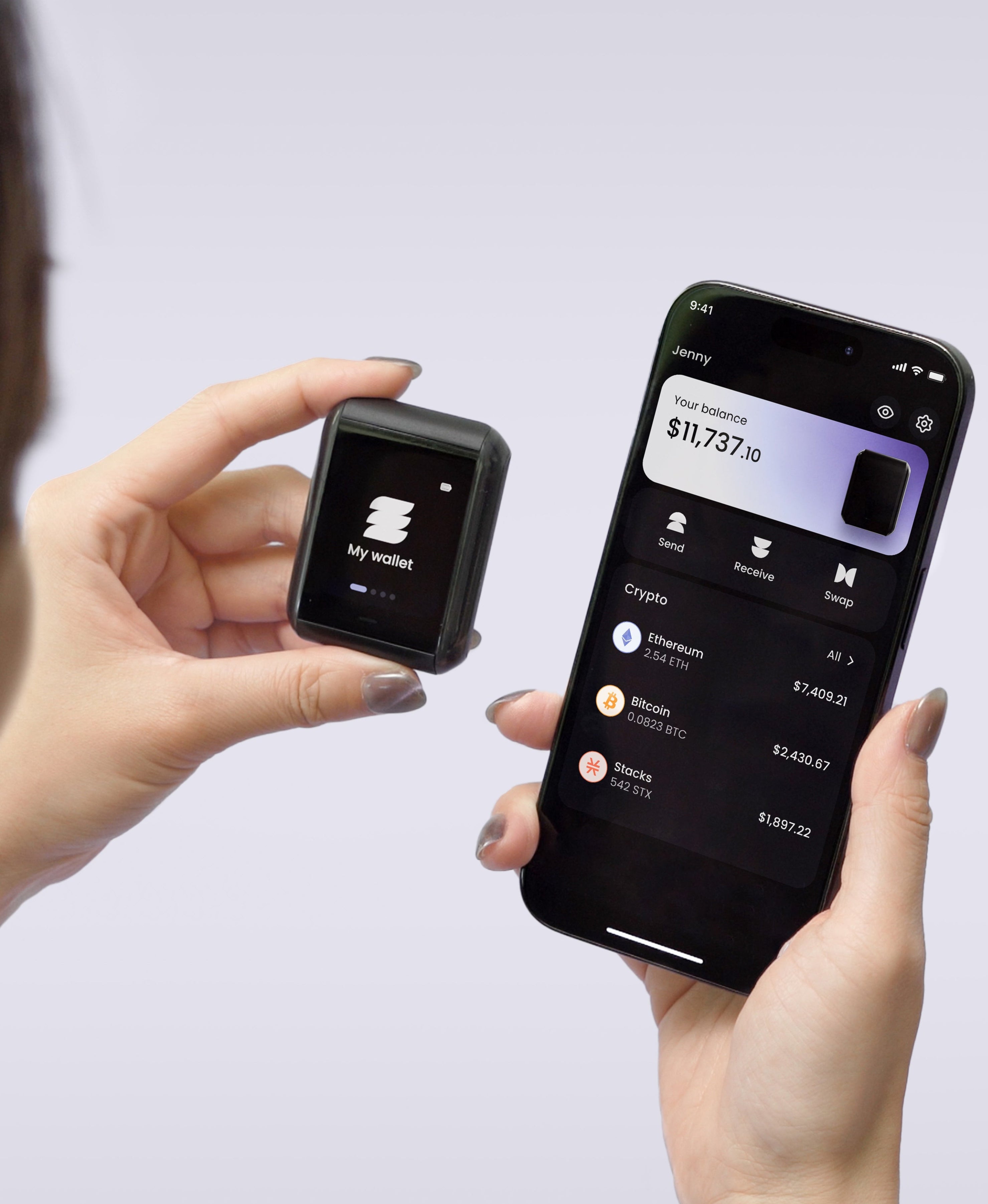
Ryder One holds Solana directly. The EAL6+ Infineon SLC38 secure element holds the private key offline. Every Solana transaction is verified on the device's 1.6-inch AMOLED touchscreen with a physical button press. Staking, swaps, and other Solana activity all run through the same on-device verification.
For Solana holders watching the ETF approval cycle, Ryder One handles the half of the position that benefits from direct ownership (staking yield, on-chain activity, no expense ratio). An ETF allocation can complement, not replace, the direct-custody position.
The bottom line
Solana spot ETFs are likely to be approved by late 2026, with five applications under active SEC review. The approval would mirror the Bitcoin ETF story in many ways — measurable inflows, price-supportive demand, increased custodial concentration in Coinbase Custody. For self-custody holders, the ETF approval doesn't change the direct-custody case. It adds another option for investors who prefer the wrapper, while leaving the structural advantages of direct holding (staking yield, on-chain access, no fees) unchanged. The cleanest position remains direct custody, with ETF allocation as an optional complement for the financial-exposure-only portion of a portfolio.
Hold Solana directly. Capture the staking yield. Past the expense ratio. Ryder One holds your SOL on an EAL6+ secure element with TapSafe Recovery as the backup. See how it works.
SEO
- Target keyword: solana etf approval
- SEO title: Solana ETF Approval: What Happens If the SEC Says Yes (52 chars)
- Meta description: Five Solana spot ETFs are pending SEC review, with first approvals expected in Q3 2026. Here's what changes for SOL markets, custody, and self-custody holders. (159 chars)



Share: