


# Solana ETF 2026: What SEC Approval Means for SOL Holders
Solana closed 2025 the same way Bitcoin closed 2024 and Ether closed the summer that followed: with a batch of spot ETFs live on U.S. exchanges. The first U.S. spot Solana products started trading on October 28, 2025, following SEC-approved generic listing standards in September 2025 that cut the approval clock from 240 days to about 75. Bitwise's BSOL debuted with 100% direct SOL exposure and built-in staking. Fidelity, 21Shares, Grayscale, Franklin Templeton, VanEck, Canary Capital, and CoinShares followed with their own filings and product launches.
In this piece we walk through what got filed with the SEC, what the staking wrinkle changed about the whole category, how a spot SOL ETF compares to spot Bitcoin and Ether ETFs, what an ETF share doesn't give you, and where a hardware wallet fits.
What's on file with the SEC
The Solana ETF race began in earnest with a wave of S-1 registrations in late 2024 and early 2025. Eight issuers filed spot Solana products: VanEck, 21Shares, Canary Capital, Bitwise, Grayscale, Franklin Templeton, Fidelity, and CoinShares. Cboe BZX and Nasdaq submitted the corresponding 19b-4 rule-change filings so the products could list on U.S. exchanges.
The SEC acknowledged the first batch of filings in early 2025 and then punted the initial decision windows across the calendar year while a broader staking-and-custody question worked its way through the agency. In September 2025 the SEC approved generic listing standards for spot crypto ETFs, removing the case-by-case bottleneck that had held up Solana products for most of the year.
Volatility Shares had already broken the seal on the category in a smaller way. Its SOLZ futures ETF launched on March 20, 2025, tracking CME Solana futures rather than spot SOL. That product doesn't hold any tokens; it holds futures contracts and swaps. The spot products that followed in October hold SOL directly at qualified custodians.
The staking question
Solana pays holders roughly 6% to 8% APY for staking their tokens with a validator, and the network runs on that participation. That number is not incidental to a Solana ETF; it's part of what SOL is. An ETF that holds SOL but doesn't stake it hands back inflation-adjusted losses to shareholders on the order of 4% to 5% a year in dilution terms.
Bitwise took the aggressive read on the SEC's evolving staking posture and shipped the Bitwise Solana Staking ETF with 100% of holdings staked through Bitwise Onchain Solutions, powered by Helius. The stated target is Solana's average staking rewards of over 7%. Management fee: 0.20%, waived to 0% for the first three months on the first $1 billion in assets. Custody sits with Coinbase Custody Trust Company.
Fidelity followed with its own Solana product using a mix of custodians (Anchorage Digital Bank, BitGo Trust, and Coinbase Custody), also with staking built in. Morgan Stanley's Solana Trust filed with Bank of New York Mellon plus Coinbase Custody. The competitive pressure pushed the whole field toward staking-enabled products, since a non-staking Solana ETF pays holders less than the underlying network does.
For an ETF holder, that yield shows up as fund NAV growth or as a distribution, depending on the fund's structure. It doesn't show up as a claim on any specific validator. The ETF issuer chooses the validator; the ETF holder gets whatever remains after the operator's cut and the management fee.
Solana ETFs versus spot BTC and ETH ETFs
The shape looks familiar. A spot Solana ETF holds SOL at a qualified custodian, prices to a Solana reference rate, and issues shares that trade on NYSE or Nasdaq. Coinbase Custody sits behind most of them, the same custodian anchoring the majority of spot Bitcoin and Ether ETFs approved in 2024.
Three differences matter.
First: staking. Neither spot Bitcoin ETFs nor spot Ether ETFs pay yield to shareholders in their current form. Bitcoin has no native staking mechanism; the Ether ETFs launched in 2024 came without staking after the SEC pushed back on that feature. Solana's spot products launched at a moment when the SEC had loosened its posture on staking, giving issuers cover to include the yield inside a fund wrapper. Bitwise's BSOL and the products that followed set a new template.
Second: fees. The competitive floor for spot Solana ETFs opened at 0.19% to 0.50% in management fees, a tighter band than the initial Bitcoin ETF launches in early 2024 (which ran from 0.20% up to 1.50% before the field compressed).
Third: flows. Spot Solana ETFs pulled in roughly $756 million in cumulative net inflows by December 26, 2025, a rounding error against Bitcoin ETF flows in absolute scale but on trajectory for a fast-follow institutional adoption curve.
What a spot ETF doesn't give you
An ETF share is a legal claim on the fund's assets, priced against a reference rate, held at a qualified custodian, and settled through your broker. That describes a good product for a lot of people. It also describes a product that has boundaries.
A spot Solana ETF does not give you a Solana address you can send from. You can't move the position to Phantom, to a validator delegation, to a DeFi lender, or to another wallet. You can't take custody. If the custodian is compromised, if the fund is halted, if your broker fails or freezes your account, if a court orders a garnishment, the ETF share is the layer that stops between you and the underlying coin. It's a good stack when you want brokerage rails; it's a longer stack than holding the coin.
A spot Solana ETF also doesn't give you access to the application layer. You can't provide liquidity on Jupiter, trade on Raydium, mint an NFT on Magic Eden, or use SOL as collateral on Kamino from an ETF share. As Firedancer moves toward majority validator adoption on Solana mainnet through 2026, the throughput ceiling for Solana applications keeps rising. ETF holders don't touch that surface; self-custody holders do.
Staking is the sharpest example of the boundary. The BSOL prospectus stakes 100% of fund SOL through Bitwise Onchain Solutions and passes rewards through to NAV. That yield gets shared across shareholders after the operator's cut. Holders who stake their own SOL keep the whole APY, choose their own validator (or run one), and can exit their delegation on their own timeline.
Where Ryder One fits
If you want the ETF wrapper for a portion of your Solana exposure, use the ETF wrapper. Retirement accounts, tax-advantaged accounts, and estates all work better when the position sits inside a brokerage account.
For the SOL you want to hold directly, the same rule that applies to Bitcoin and Ether applies here: the private key is the position. A hot wallet on a phone with a browser extension attached is convenient and, over a long enough horizon, a liability. Every signature request is a chance for a malicious dApp, a spoofed extension, or a compromised device to walk off with your tokens.
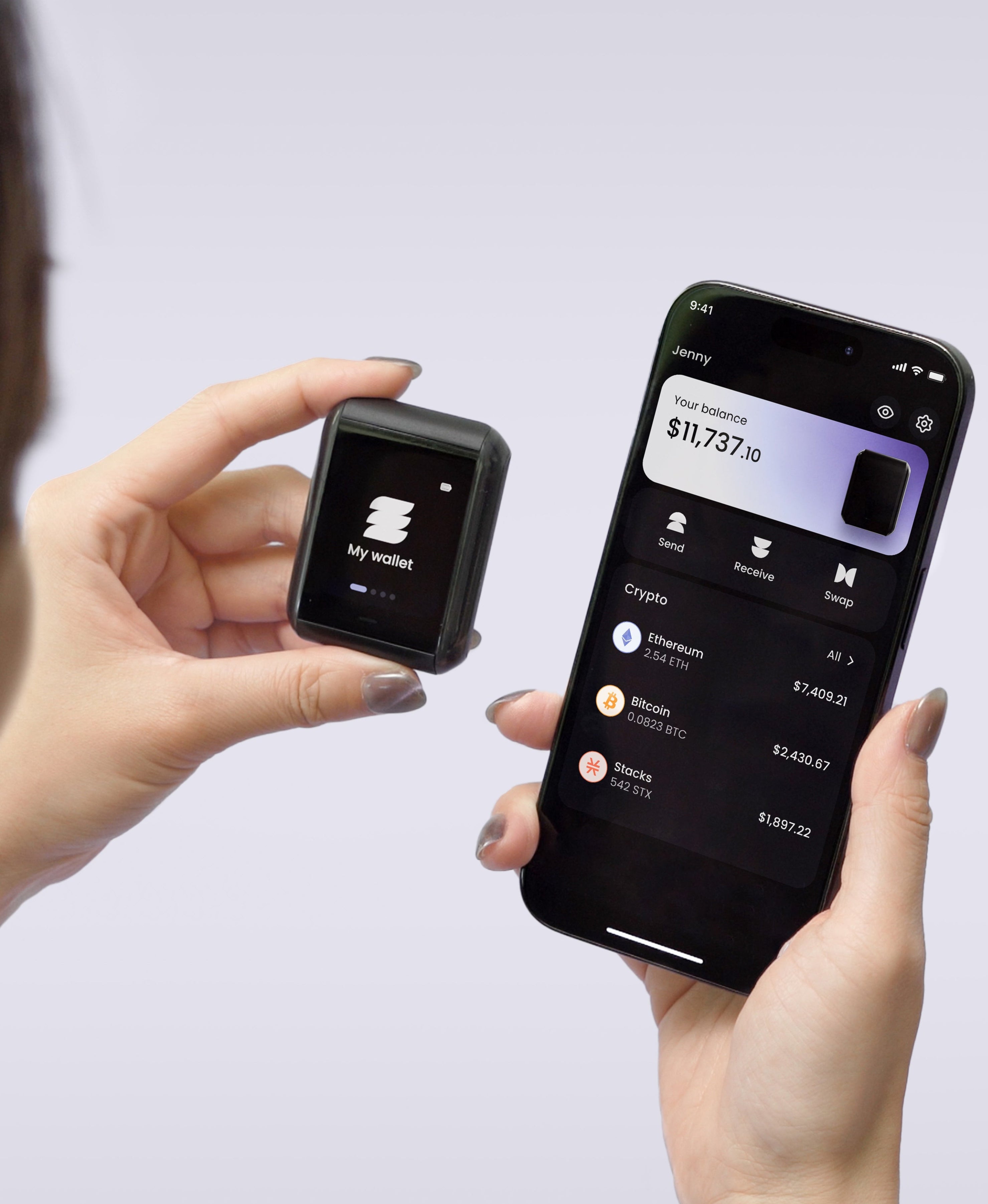
Ryder One is $229 and keeps your keys inside an Infineon SLC38 secure element with EAL6+ certification. Communication runs on NFC only, so there is no USB, Bluetooth, or WiFi surface a remote attacker can reach. The 1.6-inch AMOLED touchscreen renders the transaction on-device before you tap to approve; a compromised phone can't swap a destination address or amount without you seeing it. Backup runs on TapSafe Recovery, a Shamir-based split across a Recovery Tag, an encrypted iCloud or Google Drive blob paired to your phone, and optional Recovery Contacts. No single object holds full access on its own.
That's the setup that pairs with Solana's application layer. Stake your SOL through a Solana wallet connected to Ryder One, keep DeFi signatures anchored to the device, and rotate hot balances into the wallet for anything you're not touching this week. For a primer on the concept, our glossary post on what is self-custody walks through the tradeoffs.
Bottom line
Solana ETFs cleared the SEC on the same track Bitcoin and Ether ETFs cleared it. Eight issuers filed, October 28, 2025 was launch day, and staking-included products became the category default within weeks. If you want SOL price exposure inside a brokerage account, the wrapper exists and it's priced tightly.
An ETF share is a claim on the fund. A hardware wallet holding SOL is a claim on the network. The two products aren't interchangeable. If you want the staking yield without an intermediary taking a cut, the validator choice, the ability to interact with the application layer, and the assurance that no custodian can freeze your position, hold the coin yourself.
Get Ryder One for $229 and keep the Solana in your portfolio behind keys only you can sign with.
--- SEO
- Target keyword: solana etf
- SEO title: Solana ETF 2026: What SEC Approval Means for SOL Holders (55 chars)
- Meta description: Eight issuers filed spot Solana ETFs; U.S. products launched Oct 28, 2025 with staking. What you get, and what a hardware wallet still gives you. (147 chars)



Share: