

The self-custody question used to be theoretical. Then 2022 happened. FTX collapsed in November, Celsius went down earlier that year, and a string of smaller platforms followed. The phrase "not your keys, not your coins" stopped sounding like a slogan and started sounding like a reading of recent history. Four years on, the question isn't whether self-custody matters. It's where it makes sense and where managed custody still earns its keep. For most holders, the answer is a mix.
Definitions, briefly
Self-custody means you control the private keys to your wallet. Your hardware wallet, software wallet, or smart-contract wallet signs transactions. The keys never leave devices you own. If you lose them and don't have a recovery plan, the funds are gone. Managed custody (sometimes called custodial) means someone else holds the keys on your behalf. Coinbase, Binance, Kraken, your local on-ramp app. You hold an account balance, which is a claim against the platform. They handle the cryptography, the security, and the recovery if you lose your password. There's a middle category worth naming: hybrid models like MPC wallets (where keys are split between you and a service), or smart-contract wallets with social recovery. These blur the line in different ways.
What self-custody gives you
- Counterparty risk goes away: No platform can freeze, lose, or be ordered to seize your funds.
- Privacy improves: No KYC tied to every move, no internal reports about what you hold.
- Permission isn't required: You can move funds across jurisdictions and timezones without asking anyone.
- Long-term durability is yours: A platform can disappear in a week. A wallet you control doesn't. The cost is responsibility. There's no password reset. If your recovery plan is bad, your funds are at risk in a way no support team can solve.
What managed custody gives you
- Convenience. Buy with a card, deposit fiat, withdraw to your bank, all in one place.
- Recovery without a plan. Lost your password? Reset it. Lost your phone? Reset that too.
- Customer support. A real person to talk to when something looks wrong.
- Fiat on-ramps and off-ramps. Self-custody wallets can plug into these, but the platform usually does it more smoothly. The cost is counterparty risk. The platform can be hacked, regulated, frozen, or run by people who lose your money. Audited proof-of-reserves helps, but it isn't a guarantee, and the audited number is a snapshot, not a continuous attestation.
When self-custody makes sense
- Holdings you don't intend to touch this year: The savings layer of your crypto life belongs in self-custody.
- Larger balances: The value of removing counterparty risk grows with what's at risk.
- Privacy-sensitive users: People who don't want every transaction tied to a verified identity.
- Anyone in a region with platform restrictions: When platforms come and go in your jurisdiction, your wallet is the constant. Self-custody also makes sense if you've already had a close call with an exchange and remember the feeling.
When managed custody makes sense
- Active trading: Settling on-chain for every trade is slow and expensive. Exchanges exist for a reason.
- Small balances you spend often: A hundred dollars you'll send to merchants doesn't need cold storage.
- New users: Learning while custody is forgiving is fine. Move to self-custody when you've built confidence.
- Fiat-heavy workflows: Payroll in stablecoins, off-ramping for rent, that kind of thing. There's no shame in keeping a working balance on a reputable exchange. The mistake is keeping retirement-money there because it's convenient.
The mix most holders end up with
The pattern that works for most experienced holders looks something like this: - Cold layer: A hardware wallet holding the long-term position. Touched a few times a year. - Hot layer: A software wallet on a phone or laptop with enough to interact with dapps and pay friends. - Exchange layer: A spending and trading account funded only with what you'd be willing to lose to a worst-case platform failure. The ratios shift based on how much you trade and how much you hold. The principle stays the same: each layer has a job, and you don't park your savings in the layer that's optimized for daily use.
Things that look like self-custody but aren't
A few common patterns where users think they have custody but don't: - Custodial mobile wallets: Some popular apps hold the keys on the user's behalf and call it a wallet. Read the recovery flow. If you can recover with email and a password reset, the keys aren't yours. - Yield products on "non-custodial" platforms: Once you've signed an approval that lets a contract spend your tokens, the security profile is different from a wallet that signs each transaction. - Web3 wallets backed up to a cloud account: If your seed lives in iCloud unencrypted, your iCloud account is now the custody risk. Self-custody is a property of the system, not a marketing label.
Where Ryder One fits
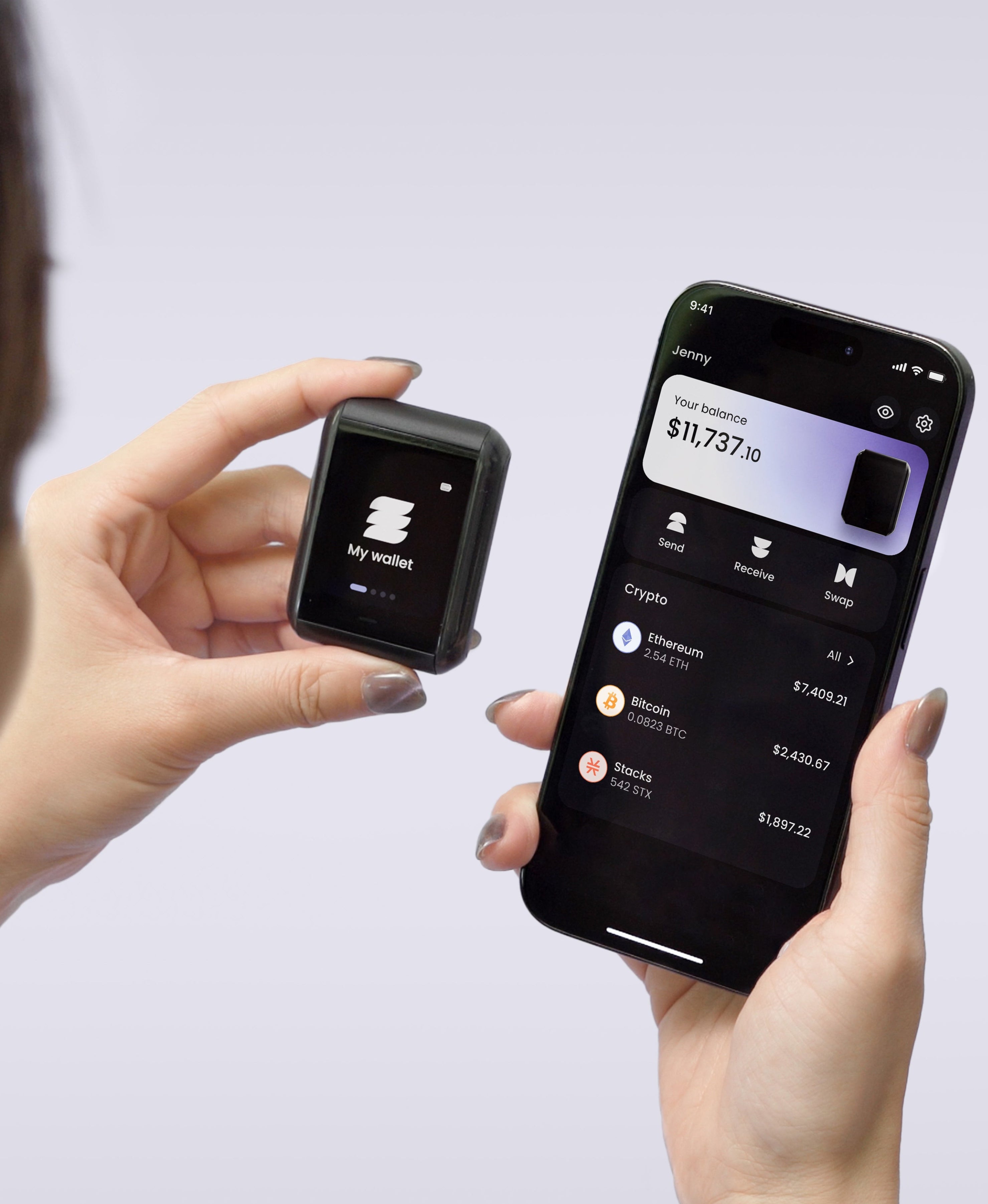
Ryder One is built for the cold layer. EAL6+ certified secure element, NFC-only signing, on-device transaction verification, and TapSafe Recovery so the recovery flow doesn't depend on a single 24-word phrase you've stored somewhere. It's not meant to replace an exchange for trading. It's meant to be the place your savings live, where the only counterparty is you, and where the recovery story is good enough that holding for a long time doesn't feel like setting yourself up for a single mistake.
A decision framework
Three questions, in order: 1. Would this balance, if lost in a platform failure, change my life in a way I'm not prepared for? If yes, move it to self-custody. 2. Would I be comfortable explaining my recovery plan in two sentences? If no, fix that before doing anything else. 3. Will I touch this balance more than a few times a year? If yes, keep some of it in a hot wallet so you don't make mistakes with the cold one. Three clean answers usually beats months of debate.
FAQ
Is self-custody safer than an exchange? It removes counterparty risk and replaces it with operational risk. Whether that's safer depends on how good your operations are. A hardware wallet with a sensible recovery plan beats most exchanges. A self-custody setup with no recovery plan beats none. What's the safest mix for a new holder? A reputable exchange for buying, a hardware wallet for anything you intend to hold for more than six months, and a small hot wallet for spending and trading. Do I need self-custody if I only hold a small amount? It's not really about how much you own but rather, how much could you afford to lose? The value of self-custody grows with the amount you hold and with how long you intend to hold it. Below a few hundred dollars, the convenience of an exchange is usually a reasonable tradeoff. Above that, the math shifts. What about MPC and smart-contract wallets? They're real options. They blur the line in useful ways, especially for inheritance and recovery. They also add complexity, on-chain costs, and a wider trust surface. Worth understanding before adopting.
Bottom line
Self-custody and managed custody aren't enemies. They're tools with different jobs. The mistake isn't using both. The mistake is using one for a job the other was built to do.


Share: